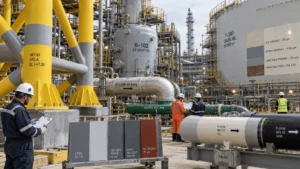
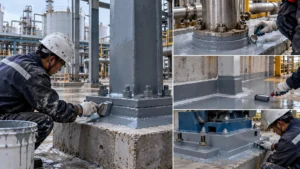
Ask a coating engineer what primer they’d put on structural steel in a coastal or offshore environment, and the answer is almost always zinc rich. It’s been the standard for demanding corrosion protection for decades. But the reasoning behind it — why zinc specifically, how the protection mechanism actually works, and why the zinc content matters so much — isn’t always well understood outside the coatings world.
The Protection Mechanism: Galvanic, Not Just Barrier
Most coating systems protect steel through barrier protection — the film physically prevents moisture and oxygen from reaching the metal surface. Zinc rich primers do this too, but they have a second protection mechanism that most coatings don’t: galvanic (sacrificial) protection.
Zinc is less noble than steel in the galvanic series — meaning it has a lower electrochemical potential. When zinc and steel are in electrical contact in the presence of an electrolyte (moisture), zinc corrodes preferentially. The zinc sacrifices itself to protect the steel. This is the same principle as hot-dip galvanising — just delivered as a coating rather than a metallurgical process.
The practical consequence is significant. If a zinc rich primer is scratched or damaged — exposing a small area of bare steel — the surrounding zinc continues to provide cathodic protection to the exposed metal. A standard epoxy primer offers no such protection. Once it’s breached, corrosion starts immediately at the exposed edge.
This edge and scratch protection is why zinc rich primers dominate specifications for structural steel in C4, C5, and CX environments. In aggressive conditions, mechanical damage to the coating is inevitable. The zinc provides a meaningful safety margin.
Organic vs Inorganic: Two Very Different Systems
Zinc rich primers split into two families based on their binder, and the distinction matters more than most people realise.
Zinc Rich Epoxy (Organic)
The more common of the two in industrial and offshore projects. Two-component system — epoxy resin with zinc dust pigment, mixed before application. Applied by airless spray to blast-cleaned steel.
The zinc loading required for effective galvanic protection is typically 80% or more by weight in the dry film — this is the ISO 12944-5 threshold for ‘zinc rich’ classification. Below that, you’ve got a zinc-containing primer, not a zinc rich primer. The distinction matters because the galvanic protection mechanism requires particle-to-particle zinc contact through the film.
- Advantages: good adhesion to blast-cleaned steel; wide application window; tolerates some humidity during application; widely available from multiple manufacturers
- Limitation: maximum temperature resistance around 120°C; in immersion service, some formulations are susceptible to osmotic blistering if DFT is too high
Inorganic Zinc Silicate (IOZ)
Single-component (ethyl silicate) or two-component (alkali silicate) system. Cures by hydration of the silicate binder — requires some moisture in the atmosphere to cure properly, which is the opposite of most coatings.
The result is a film that’s more inorganic than organic — closer to a ceramic than a paint. It’s harder, more heat-resistant (stable to 400°C), and has better abrasion resistance than zinc epoxy. In offshore topsides and petrochemical applications where heat resistance matters, IOZ is often preferred.
- Advantages: outstanding heat resistance; excellent abrasion resistance; very high zinc content possible (85%+); preferred under thermal spray aluminium topcoats
- Limitation: narrower application window (needs relative humidity above ~50% to cure); very sensitive to surface preparation — requires Sa 2½ minimum and won’t tolerate any contamination; mudcracks if applied too thick
💡 IOZ requires a mist coat (a very thin, diluted first pass) before the full coat to avoid mudcracking. This is a step that’s sometimes skipped under application pressure — don’t let it be.
The DFT Question
Zinc rich primers have a relatively tight DFT window compared to most coatings. Typical specification: 60–80 µm for zinc epoxy; 60–75 µm for inorganic zinc.
Why the ceiling? At high DFT, the zinc particles are too far apart for the galvanic mechanism to work efficiently. The film also becomes more brittle and prone to cracking — particularly with IOZ, which has very low flexibility. And on the overcoating side, a very thick zinc primer can outgas when the topcoat is applied, causing pinholes and intercoat adhesion problems.
Under-application is also a problem. At less than about 50 µm, the zinc loading per unit area is insufficient for reliable galvanic protection. This is why DFT inspection of the zinc primer coat specifically — not just the total system — is required.
Overcoating: Not All Topcoats Are Compatible
Zinc rich primers need to be overcoated with a compatible system. The most common issue is solvent attack — some topcoats or intermediate coats contain solvents that attack the zinc primer and cause adhesion failure at the interface.
For zinc epoxy, the intermediate coat is typically a high-build epoxy — compatible by design. For inorganic zinc, epoxy overcoats are standard, but application timing matters: IOZ needs to be fully cured before overcoating, and the surface sometimes needs to be lightly abraded or mist-coated to ensure adhesion.
Polyurethane topcoats applied directly over zinc primers without an epoxy intermediate are generally not recommended — adhesion is unreliable and solvent attack is a risk.
Where Zinc Rich Primers Are and Aren’t Appropriate
| Application | Zinc Rich Primer? | Notes |
| C4–CX structural steel (atmospheric) | Yes — standard | ZE or IOZ per project spec; 3-coat system |
| Offshore topsides | Yes — IOZ preferred | Heat resistance and abrasion resistance advantages |
| Tank interiors (immersion) | Not usually | Zinc can react with some stored products; use epoxy primer |
| Hot-dip galvanised steel | Not normally | Adhesion issues; sweep blast and use etch primer or T-wash |
| Stainless steel | No | No galvanic benefit; risk of chloride stress corrosion |
| Aluminium | No | Galvanic couple between zinc and aluminium is unfavourable |
| C2–C3 atmospheric (mild environments) | Not required | Standard epoxy or alkyd primer is sufficient and lower cost |
Questions That Come Up in Practice
Can I apply zinc rich primer by brush or roller?
Technically yes — most zinc epoxy products allow brush or roller application. In practice, getting consistent DFT by hand application is difficult because the zinc dust settles quickly in the can and the material is abrasive on brushes. Airless spray is strongly preferred for any significant area. Brush application is acceptable for stripe coats and touch-up of small damaged areas.
What’s the shelf life of mixed zinc epoxy?
Once the two components are mixed, pot life is typically 4–8 hours at 20°C — shorter in hot weather (sometimes as little as 1–2 hours at 35°C). Unmixed, the zinc dust pigment tends to settle over storage time, so the Part B component needs thorough agitation before mixing. Check the TDS for specific pot life and storage recommendations.
Is a zinc rich primer the same as galvanising?
Same protection principle — different application method and zinc loading. Hot-dip galvanising deposits a metallurgically bonded zinc layer with 100% zinc content, at typically 50–120 µm. Zinc rich primers have 80–85% zinc content in an organic or inorganic binder, applied at 60–80 µm. Galvanising generally provides longer service life for the zinc layer itself, but zinc rich primers offer much greater flexibility — they can be applied to fabricated structures and can be easily repaired. The two are sometimes combined: galvanised steel with a zinc-compatible primer system on top.
Related Reading
- Zinc rich primer for steel structures — full guide — types, standards, and long-term corrosion protection.
- Zinc rich primer vs epoxy primer — differences, protection mechanism, and when to use each.
- ISO 12944 C5 corrosion protection — C5 environment classification, protection level, and coating system requirements.
- Anti-corrosion coating for steel structures — a procurement guide for engineers covering system selection for offshore and industrial projects.
Send your project environment, steel section details, and corrosivity category via the project inquiry form and our technical team will recommend the right primer system and full coating specification.