Zinc coating on steel protects structural steel by using zinc as a sacrificial layer or zinc-rich primer system that corrodes preferentially before the steel substrate. For EPC contractors, steel fabricators, bridge engineers, offshore project owners, and industrial buyers, the key decision is whether the project needs galvanized zinc coating, zinc-rich primer, or a complete multi-coat system with primer, intermediate coat, and topcoat.
Steel structures are widely used in infrastructure, industrial plants, bridges, offshore platforms, power facilities, and petrochemical projects. Exposure to moisture, oxygen, chloride salts, and industrial contaminants can quickly cause corrosion if the steel is not protected with the right zinc-based corrosion protection method.
For heavy-duty steel structures, zinc-rich primer remains one of the most proven coating options because it can provide sacrificial protection, not only barrier protection. When the steel is properly blasted and the primer is correctly overcoated, a zinc rich coating for steel can support long-term corrosion resistance in C3, C4, and C5 service environments.
For broader system planning, the steel structure coating systems page can help align primer choice with environment, intermediate coat, topcoat, and durability expectations.
Quick Guide: When to Use Zinc Coating on Steel
Zinc coating on steel should be selected when the structure needs corrosion resistance beyond ordinary barrier coating performance. The best choice depends on exposure environment, fabrication method, surface preparation, repair needs, and whether the steel will receive a full coating system.
Use this quick decision logic:
- Choose galvanized zinc coating when factory-controlled hot-dip galvanizing is practical and the geometry allows full immersion in the galvanizing bath.
- Choose zinc-rich primer when the project needs a coating-compatible zinc layer for bridges, offshore steel, industrial plants, or fabricated structural steel.
- Choose zinc rich epoxy primer when easier repair, broad system compatibility, and field or shop application are important.
- Specify Sa 2.5 abrasive blasting, surface profile, DFT range, and recoat interval before purchase.
- Check welds, edges, bolt areas, handling damage, and repairs before overcoating or shipment.
- Ask for TDS, method statement, QC points, and an epoxy zinc rich primer specification with the quotation.
What Is Zinc Coating on Steel?
Zinc coating on steel is a corrosion protection method where zinc is placed on or near the steel surface to protect the base metal from rusting. In industrial projects, the main options are galvanized zinc coating and zinc-rich primer coating systems.
A galvanized zinc coating is formed by applying zinc to steel through a galvanizing process, often hot-dip galvanizing. A zinc-rich primer is a coating that contains a high concentration of metallic zinc particles in the dry film and is applied to blast-cleaned steel as the first coat in a protective system.
The difference matters because galvanized steel and zinc-rich primed steel are not specified, inspected, repaired, or overcoated in the same way. Galvanizing is a metallurgical zinc layer, while zinc-rich primer is a coating film that depends on binder type, zinc content, surface preparation, film thickness, curing, and overcoating practice.
Define Zinc-Rich Primer Clearly
A zinc-rich primer is an anti-corrosion primer for steel that contains a high concentration of metallic zinc particles in the dry coating film. In many industrial specifications, zinc-rich primers are expected to meet zinc content and performance requirements defined by the project specification, product TDS, or standards such as SSPC Paint 20.
When properly applied over clean, blast-profiled steel, the zinc particles form an electrically conductive network inside the primer film. This allows the primer to provide sacrificial protection instead of acting only as a passive barrier.
This is why a zinc-rich primer for steel structures is commonly used in bridges, steel buildings, offshore platforms, petrochemical plants, energy facilities, pipe racks, and exposed structural steel. The zinc particles help protect the steel even if the coating is scratched locally, provided the primer has sufficient zinc contact and the damage area is limited.
How Zinc-Rich Coatings Protect Steel by Cathodic Action
Zinc-rich coatings protect steel through sacrificial cathodic action, barrier protection, and system-level durability. This combined protection is the reason zinc-rich primers are often specified for aggressive steel environments where maintenance access is difficult or expensive.
Cathodic Protection
Cathodic protection occurs because zinc is more electrochemically active than steel. When moisture and oxygen are present, zinc corrodes preferentially and helps reduce corrosion of the nearby steel substrate.
This is the core reason zinc-rich primer is described as a cathodic protection coating. Even when the coating film is scratched, zinc can continue to protect a limited exposed area around the defect if the zinc network remains electrically connected.
The principle is similar to galvanized steel, where zinc protects the base steel by corroding before the steel. However, zinc-rich primer performance depends more heavily on surface preparation, zinc loading, DFT control, and correct overcoating.
Barrier Protection
Barrier protection occurs when the primer film slows the movement of water, oxygen, and corrosive ions toward the steel surface. A zinc-rich primer provides some barrier effect by itself, but its strongest long-term performance usually comes when it is used under an epoxy intermediate coat and a weather-resistant topcoat.
A common system for exposed steel includes:
- Zinc-rich primer for sacrificial protection.
- Epoxy intermediate coating for barrier build.
- Polyurethane or fluorocarbon topcoat for UV and weather resistance.
Long-Term System Protection
Long-term corrosion protection depends on the full coating system, not the primer alone. A strong zinc-rich primer cannot compensate for a weak intermediate coat, poor topcoat selection, missed stripe coating, or poor surface preparation.
For engineering design, the anti-corrosion primers page can support early primer selection before confirming the full system against the project environment and TDS.
Galvanized Zinc Coating vs Zinc-Rich Primer
Galvanized zinc coating and zinc-rich primer both use zinc to protect steel, but they fit different fabrication, repair, and coating system requirements. Galvanizing is usually selected before fabrication or final assembly, while zinc-rich primer is often selected as part of a shop-applied or field-applied coating system.
| Option | Protection Method | Typical Use | Main Advantage | Buyer Watch Point |
|---|---|---|---|---|
| Hot-dip galvanized zinc coating | Zinc metallurgical layer on steel | Small-to-medium fabricated parts, grating, guardrails, hardware | Durable zinc layer with strong edge coverage when geometry allows | Size limits, bath access, distortion risk, overcoating compatibility |
| Zinc-rich primer | Metallic zinc particles in coating film | Structural steel, bridges, plants, offshore steel | Can be used in multi-coat systems with epoxy and polyurethane | Requires Sa 2.5 blasting, DFT control, mixing, and recoat control |
| Zinc rich epoxy primer | Zinc-rich primer with epoxy binder | General industrial steel and fabrication yards | Good adhesion, broad compatibility, easier repair than many inorganic systems | Zinc settling, pot life, overcoating window, and surface prep must be controlled |
| Inorganic zinc silicate primer | Zinc-rich primer with silicate binder | Offshore, petrochemical, power, heat-resistant service | Strong corrosion and heat resistance in severe environments | More sensitive to curing, humidity, and overcoat practice |
For large industrial steel structures, zinc-rich primer is often more practical than galvanizing because sections may be too large, already assembled, field-welded, or scheduled for a multi-coat system.
Compare the Main Zinc-Rich Primer Types
The main zinc-rich primer types are epoxy zinc-rich, inorganic zinc-rich, and organic zinc-rich systems. Buyers should compare binder type, application difficulty, repair convenience, overcoat compatibility, and service environment before approval.
Zinc Rich Epoxy Primer
Zinc rich epoxy primer is widely used for steel structures because it combines sacrificial zinc protection with epoxy binder adhesion and practical application properties. It is commonly specified for bridges, industrial plants, pipe racks, machinery supports, and general fabricated steelwork.
Where it fits:
- Steel structures in C3–C5 atmospheric environments.
- Shop-applied structural steel coating systems.
- Projects requiring epoxy intermediate coats and polyurethane topcoats.
- Repairs and touch-up areas where organic binder systems are easier to handle.
- Steel projects where practical application control matters as much as theoretical performance.
Buyer watch points:
- Zinc particles are heavy and can settle during use.
- Mixing and agitation must be controlled before and during application.
- DFT must stay within the TDS range to avoid under-protection or cracking.
- Recoat interval must be confirmed before intermediate coat application.
Inorganic Zinc-Rich Primer
Inorganic zinc-rich primer typically uses a silicate binder and is known for high zinc loading, strong heat resistance, and excellent corrosion resistance in severe environments. It is often specified for offshore platforms, petrochemical facilities, power plants, and other high-durability steel projects.
Inorganic zinc systems can be less forgiving during application. Humidity, curing conditions, film thickness, surface profile, and overcoating practice must be controlled carefully. Incorrect overcoating can cause pinholing, bubbling, or adhesion issues in the next coat.
Organic Zinc-Rich Primer
Organic zinc-rich primer uses an organic binder, commonly epoxy. Compared with inorganic zinc systems, it usually offers better flexibility, simpler repair, and easier application in fabrication yards.
Organic zinc-rich primers are often preferred when the project requires a practical balance between corrosion resistance, shop productivity, field repair, and compatibility with epoxy or polyurethane coating systems.
Standards for Zinc-Rich Primer Specification
Zinc-rich primer specification should reference recognized standards, but the RFQ must still define exposure environment, surface preparation, DFT range, recoat interval, and inspection requirements. A standard alone does not replace project-specific coating system design.
ISO 12944-5 describes coating system types commonly used for corrosion protection of steel structures and gives guidance for selecting systems by environment, preparation grade, and durability category. The project specification can use ISO 12944-5 to frame environment-based system selection.
SSPC Paint 20 is commonly used as a zinc-rich coating reference for inorganic and organic zinc-rich coatings. The project specification can use SSPC Paint 20 when reviewing zinc-rich coating type, formulation expectations, and performance requirements.
ASTM D520 covers zinc dust pigment used in coatings, and it may be referenced when zinc pigment quality is part of the coating specification. The project specification can use ASTM D520 when pigment requirements must be documented.
A practical epoxy zinc rich primer specification should include:
- Project environment: C3, C4, C5, marine, industrial, offshore, or chemical exposure.
- Required primer type: organic zinc-rich, inorganic zinc-rich, or epoxy zinc-rich.
- Zinc content or standard reference.
- Surface preparation grade and surface profile.
- DFT range for the primer.
- Intermediate coat and topcoat compatibility.
- Recoat interval and curing condition.
- Inspection hold points and repair requirements.
Build the Right Zinc-Rich Primer Coating System
A zinc-rich primer performs best when it is part of a complete coating system rather than treated as a standalone product choice. The primer provides sacrificial protection, the intermediate coat improves barrier performance, and the topcoat improves UV, weather, and chemical resistance.
A typical structural steel system may include:
| Layer | Typical Function | Common Inspection Focus |
|---|---|---|
| Zinc-rich primer | Sacrificial protection and initial adhesion | Surface prep, DFT, zinc mixing, cure |
| Epoxy intermediate coat | Barrier build and system thickness | Recoat interval, film continuity, pinholes |
| Polyurethane topcoat | UV resistance, color retention, weathering resistance | DFT, appearance, cure, damage repair |
| Stripe coats | Edge and weld protection | Welds, corners, bolt areas, cut edges |
Before approval, confirm:
- Inland, coastal, marine, industrial, or chemical exposure.
- Shop application, field application, or mixed application.
- Target DFT range for each layer.
- Recoat interval range between coats.
- Whether handling, transport, stacking, or erection damage is likely.
- Whether stripe coating is required on edges and welds.
A common field mistake is choosing a high-performance primer but under-specifying the intermediate coat or topcoat. This creates a weak overall system even when the primer itself is suitable.
Surface Preparation for Zinc Coating on Steel
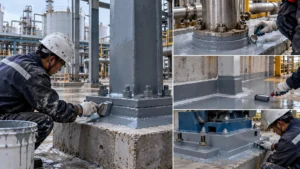
Surface preparation is one of the biggest factors affecting zinc coating on steel when the zinc protection is provided by primer rather than hot-dip galvanizing. Zinc-rich primers usually need clean, abrasive-blasted steel to achieve zinc-to-steel contact, adhesion, and long-term corrosion resistance.
Typical preparation steps include:
- Degreasing to remove oil, grease, and shop contamination.
- Abrasive blasting to the required cleanliness grade, often Sa 2.5 for industrial steel.
- Removal of mill scale, rust, dust, soluble salts, and old coating residues.
- Achieving the surface profile required by the primer TDS.
- Checking edges, welds, corners, bolt holes, and repaired areas before priming.
- Maintaining steel temperature at least 3°C above dew point during application.
Poor preparation is one of the most common reasons zinc-rich coatings fail early. Problems usually begin at edges, weld seams, damaged handling areas, and repair zones long before large flat surfaces show obvious defects.
Common Application Mistakes That Reduce Zinc-Rich Primer Performance
Most zinc-rich primer failures come from process mistakes rather than from the zinc-rich protection concept itself. The most common issues include inadequate surface preparation, poor zinc mixing, incorrect DFT, weak curing control, and overcoating outside the allowed window.
Inadequate Surface Preparation
Inadequate surface preparation prevents the primer from bonding correctly to steel. Mill scale, oil, salts, dust, or flash rust can interrupt zinc-to-steel contact and reduce both adhesion and sacrificial protection.
Incorrect Coating Thickness
Incorrect coating thickness can reduce performance in two directions. If the film is too thin, the zinc network may not provide the intended protection. If the film is too thick, mud-cracking, solvent retention, or adhesion problems may occur, especially before overcoating.
Poor Mixing of Zinc Particles
Poor mixing causes uneven zinc distribution because metallic zinc particles are heavy and settle during storage and application. Without proper agitation, one area may receive zinc-rich film while another receives resin-rich film with reduced sacrificial protection.
Improper Curing Conditions
Improper curing can reduce adhesion, hardness, overcoatability, and corrosion resistance. Inorganic zinc silicate primers are especially sensitive to curing conditions, while epoxy zinc-rich systems require correct mixing ratio, pot life control, temperature, humidity, and ventilation.
Overcoating Too Early or Too Late
Overcoating outside the approved recoat window can cause intercoat adhesion problems, pinholing, bubbling, or weak film build. The correct recoat interval depends on product TDS, DFT, temperature, humidity, ventilation, and application method.
Where Zinc-Rich Primer Adds the Most Value
Zinc-rich primer adds the most value where steel is exposed to aggressive environments and future maintenance access is difficult or expensive. These conditions are common in bridges, offshore facilities, industrial plants, power stations, pipelines, and storage tanks.
Bridges and Infrastructure
Bridges and infrastructure steel are exposed to weather, pollution, deicing salts, and chloride contamination in many regions. Zinc-rich primer is commonly used as the first layer in long-life protective coating systems where durability and inspection documentation matter.
Offshore and Marine Structures
Offshore platforms, marine terminals, port structures, and coastal steelwork operate in highly aggressive salt environments. Zinc-rich primer is often used with epoxy intermediate coats and polyurethane or fluorocarbon topcoats for high-durability protection.
Industrial Plants and Energy Facilities
Refineries, petrochemical plants, power stations, and heavy industrial facilities use zinc-rich systems for structural steel, pipe racks, supports, platforms, and equipment steelwork. These areas often face chemical atmosphere, heat, moisture, and limited access for maintenance.
Pipelines and Storage Tanks
Pipelines and storage tanks can use zinc-rich primers as part of external atmospheric protection systems where steel faces moisture, UV exposure, industrial contamination, or coastal conditions. The primer must still be matched to the full coating system and service exposure.
QC Checklist for Zinc Coating on Steel Before Overcoating
QC before overcoating confirms whether the zinc-rich primer is ready to receive the next layer without burying defects. If defects are covered by an intermediate coat, repair becomes more expensive and failure may appear after shipment or commissioning.
Use this inspection checklist:
- Confirm steel surface cleanliness before priming.
- Verify surface profile against primer TDS.
- Check full mixing and agitation of zinc-rich material.
- Measure primer DFT at flat areas, welds, edges, and repair zones.
- Confirm cure condition and recoat interval before overcoating.
- Inspect dry spray, pinholes, cracking, missed areas, and handling damage.
- Check stripe-coated edges and weld seams.
- Repair damaged areas before applying the next coat.
- Record inspection hold points for owner or EPC review.
For steel projects with complex geometry, transport handling, and field repair requirements, the steel structure coating system guide can support primer-intermediate-topcoat planning.
RFQ Checklist for Zinc Coating on Steel Projects
A complete RFQ improves zinc-rich primer quotation accuracy and reduces technical clarification during procurement. Buyers should send enough information for the supplier to recommend the correct primer type, DFT range, coating system, and inspection controls.
Include these details:
- Steel structure type and project location.
- Inland, coastal, marine, offshore, industrial, or chemical exposure.
- Target corrosion category and expected durability.
- Shop application, field application, or mixed application scope.
- Required primer type if already specified.
- Required coating layers and DFT ranges.
- Surface preparation standard and blasting responsibility.
- Topcoat color or finish requirement if exposed steel is visible.
- Transport, stacking, storage, and erection conditions.
- Edge grinding, weld treatment, and stripe coat requirements.
- Inspection hold points and documentation needs.
- Whether you need TDS, method statement, or system recommendation.
What buyers forget most often is the fabrication and logistics sequence. Steel that is stacked, transported long distance, touched up on site, or welded after priming may need a different repair plan than steel that remains in a controlled coating shop.
FAQ
What is zinc coating on steel used for?
Zinc coating on steel is used to protect steel from corrosion by placing zinc between the steel and the environment. In structural steel projects, this may mean hot-dip galvanizing or a zinc-rich primer system applied over Sa 2.5 blast-cleaned steel.
For bridges, industrial plants, offshore steel, and power facilities, zinc-rich primer is often preferred when the steel needs a multi-coat system with epoxy intermediate and polyurethane topcoat.
What is zinc rich epoxy primer?
Zinc rich epoxy primer is an organic zinc-rich primer that uses epoxy binder and metallic zinc particles to protect steel through sacrificial and barrier mechanisms. It is commonly used on structural steel because it offers strong adhesion, good overcoat compatibility, and practical repair properties.
The specification should confirm zinc content, DFT range, Sa 2.5 surface preparation, recoat interval, and compatible intermediate coat.
Is zinc-rich primer the same as galvanized zinc coating?
Zinc-rich primer is not the same as galvanized zinc coating. Galvanizing forms a zinc layer on steel through a galvanizing process, while zinc-rich primer is a coating film containing metallic zinc particles in a binder.
Both use zinc for corrosion protection, but they differ in application method, inspection, repair, overcoating, and project suitability.
What surface preparation is required for zinc-rich primer?
Zinc-rich primer usually requires abrasive blasting to a clean steel surface, often Sa 2.5 for industrial structural steel. The surface profile must match the primer TDS, and contaminants such as oil, dust, soluble salts, mill scale, and flash rust must be removed.
Poor surface preparation reduces zinc-to-steel contact and can cause adhesion loss, blistering, or early corrosion at welds and edges.
How thick should zinc-rich primer be applied?
Zinc-rich primer thickness must follow the product TDS and project specification, but it is typically controlled as a defined DFT range rather than a single number. Applying too little can reduce sacrificial protection, while applying too much can cause mud-cracking, solvent retention, or overcoating problems.
DFT readings should include flat steel, welds, edges, corners, repair areas, and handling-damaged areas before overcoating.
Technical Note
Zinc coating on steel performance depends on steel condition, zinc protection method, surface preparation, surface profile, zinc content, DFT range, climate during application, curing control, overcoating practice, repair quality, and total system design. Final product selection should always be checked against the latest TDS, project specification, and relevant standards before purchase and application.
Request a Zinc-Rich Primer Recommendation
If you are evaluating zinc coating on steel for a bridge, plant, offshore, marine, or heavy industrial project, send your steel details, exposure environment, expected coating build-up, surface preparation method, and target service life.
Our manufacturer technical team can help review your RFQ, recommend a suitable zinc-rich primer system, and support your TDS request through the industrial coating technical support contact.