Why ISO 12944 matters in industrial projects
ISO 12944 is used to guide corrosion protection of steel structures by protective paint systems, helping owners and EPC teams translate exposure conditions into a spec that can be tested, executed, and maintained.
The standard is a design and specification tool, not a product catalog, and it is most valuable when it forces alignment between environment category, durability class, surface preparation, and system performance expectations.
If your procurement packages include global sites across the Middle East, Southeast Asia, and Central Asia, ISO 12944 helps you avoid “one system fits all” mistakes by pushing zone-based thinking instead of a single label for an entire plant or corridor.
Understand the ISO 12944 structure before using it
ISO 12944 is split into multiple parts that cover environment classification, design considerations, surface preparation, system selection guidance, laboratory performance testing, execution and supervision, and specification development for new work and maintenance.
This structure matters because a “C5 system” without clear execution controls and maintenance assumptions is incomplete, and incomplete specs are where coating failures and contract disputes usually start.
Practical rule for spec writers: if you only cite ISO 12944-2 (environment) but do not reflect execution, testing logic, and specification development intent, your spec is likely missing deliverables that determine real performance.
ISO 12944 corrosion categories explained: C1 to CX
ISO 12944 environment classification is intended to reflect corrosivity exposure so you can choose protective measures that match the real risk, not the project’s optimism.
C1: Very low
Typical environments are clean, dry, and mostly indoor, where corrosion drivers are limited.
Risk focus is usually localized condensation points and poor detail design rather than aggressive atmosphere.
C2: Low
Low corrosivity environments commonly include sheltered or low-pollution areas with moderate humidity cycles.
Risk focus is often inconsistent surface prep and edge coverage rather than “system strength.”
C3: Medium
C3 environments can include urban or industrial atmospheres with higher humidity and more frequent wet-dry cycling.
Risk focus shifts to barrier build, detail protection, and execution discipline that prevents early underfilm corrosion.
C4: High
C4 increases severity and pushes you toward stronger surface preparation discipline, higher barrier build, and tighter QC records.
Risk focus includes soluble contamination control, recoat interval management, and repair strategy for complex geometry.
C5: Very high
C5 environments are very aggressive and often coincide with coastal influence or heavy industrial pollutant loading, making zone control essential.
Risk focus is system robustness plus execution controls, because access costs and maintenance disruption rise rapidly.
CX: Extreme, offshore and related
CX is used for offshore and related severe marine environments where salt loading and exposure severity demand high-performing systems and performance testing logic specific to those conditions.
If your scope includes offshore or near-offshore steel, treat CX as a different design problem, not “C5 with thicker paint.”
Atmospheric vs immersion categories: don’t mix them up
ISO 12944’s common “C categories” relate to atmospheric exposure, but the overall framework also addresses other exposure types such as offshore and immersion-related categories in relevant parts.
A frequent engineering mistake is applying atmospheric category thinking to immersion, splash, or buried conditions without defining those zones explicitly in the coating specification.
Decision rule: if steel sees continuous wetting, splash, or immersion patterns, write those zones separately and assign system requirements per zone, not per “asset name.”
ISO 12944 design life classification: what it is and what it is not
ISO 12944 uses durability classes that reflect time to first major maintenance, which helps owners and EPC teams plan maintenance windows and budget lifecycle cost.
These durability classes are not the same thing as warranty length, and confusing the two is a common reason owner expectations do not match contractor deliverables.
Use the standard durability language as planning bands:
How ISO 12944 defines coating system performance
ISO 12944 focuses on protective paint systems and includes laboratory performance test methods that are intended to help select suitable paint systems, rather than to provide exact durability prediction for every project.
This is why system compatibility, layer roles, and execution controls matter as much as the nominal chemistry, because the standard’s intent is to qualify system performance, not single-product marketing claims.
Spec-writing tip: when bidders propose “equivalent systems,” require them to show how the system meets performance intent, not just match a generic product type label.
Example ISO 12944 coating system directions for steel structures
These are example directions to translate ISO logic into a buildable specification without naming brands.
- C3 with High durability band: prioritize consistent surface preparation, corrosion-control primer strategy, barrier build intermediate, and durable topcoat with defined DFT ranges.
- C4 with High to Very High planning: increase barrier build and detail protection, enforce stripe coats and hold points, and require tighter inspection records.
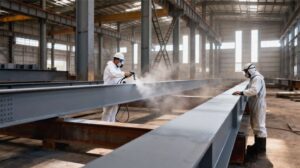
- C5 with Very High planning: treat the structure as zones, set stricter contamination control and execution supervision, and select heavy-duty architectures that reduce repaint events.
- CX offshore direction: use offshore-oriented performance logic and execution controls designed for extreme marine conditions.
For steel structure system selection language that your EPC and contractor teams can align to, see the internal guide once: Anti-Corrosion Coating for Steel Structure: System Guide.
For marine and offshore environment thinking that supports CX-style severity discussions, reference: Marine Anti Corrosion Coating: Offshore System Guide.
Common misunderstandings that cause ISO 12944 project failures
- Writing only “C5” without stating durability class, zoning, or the maintenance planning assumption.
- Ignoring surface preparation scope and verification, then expecting a high-performance system to compensate for poor substrate conditions.
- Treating ISO 12944 as a product certification rather than a system and execution framework.
- Forgetting maintenance strategy and repair rules, which makes long-life planning impossible in real operations.
Inspection tip: if you want ISO intent to survive field reality, require documented hold points and recoat window control, not just a final DFT reading summary.
ISO 12944 vs NACE: how engineers should think about it
ISO 12944 is commonly used as a global coating system framework for corrosion protection by paint systems, while NACE and AMPP-related documents are also widely used in corrosion engineering practice, especially in oil and gas contexts.
In multi-region projects, the practical approach is to align terminology, environment definition, surface preparation, and inspection deliverables across packages so bidders can quote on the same scope.
If you want, share the exact NACE or AMPP documents your client spec requires, and I will build this section as a precise comparison without guessing document numbers.
Step-by-step: select an ISO 12944 coating system for your project
- Define the asset zones, atmospheric exposure, sheltered condensation, splash points, chemical areas, and hot zones.
- Assign the corrosivity category and note any offshore or extreme conditions separately when applicable.
- Choose the durability class as a maintenance planning decision, not a marketing target.
- Select a system architecture by layer function, corrosion control, barrier build, and weathering resistance, then set DFT ranges by layer.
- Lock execution and supervision requirements, surface prep acceptance, stripe coats, recoat intervals, and repair rules.
- Build the QC dossier requirements into the RFQ so bids are comparable.
For an execution-ready inspection deliverable structure your contractors can follow, reference: Steel Structure Coating Inspection Checklist.
How ISO 12944 impacts project budget and lifecycle cost
Moving from C3 to C5-level severity logic typically increases surface preparation controls, barrier build, inspection density, and access planning, which changes installed cost more than material cost alone.
Similarly, choosing High versus Very High durability planning changes how many major repaint events you expect over the asset life, which is why lifecycle cost evaluation is a procurement and O&M issue, not just an engineering preference.
External reference for ISO scope and part structure: see ISO’s listing for ISO 12944-9 and related documents. ISO
Practical recommendations for ISO 12944-aligned projects
- Write a zone-based coating specification and tie each zone to an environment category and durability class.
- Require system-level documentation and inspection hold points, not just product names.
- Specify detail control explicitly, stripe coats, edge retention checks, and repair method acceptance.
- Plan maintenance windows and define how the system will be inspected and repaired over time.
CTA
Contact us for ISO 12944-compliant coating system design tailored to your project environment and required service life, and request a TDS pack and system recommendation via Contact Industrial Coating Manufacturer.
Technical Note
All guidance in this article is for engineering and specification support; final coating selection, surface preparation level, DFT ranges, and acceptance criteria must be confirmed by the applicable product TDS and the project specification.