Most coating failures on outdoor steel structures don’t start with a bad product. They start with a wrong environment assessment — someone specifying a C3 system for what is effectively a C4 or C5 environment, or ignoring the difference between a sheltered inland location and an exposed coastal one. Three years later, the coating is blistering at weld lines and the steel is rusting at edges, and the post-mortem always finds the same root cause: the coating system wasn’t matched to the actual environment.
This guide works through how to assess the corrosion environment for an outdoor steel structure and how to match the coating system to what you find. It references ISO 12944 throughout — the international framework for this process — because it gives engineers a consistent, defensible basis for specification.
Step 1: Assess the Actual Environment — Don’t Assume
The corrosivity category of a site is not obvious from a postcode or a general description like ‘industrial area’. Two sites 500 metres apart can be in different corrosivity categories depending on local factors. The variables that matter:
- Distance from the sea: chloride deposition rate drops rapidly with distance inland, but the relationship isn’t linear — prevailing wind direction and local topography matter significantly. A coastal site with consistent onshore wind may have C5 conditions 2km inland; a sheltered bay site may be C3 at 500m.
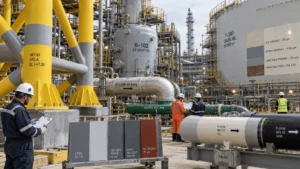
- Industrial atmosphere: SO₂ from combustion processes, chlorides from chemical operations, and H₂S from certain processes all accelerate corrosion. A steel structure adjacent to a chemical plant or heavy industrial facility may warrant C4 or C5 even in an inland location.
- Microclimate: sheltered vs exposed, time of wetness (a humid, shaded structure corrodes faster than an exposed, dry one), and whether the steel sees frequent condensation cycles.
- Previous corrosion data: if there’s existing steel on the site, the actual corrosion rate is the most reliable indicator of the local environment. Mass loss measurements on exposed coupons (ISO 9226) give the most accurate classification.
ISO 12944-2 provides tables correlating these factors to corrosivity categories C1 through CX. Use them — particularly for borderline sites — rather than making a judgement call. The ISO 12944 corrosion categories guide (C3, C4, C5) covers the practical classification process and typical examples for each category.
The Cost of Getting the Category Wrong
| Specification Error | Consequence | Typical Timeline to Failure |
|---|---|---|
| C3 system in C4 environment | Early rust bleed at welds and edges; surface contamination of coating within 5 years | 3–7 years to first maintenance, versus 15+ years for correct specification |
| C4 system in C5 environment | Osmotic blistering on flat surfaces; delamination at holidays | 5–10 years to significant failure |
| No zinc primer in C4+ | Rapid corrosion at any mechanical damage or weld area | 2–5 years to visible rust at damage points |
| Ignoring coastal reclassification | Progressive underfilm corrosion from chloride attack | Often undetected until blistering appears — 5–12 years |
The asymmetry is important: over-specifying by one category (e.g. C5 system in a C4 environment) adds modest cost — typically 20–40% more in materials — but adds nothing to service life. Under-specifying has a compounding cost: premature maintenance plus access plus disruption. For any structure where maintenance access is non-trivial, always err toward the more conservative category.
Coating System Selection by Environment
| Category | Environment | Primer | Intermediate | Topcoat | Total DFT | Service Life (H) |
|---|---|---|---|---|---|---|
| C3 | Urban/mild industrial inland | Epoxy primer | High-build epoxy 1 coat | Aliphatic PU | 175–240 µm | >15 years |
| C4 | Industrial; mild coastal | Zinc-rich epoxy | High-build epoxy 1–2 coats | Aliphatic PU | 260–340 µm | >15 years |
| C5 | Aggressive industrial; coastal | Zinc-rich epoxy | Glass flake epoxy 1–2 coats | Aliphatic PU | 340–440 µm | >15 years |
| CX | Offshore; extreme marine | Zinc-rich epoxy | Glass flake epoxy 2 coats | Aliphatic PU | 420–520 µm | >15 years |
A few things worth emphasising in this table. The jump from C4 to C5 is not just more DFT — it’s a change in intermediate coat type. Glass flake epoxy provides significantly better osmotic blistering resistance than standard high-build epoxy in aggressive environments, because the glass flake platelets create a tortuous diffusion path for chloride ions. In a C5 coastal or marine industrial environment, specifying standard epoxy intermediate instead of glass flake is one of the most common errors in building and infrastructure projects. The full system design logic for C5 is covered in the ISO 12944 C5 corrosion protection guide.
Special Cases for Outdoor Steel
Steel at Ground Level and Below
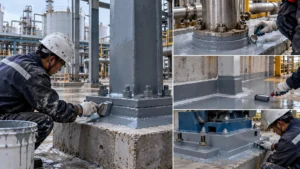
The underside of steel beams, columns near grade, and steel embedded in or near concrete face a different micro-environment from the rest of the structure: more sustained moisture, potential soil splash, and in some cases standing water. For these zones, the coating system should be at least one category more conservative than the general specification — or a specific immersion-rated product should be used for the lowest metre or so of columns and supports.
Gutter Areas and Water Collection Points
Wherever water collects and sits on a steel structure — horizontal ledges, beam tops that aren’t properly drained, gutter connection points — corrosion is accelerated regardless of the general site category. These areas need a stripe coat and should be considered as a minimum one category more aggressive than the general atmosphere. If possible, design the structure to eliminate flat water-trapping surfaces.
Weathering Steel (Corten)
Weathering steel (ASTM A588, EN 10025-5) develops a self-protecting rust patina in suitable atmospheric environments — C3 and some C4 conditions. It’s not a coating-free solution in all environments: in C5, coastal, or immersion conditions, it corrodes as fast as standard steel and requires protective coating. If you’re specifying coating for weathering steel, the adhesion approach differs from mild steel — sweep blast to Sa 1 and use a primer formulated for weathering steel adhesion. Do not apply standard zinc-rich epoxy primer directly over weathering steel without confirming compatibility.
Surface Preparation for Outdoor Steel
The environment classification also drives the surface preparation requirement. For C3, a commercial blast (ISO 8501-1 Sa 2) is technically acceptable for non-zinc primers. For C4 and above, Sa 2½ (near-white blast) is the minimum — and this is a firm minimum, not a starting point for negotiation.
For outdoor structures where site blasting is required after erection, vacuum blasting or UHP (ultra-high pressure) water jetting are the alternatives to open abrasive blasting. Both are acceptable methods for achieving Sa 2½-equivalent cleanliness, and both are specified in equivalent standards (ISO 8501-4 for water jetting). Confirm that the primer specified is compatible with the surface preparation method — some zinc-rich primers perform differently on water-jetted versus blast-cleaned surfaces. For a full breakdown of preparation grades, methods, and inspection requirements, the structural steel coating specification guide covers each hold point in detail.
Frequently Asked Questions
How do I classify the environment for a new building site with no existing data?
Use the ISO 12944-2 classification tables as a starting framework. For sites near the coast, estimate the chloride deposition rate from local meteorological data if available, or from a corrosion engineer’s assessment. For industrial sites, request information on the main atmospheric pollutants from the site operator. Where the classification is genuinely uncertain between two categories, specify the more conservative one — the material cost difference is modest and the protection margin is significantly better.
Does the coating spec need to change for a structure that’s partially indoor, partially outdoor?
Yes — specify each zone separately. The outdoor sections get the appropriate C-category specification. The indoor sections can often be specified one category lower than the outdoor, depending on the internal environment. For industrial buildings where the internal atmosphere is actively corrosive — chemical fumes, high humidity, process steam — the internal specification may need to be equal to or more demanding than the external. Don’t apply a single system across the whole building without evaluating both zones.
How often should outdoor steel coating be inspected?
For a well-specified C4 or C5 system with high durability (>15 years) target, annual visual inspection is a reasonable minimum. Focus on coating breakdown at edges, welds, mechanical damage points, and areas of water collection — these are where failure initiates first. A more thorough inspection — DFT measurement, adhesion testing — every 5 years aligns with ISO 12944’s inspection framework. Early identification of localised breakdown allows spot repair before progressive failure requires full recoating.
Is a topcoat always required for outdoor structural steel?
For most outdoor environments — C3 and above — yes. The topcoat provides UV resistance and weathering protection that epoxy and zinc primers alone cannot deliver; epoxies chalk and degrade under UV exposure, which compromises long-term barrier performance. Aliphatic polyurethane topcoats are the standard choice for outdoor steel because they maintain colour, gloss, and film integrity under UV exposure. Skipping the topcoat on an outdoor structure saves cost initially but shortens the system service life — and re-topcoating an in-service structure costs significantly more than applying it correctly the first time.
What’s the main difference between specifying for a coastal C4 site versus an inland C4 site?
The environment category is the same but the dominant corrosion driver differs. Inland C4 sites are typically driven by industrial SO₂ and humidity, while coastal C4 sites are driven by chloride deposition. Chloride attack is more aggressive for coating integrity — it causes osmotic blistering and underfilm corrosion — so for coastal C4, consider specifying glass flake epoxy as the intermediate coat rather than standard high-build epoxy, even though the category doesn’t strictly require it. The additional cost is modest and the protection improvement in chloride-rich environments is meaningful.
Get a System Recommendation for Your Outdoor Steel Project
Huili Coating manufactures anti-corrosion systems for outdoor steel structures across ISO 12944 categories C3 through CX — zinc-rich primers, glass flake epoxy intermediates, and aliphatic polyurethane topcoats with full third-party test data and project documentation.
To recommend the right system and provide TDS or RFQ support, send your project details via the Huili Coating project inquiry form:
- Site location and environment description (coastal distance, nearby industrial sources, local climate)
- ISO 12944 category if already classified, or site details for assessment
- Structure type and geometry (portal frame, lattice, equipment support, bridge, etc.)
- Any special zones: ground-level steel, water collection areas, weathering steel sections
- Surface preparation method available (shop blast, site blast, water jetting)
- Required durability range and design life
- Drawings or project specification if available
The technical team will respond with a coat-by-coat system recommendation matched to your environment, DFT table, and full product documentation — no generic catalogue, project-specific guidance based on what the environment actually requires.