Steel-frame buildings — warehouses, factories, distribution centres, industrial workshops, commercial buildings — make up the largest single category of structural steel in most markets. And yet coating specifications for this category are often either over-engineered (specifying offshore-grade systems for an inland warehouse) or under-engineered (applying a single coat of alkyd primer and hoping for the best).
Getting it right comes down to one question answered correctly: what’s the actual corrosion environment? For most steel buildings, that answer sits somewhere in ISO 12944 corrosion categories C3, C4, and C5 — and each requires a meaningfully different coating system.
C3 vs C4: What’s the Actual Difference?
The ISO 12944 category isn’t just a label — it directly determines the coating system thickness, primer type, and expected service life. Here’s how to distinguish them for building applications:
| Factor | C3 (Medium) | C4 (High) |
| Location | Inland urban or mild industrial | Industrial park with chemical/process exposure; coastal up to ~1km from sea |
| Atmosphere | Low to moderate pollution; some humidity | Moderate to high industrial pollution; salt-laden coastal air |
| Inside the building | Offices, dry storage, controlled environment | Chemical storage, food processing, wet production areas |
| Outside the building | Standard urban industrial | Coastal industrial; near chemical plant or heavy industry |
| Annual corrosion rate (steel) | 1.3–25 µm/year | 25–50 µm/year |
| Typical examples | Inland warehouse, commercial steel building | Coastal factory, chemical plant building, fertiliser storage |
When in doubt between C3 and C4, go with C4. The additional cost of a C4 system over C3 is typically 15–25% in materials — modest compared to the cost of recoating a building 5 years early because it was underspecified. On coastal sites especially, underestimating the corrosivity category is one of the most common specification errors in building projects.
Recommended Coating Systems
C3 — Medium Environment: Standard Three-Coat System
For a typical inland industrial or urban commercial building, a standard three-coat epoxy/polyurethane system provides cost-effective, high-durability protection.
| Coat | Product Type | Typical DFT | Function |
| Primer | Epoxy primer (anti-corrosive pigment) | 50–75 µm | Adhesion to steel; initial corrosion inhibition |
| Intermediate | High-build epoxy | 75–125 µm | Barrier; film build |
| Topcoat | Aliphatic polyurethane | 50–75 µm | UV resistance; weathering; appearance |
| Total | — | 175–275 µm | C3 High durability (>15yr) |
For C3 environments, a zinc-rich primer is technically optional — but worth specifying if the building will see any mechanical traffic, impact, or if the steel is in a location where touch-up is difficult after erection. The galvanic protection of a zinc primer adds meaningful protection at scratch and damage points without a large cost premium.
C4 — High Environment: Zinc-Rich Primer System
For C4, a zinc-rich epoxy primer is effectively mandatory for a High durability specification. The corrosivity is high enough that any coating damage — weld spatter, impact, erection scratches — will initiate corrosion rapidly without the galvanic protection that zinc provides. A C4 building without a zinc primer will show rust staining at weld lines and bolt areas within 3–5 years.
| Coat | Product Type | Typical DFT | Function |
| Primer | Zinc-rich epoxy (80%+ zinc) | 60–75 µm | Galvanic protection at damage points |
| Intermediate | High-build epoxy (1–2 coats) | 100–150 µm per coat | Barrier; build; chemical resistance |
| Topcoat | Aliphatic polyurethane | 50–75 µm | UV and weathering resistance |
| Total | — | 260–350 µm | C4 High durability (>15yr) |
💡 For buildings near the coast (within 1–3km, depending on exposure) or in areas with significant industrial SO₂ — consider specifying glass flake epoxy as the intermediate coat. The additional cost is modest and significantly extends the service life of the coating in moderately aggressive atmospheres.
Internal vs External: Two Different Specs for the Same Building
This is a point often missed in building specifications. The external structural steel faces weathering, UV, and the outdoor environment. The internal steel — in an unheated warehouse, for example — faces condensation, temperature cycling, and whatever the internal atmosphere contains. These are different environments and may warrant different coating systems.
For most standard warehouses and factories, the internal and external steel get the same system for simplicity and because the external environment typically drives the specification. But for buildings with specific internal conditions — chemical storage, food processing, wet process areas — the internal coating needs separate consideration:
- Chemical storage buildings:epoxy topcoat (rather than PU) for better chemical splash resistance inside
- Food production facilities:light-coloured, easily cleanable topcoat; check food contact regulations if coating is on structure above food handling areas
- Cold storage / freezer warehouses:confirm the primer system is rated for the application temperature; some products cannot be applied at low temperatures and some lose adhesion under freeze-thaw cycling
- High-humidity internal environments (wet process, laundries):consider a C4 specification for internal steel even if the external environment is C3
Surface Preparation: Don’t Cut Corners Here
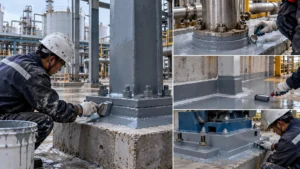
For both C3 and C4 buildings, the minimum surface preparation standard is ISO 8501-1 Sa 2½ (near-white blast cleaning). This is achievable in a fabrication shop environment and should be specified as a hold point — inspector sign-off required before any coating is applied.
In practice, some building steel is site-painted after erection where full abrasive blasting isn’t practical. For site-applied maintenance or touch-up coatings, power tool cleaning to SSPC-SP 11 (clean to bare metal) is the minimum acceptable standard for a zinc-rich primer application. SSPC-SP 3 (power tool cleaning, rusted surfaces) is not sufficient for a new or maintenance zinc primer. A detailed breakdown of preparation grades and inspection requirements is covered in the surface preparation guide for industrial coatings (ISO 8501 / SSPC).
Shop Application vs Site Application
Most structural steel for buildings is coated in the fabrication shop — primer and intermediate coat applied before delivery, with topcoat applied on site after erection. This is efficient and gives better quality control than full site application.
Two things to manage in this sequence. First, the overcoat interval: if the steel sits in the yard for weeks before erection, the intermediate coat surface may exceed the maximum recoat interval and need light abrasion before topcoating. This should be specified. Second, field joints and connection areas: bolted connections and site welds will need spot preparation and coating application on site regardless of the shop coating. Specify that all site welds and bolted areas are prepared to SSPC-SP 10 and primed before topcoat.
How Long Should a Well-Specified Building Coating Last?
For a C3 environment with a properly applied three-coat system at the recommended DFT: 15–25 years before first major maintenance is realistic. For a C4 zinc-rich primer system at full DFT: 15–20 years. These are to first maintenance — not total system failure — meaning you’d expect to see some minor corrosion at damage points and weld areas by then, which warrants spot repair rather than full recoating.
The most common causes of early failure — before 10 years — are: insufficient DFT (often from insufficient primer coverage), no zinc primer in a location where mechanical damage occurred, chloride contamination beneath the coating from inadequate surface preparation, or missing stripe coat on edges and welds.
Frequently Asked Questions
Do I need to specify differently for hot-rolled vs cold-formed steel?
The coating system is the same, but surface preparation may differ. Cold-formed steel (light gauge) often has tight tolerances that make full abrasive blasting impractical — some cold-formed steel building systems use chemical pre-treatment (phosphating) as the surface preparation instead of blasting. Confirm with the steel fabricator what surface preparation method is used and that it’s compatible with your specified primer. For heavy hot-rolled sections in a framed building, standard Sa 2½ blast cleaning applies.
Can I use a water-based epoxy system to reduce VOC on a building project?
Water-based (waterborne) epoxy systems are used on building projects where VOC regulations are strict — certain US states, European projects with sustainability requirements. Performance has improved significantly. For C3 environments, a well-specified water-based epoxy system can provide adequate protection. For C4 and above, the evidence base for waterborne systems is thinner and the performance gap with solvent-borne systems in aggressive environments is more significant. If VOC compliance is required for C4, specify a low-VOC solvent-borne system rather than a fully water-based one.
Does the coating spec change for a building near the sea?
Yes — and the transition happens faster than most people think. Within roughly 1km of the coastline (depending on wind exposure and topography), the chloride deposition rate elevates the effective corrosivity category. A site 500m from the shore in an exposed location may qualify as C5 rather than C4. Use the ISO 12944-2 classification guidance for coastal sites, or request a corrosivity assessment from a coating engineer if the site is in a borderline location. Underspecifying a coastal building is significantly more expensive to remedy than overspecifying it.
Anti-Corrosion Coating for Steel Buildings — Supply from Huili Coating
Huili Coating manufactures zinc-rich epoxy primers, high-build epoxy intermediate coats, and aliphatic polyurethane topcoats for steel building applications in C3 and C4 environments — with ISO 12944-compliant systems and full technical documentation for project specification.
To recommend the right system and provide TDS or RFQ support, send your project details via the Huili Coating project inquiry form:
- C3 and C4 coating systems: zinc-rich epoxy primer / epoxy / PU topcoat
- Glass flake epoxy for coastal C4 and C5 buildings
- ISO 9001 certified; third-party salt spray and adhesion test data
- Export supply to building projects in Middle East, Southeast Asia, and Europe
The technical team will respond with a coat-by-coat system recommendation, DFT table, and relevant product data — specific to your environment, not a generic catalogue sheet.