Why steel structures are highly vulnerable to corrosion
Steel structures rarely see “one uniform environment” across the whole asset—pipe racks, platforms, stair towers, and equipment supports create shaded wet zones, dust traps, and crevices where wet-time increases and corrosion accelerates. ISO 12944 treats corrosion risk as an environmental corrosivity problem plus durability planning, which aligns with how corrosion actually shows up on real structures.
High-risk locations that typically drive early failure:
- Welds and heat-affected zones (profile discontinuities and difficult coating build).
- Sharp edges and cut-outs (thin film build and early breakdown).
- Bolted connections and lap joints (crevice moisture + difficult access).
- Horizontal ledges and drainage shadows (standing water and long condensation periods).
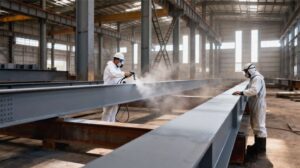
Fabrication vs installation impact: shop coating offers better control, but erection damage, field welding, and touch-up quality often determine real service life, so your system must be repairable and your QC plan must cover the interfaces.
Why a coating system matters more than individual products
Most industrial projects fail when teams select “a good paint” instead of defining a complete steel structure coating system with clear layer functions and QC rules. HUILI’s system guidance emphasizes that corrosion begins under the coating once the barrier is compromised, which is why system design and execution controls matter as much as product choice.
Primer / intermediate / topcoat: the functional split
- Primer: adhesion + corrosion control foundation.
- Intermediate (often epoxy): barrier build to slow water/ion transport.
- Topcoat: weathering/UV resistance, chemical splash tolerance (where required), and maintainability.
What buyers forget: “High-end product” cannot compensate for weak surface prep acceptance criteria or missing detail protection at edges and welds.
Typical anti-corrosion coating systems for steel structures
Below are two proven system “families” used in industrial steel corrosion protection, with selection logic you can apply before issuing RFQs.
Zinc-rich primer + epoxy + polyurethane system
Where it fits: many atmospheric steel structure scopes from medium to severe corrosivity when durability and appearance are both required. (For how ISO 12944 structures corrosivity/durability thinking, see an overview from the Institute of Corrosion.)
Why it works: each layer has a different job, so you can tune the system by zone (more barrier where wet-time is high, tougher finish where UV and abrasion are high).
Typical industrial applications
- Steel structures in industrial facilities (pipe racks, platforms, conveyors).
- Coastal industrial structures where salt deposition is present.
- Fabrication shops needing a controllable system and clear QC deliverables.
High-build epoxy coating systems
Where it fits: sheltered structures with long wet-time/condensation, interiors with chemical exposure, or areas where UV is not the dominant degradation driver.
Constraints to manage: high-build systems require disciplined surface preparation and recoat control to prevent intercoat adhesion issues, and outdoor exposure often needs a weathering strategy to protect the epoxy barrier.
System selection table (use in RFQs)
| Exposure pattern on steel structure | What fails first (typical) | System direction | What to lock in the RFQ |
|---|---|---|---|
| General industrial outdoor | Edges/welds, early rust at details | Role-based 3-layer system | Detail plan (stripe coats + edge DFT readings), repair method, QC dossier |
| Coastal / salt deposition | Underfilm corrosion at joints/crevices | Stronger barrier emphasis | Zone map, contamination control, defined touch-up scope |
| Sheltered condensation zones | Blistering / underfilm corrosion | Barrier-first epoxy strategy | Dew-point checks, recoat interval logging, hold points |
Environmental factors that should change your selection
Coastal & marine atmosphere
Salt deposition increases the corrosion driving force and raises the importance of barrier design and detail sealing, especially at bolted joints and crevices.
Heavy industrial pollution
Fallout, chemical vapors, and aggressive humidity cycles can shift failure modes toward underfilm corrosion and faster breakdown in water-trap areas.
High humidity & temperature variation
Long wet-time from condensation often matters more than peak temperature, so you should upgrade your system in sheltered zones even if the “overall site” seems moderate.
Durability planning tip: ISO 12944-style durability bands are commonly discussed as planning ranges such as “up to 7 years,” “7–15 years,” “15–25 years,” and “more than 25 years,” which helps teams align coating scope with maintenance strategy. (Reference explanation: FROSIO Training.)
Where failures start (common design mistakes)
- Wrong environment classification (treating coastal exposure as “normal outdoor,” ignoring sheltered wet zones).
- Specifying a blast-cleaning system when the site can only power-tool clean (system-prep mismatch).
- Over-compressing total film build to reduce initial cost (shortens maintenance interval).
- Ignoring fabrication/erection interfaces (shop primer repairs, field welds, touch-up scope undefined).
- Treating edges and welds as “included by default” instead of specifying measurable detail work.
If you want a practical execution control baseline, use an inspection checklist that forces surface prep acceptance, DFT logging, recoat control, and touch-up records (see Steel Structure Coating Inspection Checklist).
How to design a long-life system
Step 1: Zone the structure by exposure
Split into zones such as: fully weathered, sheltered condensation-prone, splash/chemical areas, and maintenance-access-limited areas.
Step 2: Specify surface preparation as a measurable scope
Define surface prep method, acceptance criteria, and inspection hold points before priming, because surface prep quality is a dominant driver of coating longevity. (Use a checklist/ITP approach so acceptance is auditable.)
Step 3: Select system architecture by zone (not one system everywhere)
Use role-based layering and adjust the barrier strategy where wet-time and contamination are higher.
Step 4: Write QC deliverables into the RFQ
Require (as minimum): DFT targets by coat as ranges (per TDS), recoat interval controls, climate logs where relevant, repair procedure, and batch traceability format.
Step 5: Plan maintenance from day one
Define the inspection rhythm and touch-up philosophy for details and damage-prone areas, so “minor maintenance” prevents major recoating.
Recommended anti-corrosion solutions for steel structure projects
If you need a system-oriented supplier view for industrial steel structures (typical assets, exposure patterns, and solution direction), start here: Steel Structure Coating Solutions.
For a deeper system selection walkthrough that you can reference during specification finalization and RFQ alignment, use: Anti-Corrosion Coating for Steel Structure: System Guide.
Quality / inspection checklist (DFT, recoat, surface prep)
- Surface preparation: standard + acceptance method defined, with a hold point before priming.
- Details: stripe coats required at edges/welds/bolts, and detail DFT readings recorded.
- DFT control: targets stated by coat as ranges (from TDS), with minimum readings frequency and calibration records.
- Recoat control: recoat windows and surface condition checks documented to prevent intercoat delamination.
- Repairability: touch-up materials and repair steps agreed before work starts; repairs logged into the QC dossier.
RFQ checklist (send this to get a system recommendation)
- Asset type and steel scope (shop vs site split, erection sequence constraints)
- Service environment and zone map (coastal/industrial/sheltered wet zones)
- Substrate condition (new fabrication vs maintenance; existing coating info)
- Available surface preparation method and constraints
- Durability target aligned to maintenance expectations (e.g., 7–15 vs 15–25 years planning band)
- Required deliverables: TDS/SDS, system recommendation sheet, inspection checklist, repair procedure, batch traceability format
Technical Note
Coating system build-up, surface preparation level, and acceptance criteria must be confirmed by the applicable TDS and project specification, including the exposure classification and durability planning method used (commonly ISO 12944-style).
CTA
Contact us to design an anti-corrosion coating system tailored to your steel structure project, including system recommendation, TDS/SDS, and QC deliverables, via Contact.