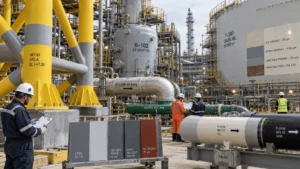
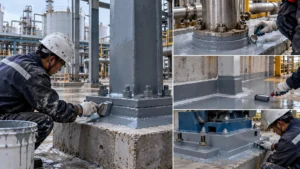
Intumescent coating for steel can vary 2–3× in cost per square metre between two projects with the same stated fire rating — and the price difference has almost nothing to do with brand selection. The real cost drivers are the required dry film thickness for each steel member, the section factor of those members, the fire resistance rating duration, and the installed scope written into the RFQ. Without a steel member schedule, any price per m² is a guess — and the guess is usually wrong in the direction that causes budget overruns during application.
For the full intumescent coating and passive fire protection product range, see the fire protection coatings series.
Types of Fireproof Coatings and Price Logic
The two principal systems used for passive fire protection of structural steel — intumescent coating and cementitious fireproofing — have different cost-per-m² behaviour, and the logic behind each is distinct.
Intumescent Fire Protection Coatings
Intumescent coating for steel works by reactive expansion: when exposed to fire, the coating chars and expands to form a low-conductivity foam layer that insulates the steel from heat and delays the temperature rise that causes structural failure. The critical engineering parameter is dry film thickness (DFT) — and DFT is not one fixed number per fire rating. It is a value derived from loading tables based on the section factor of each individual steel member and the required fire resistance rating duration.
This means two beams on the same project, with the same 60-minute rating, may require different DFT values if their section factors differ. Smaller, lighter sections typically require significantly higher DFT than larger, heavier sections for the same rating — because smaller sections heat up faster and need more insulation to achieve the same time to critical steel temperature. This DFT variation is the primary reason fireproof coating cost per m² cannot be calculated from a fire rating alone.
Cementitious Fireproof Coating Service
Cementitious systems apply a mineral-based spray or trowel material that provides fire protection through thermal mass and moisture content rather than reactive expansion. Cementitious fireproofing can be cost-effective where greater thickness is structurally and aesthetically acceptable, and it is commonly used in concealed structural areas, plant rooms, and industrial facilities where appearance is not a primary requirement.
Installed cost still depends heavily on applied thickness, access constraints, and the scope of impact protection and finishing required over the cementitious layer. For exposed structural steel and architecturally visible applications, intumescent coating for steel is typically specified because it adds minimal visual profile and is compatible with decorative topcoats.
Key Factors Affecting Intumescent Coating Cost per Square Metre
These five factors each independently change the price per m² — and in an RFQ that does not specify all five, competing suppliers will make different assumptions, producing quotes that cannot be compared.
1. Fire Resistance Rating (30 / 60 / 90 / 120 Minutes)
Required DFT from loading tables increases with longer rating duration for equivalent section factors. A 120-minute rating on the same steel member will require higher DFT — and therefore higher material consumption per m² — than a 60-minute rating. This relationship is not linear: the DFT increase from 60 to 120 minutes can be significantly larger than from 30 to 60 minutes depending on the product and section factor range.
2. Section Factor and Member DFT
The section factor (Hp/A — the heated perimeter divided by the cross-sectional area) determines how quickly a steel member absorbs heat from a fire. A high section factor means the member heats rapidly and requires higher DFT from the loading table to achieve the same rating. In a typical structural steel project:
- Large, heavy I-beams and columns have low section factors and require relatively modest DFT
- Smaller beams, purlins, and angles have high section factors and may require 2–3× the DFT of the heavy sections for the same rating
- HSS (hollow structural sections / CHS/RHS) typically require significantly higher intumescent DFT than open sections of equivalent size, because their geometry provides less surface area relative to the steel mass being protected
Quoting a single average DFT across a project without a member schedule consistently underestimates the cost for projects with high proportions of small sections and HSS.
3. Steel Member Type and Geometry
Open sections (I-beams, H-columns, angles, channels) and hollow sections (CHS, RHS, SHS) are treated differently in intumescent loading tables and may be governed by different certified product approvals. HSS members typically appear in the higher DFT range of loading tables — which means more material, more application passes, and longer curing time per member compared to open sections at the same fire rating.
4. Surface Preparation and Primer Compatibility
Intumescent coating for steel is applied over a specified primer — and the primer must be confirmed compatible with the intumescent system from the same manufacturer’s approved system list, not assumed compatible because it is “also an epoxy.” Applying intumescent over an unapproved primer changes the bonding mechanism and can void the product certification.
Surface preparation scope — whether the steel is new build arriving blast-cleaned from the fabricator, or existing steel requiring blast repairs and spot prime before the intumescent application — directly changes application labour cost and project duration. An RFQ that does not state substrate condition and primer scope will receive quotes based on different assumed preparation levels.
5. Topcoat and Sealer Requirement
In outdoor or high-humidity environments, intumescent coating for steel typically requires a sealer or decorative topcoat over the intumescent layer to prevent moisture absorption that can degrade the intumescent char performance over time. Indoor, dry, concealed structural steel may not require a topcoat. The topcoat requirement, UV exposure, and aesthetic finish specification must be confirmed in the RFQ — omitting this produces quotes that exclude a cost item that is mandatory for the actual service condition.
Material Cost vs Application Cost: What Really Changes Your Budget
Understanding which cost component is being driven by which variable is the key to writing an RFQ that produces comparable quotes.
| Cost Item | What Changes the Number | RFQ Wording That Prevents Surprises |
|---|---|---|
| Intumescent coating material | DFT per member × area; waste factor for complex geometry | “DFT per loading table by member size and rating; provide steel schedule” |
| Surface preparation and primer | Existing steel condition; blast grade required; primer repair scope | “State substrate condition (new build / maintenance); include primer repair scope” |
| Application labour | Access height; section complexity; number of passes to build DFT | “Provide access height, scaffold constraints, and workface density” |
| QA/QC and reporting | DFT measurement frequency; third-party inspection; handover documents | “Include DFT report per member, batch traceability, and inspection hold-point records” |
| Topcoat or sealer | Exposure (UV / condensation / chemical splash / aesthetic requirement) | “State indoor/outdoor, UV exposure, and finish color requirement” |
The most common budget error is requesting “price per m² for 120-minute intumescent coating” without a steel schedule. The supplier must then assume an average section factor — and if the project has a high proportion of HSS or lightweight sections, the actual DFT requirement from the loading table may be 40–80% higher than the assumed average, producing a material quantity significantly above the quoted estimate.
Intumescent Coatings Application for Steel Structures: How to Estimate Correctly
A technically defensible cost estimate for intumescent coating on structural steel requires four inputs, in sequence. Skipping any input produces an estimate that will require revision during application.
Step 1: Define the fire scenario and compliance basis
Confirm the required fire resistance rating (30 / 60 / 90 / 120 minutes), the fire scenario (standard cellulosic fire curve or hydrocarbon fire for petrochemical applications), and the compliance route (tested and certified assembly per UL, FM, or equivalent, or engineering judgement approach). UL emphasises that the tested system configuration — primer type, intumescent product, DFT range, topcoat — must be followed precisely to maintain the certified performance. Deviations from the approved design details can void the fire performance claim regardless of DFT achieved.
Step 2: Convert the steel schedule to DFT by member
Send the steel member schedule (beam sizes, column sizes, HSS dimensions, and quantities per type) to the coating supplier or passive fire protection specialist. DFT must be read from the product’s loading table for each member type and section factor at the specified rating duration — not estimated from a project average. For projects with mixed open and hollow sections, the DFT range across the schedule may be wide, and the cost estimate must reflect the actual distribution of member types.
Step 3: Write an installed-scope RFQ
State explicitly what is included in the quoted scope:
- Surface preparation method and acceptance grade (Sa 2.5 for new build; spot blast and primer repair for maintenance)
- Primer: included in scope or by others (confirm compatible primer approved for the intumescent system)
- Intumescent coating application to DFT per loading table by member type
- Topcoat or sealer: included or excluded; specify exposure condition
- QA/QC deliverables: DFT measurement records per member, batch traceability, inspection hold points, handover documentation
Step 4: Require a cost breakdown, not a single price per m²
Request that suppliers break down their quotation into: materials (intumescent coating, primer, topcoat), application labour, access and scaffolding, and QA/QC. A single price per m² cannot be verified, adjusted, or compared between suppliers — a cost breakdown allows direct comparison of the items that actually vary between quotes.
Common Pricing Mistakes in Intumescent Coating Projects
Quoting average DFT without a steel schedule
The most common source of cost overruns on intumescent projects. A project average DFT that appears reasonable for heavy I-sections will be significantly below the loading table requirement for HSS and lightweight sections. The discrepancy only becomes apparent during application — at which point additional material, labour, and schedule time have already been consumed.
Treating the system as interchangeable products
Substituting a different primer or topcoat without confirming it is approved within the same certified intumescent system is a specification error that voids the fire performance certification. UL and other certification bodies test specific system combinations — the intumescent product, primer type and DFT, and topcoat or sealer — as a unit. Changing any component without reverification against the certified design means the installed system is no longer the tested assembly, regardless of whether the intumescent DFT meets the loading table requirement.
Comparing material-only quotes against installed quotes
A material-only price per m² (coating product cost alone) and an installed price per m² (coating, application, access, QA/QC) are not comparable and should never be used as the basis for budget comparison. Installed cost typically ranges from 3–5× the material cost on complex steel structures with difficult access.
Omitting topcoat scope from outdoor or high-humidity projects
Intumescent coating for steel in outdoor or high-humidity service requires a sealer or topcoat to protect the intumescent layer from moisture — moisture absorption degrades the expansion and insulation properties of the char over the system’s service life. Omitting the topcoat from the RFQ scope produces a lower quote that will require a change order during execution.
Intumescent Paint Contractors: RFQ Checklist for Accurate Pricing
Copy this checklist into your RFQ to receive a technically correct, comparable fireproof coating quotation.
Fire scenario and compliance basis:
- Fire resistance rating required: 30 / 60 / 90 / 120 minutes
- Fire curve: standard cellulosic (buildings) or hydrocarbon (petrochemical/offshore)
- Compliance route: UL-listed or certified assembly / FM approval / project-specific engineering basis
- Any project-specific or client standard requirements
Steel member schedule (mandatory for DFT-based pricing):
- Member types and sizes: I-beams, H-columns, angles, channels, HSS (CHS/RHS/SHS) with dimensions
- Quantities per member type and total steel area by section type
- New fabrication or existing in-service steel
Substrate and primer scope:
- Substrate condition: new build (blast-cleaned from fabricator) or maintenance (existing coating)
- Primer: included in this scope / specified by others (state primer type and DFT if by others)
- Blast repair and spot prime scope for maintenance projects
System scope:
- Intumescent coating product: supplier recommendation per loading table / client-specified product
- Topcoat or sealer: required / not required — state exposure condition (indoor dry / outdoor UV / condensation / chemical splash)
- Color and finish requirement (if topcoat is in scope)
Site and application constraints:
- Shop application (fabricator yard) or site application (erected steelwork)
- Access height and scaffold availability
- Shutdown windows or production constraints during application
- Application season and climate (temperature and humidity range)
QA/QC and handover deliverables:
- DFT measurement records: per member type / per structural zone
- Batch traceability and material delivery records
- Inspection hold points: surface preparation acceptance, primer DFT, intumescent DFT, topcoat DFT
- Repair procedure for damaged areas
- System data pack: TDS, SDS, method statement, and certified assembly reference
FAQ
Why does intumescent coating DFT vary between steel members with the same fire rating?
DFT for intumescent coating on steel is determined by the section factor (Hp/A) of each member — the ratio of the heated perimeter to the cross-sectional area. A high section factor means the member heats rapidly when exposed to fire and requires higher intumescent DFT to delay the temperature rise to the critical steel failure temperature. A large, heavy I-beam has a low section factor and requires relatively modest DFT; a small angle or HSS tube has a high section factor and may require 2–3× the DFT of the heavy section for an identical fire resistance rating. This is why DFT must be read from the product’s loading table for each member type — a single average DFT across the project produces an inaccurate cost estimate and an under-specified system on the lightweight sections.
What is the difference between intumescent coating and cementitious fireproofing for steel?
Intumescent coating for steel works reactively — it expands and chars when exposed to fire heat, forming an insulating foam layer around the steel. Applied DFT is typically 0.5–5 mm depending on section factor and rating, adding minimal visual profile. Cementitious fireproofing applies a mineral-based material in thicker builds (typically 10–50 mm) that protects steel through thermal mass. Intumescent systems are standard for visible structural steel and architecturally exposed applications; cementitious systems are used where greater thickness is acceptable and cost efficiency at high rating durations is the priority. Both require correct surface preparation, primer compatibility verification, and QA/QC during application.
Can I change the primer under an intumescent coating system without affecting the fire rating?
No — not without re-verifying against the certified system configuration. Fire-resistant coating for steel in a certified assembly is tested as a specific combination: primer type and DFT, intumescent product, intumescent DFT range, and topcoat or sealer. UL and equivalent certification bodies certify this combination as a unit. Substituting a primer that is not listed as approved within the certified system — even if it is technically similar — means the installed system is no longer the tested assembly, and the fire performance claim cannot be supported by the certification. Primer compatibility and system approval must be confirmed from the intumescent coating manufacturer’s approved system documentation before specification is finalised.
How should I write a fireproof coating RFQ to get comparable quotes?
The two most important inclusions are a steel member schedule and a defined installed scope. Without a member schedule, suppliers must assume an average section factor and DFT — and different assumptions produce non-comparable quotes. Without a defined installed scope (surface preparation method, primer responsibility, topcoat requirement, QA/QC deliverables), each supplier prices different work. Require a cost breakdown by material, application labour, access/scaffolding, and QA/QC rather than a single price per m² — this is the only format that allows direct comparison of the items that vary between proposals.
What QA/QC records should be required for intumescent coating application on structural steel?
At minimum: surface preparation acceptance records (blast grade, surface profile, soluble salt level where applicable), primer DFT records per member or zone, intumescent coating DFT records per member type with minimum/maximum readings, topcoat DFT records where a topcoat is in scope, batch numbers and material traceability for each product used, and inspection hold-point sign-offs at each stage. DFT records should reference the loading table DFT requirement for each member type, allowing direct verification that the installed DFT meets the fire resistance rating requirement for that section. These records form the evidence base for fire performance compliance and are required for handover to the building owner and fire authority.a Contact.