What does anti-corrosion coating cost really include?
A project budget is not just a “price per m².” It is the installed cost of a protective coating scope that can be executed, inspected, accepted, and maintained.
Use this cost framework to align EPC, contractor, and owner expectations:
- Material cost: Primer, intermediate coats, topcoat, thinners, mixing consumables, plus waste allowance driven by geometry.
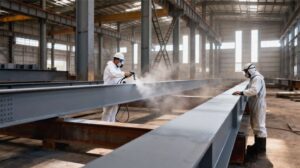
- Surface preparation cost: Abrasive blasting or mechanical prep, media consumption, dust control, and surface cleanliness verification.
- Labor and application cost: Applicator crew, supervision, HSE controls, and productivity impacts from access constraints.
- Equipment and inspection cost: Compressors, blast pots, dehumidification where needed, DFT gauges, calibration, and reporting.
- Future maintenance cost: Touch-up rules, inspection frequency, and planned maintenance windows.
Material cost factors in anti-corrosion coating systems
Material portion varies mainly with chemistry choices, volume solids, and total DFT ranges.
- Zinc-rich vs standard primers: Zinc-rich primers are often chosen to improve corrosion control at damage points and cut edges, but they typically raise the material line item versus simpler primers.
- High-build epoxy thickness: Higher barrier build typically increases liters per m² and also increases the importance of recoat window control and inspection discipline.
- Topcoat choice: Finish selection affects long-term weathering and appearance retention, and higher-durability finishes can increase initial material cost while reducing repaint frequency in exposed zones.
- Film thickness requirements: Total DFT ranges are a direct cost driver because consumption scales with thickness and loss factors.
Decision rule for procurement: compare bids on “cost per m² at specified DFT ranges and prep scope,” not unit price per liter.
Surface preparation level and its impact on cost
Surface preparation is the strongest lever in both cost and durability because it controls adhesion and underfilm corrosion risk.
- Sa-level blasting versus lower-intensity prep: higher cleanliness and consistent profile generally cost more upfront but reduce early failure probability for long-life systems.
- Abrasive blasting versus power-tool cleaning: power-tool cleaning can be suitable for localized maintenance, while long-life new-build scopes often rely on abrasive blasting to reduce variability.
- Salt contamination and dew point control: coastal and high-humidity regions require more control steps to prevent flash rust and adhesion loss, and these steps should be priced explicitly.
Design life vs project cost: 10-year vs 20-year systems
This is the core value-engineering point for EPC procurement.
A short-life system can reduce initial cost by reducing surface prep scope, reducing coat count, or reducing DFT ranges, but it typically increases lifetime repaint events, access costs, and shutdown losses. A longer-life system costs more upfront because it usually requires stronger preparation discipline, higher barrier build, and more rigorous QC to prevent early defects.
| Decision variable | Lower-spec approach | Long-life approach | Budget consequence |
|---|---|---|---|
| Surface preparation | Lower intensity, higher variability | Higher consistency and verification | Prep cost up, rework risk down |
| Layer architecture | Fewer layers or reduced barrier build | Corrosion-control primer + barrier epoxy + durable topcoat | Initial cost up, maintenance down |
| QC dossier | Minimal documentation | DFT by layer, climate logs, repair logs | Acceptance cost up, dispute risk down |
| Maintenance window | Short intervals, frequent touch-up | Longer intervals, planned inspections | Downtime cost down |
Typical anti-corrosion coating cost range without quoting exact prices
Instead of quoting exact prices, use cost tier logic by severity and complexity:
- Mild to moderate atmospheric: lower DFT ranges, simpler access, fewer special controls.
- Heavy industrial: higher barrier build and stricter QC, plus more shutdown coordination.
- Marine and coastal: tighter contamination control and higher-severity zones, often increasing both prep scope and contingency.
For severe environments where heavy-duty systems are the correct budgeting baseline, reference this system overview once: Heavy Duty Anti-Corrosion Coatings for Industrial Projects.
How to estimate anti-corrosion coating cost for steel structures
Use a simplified logic that yields comparable bids:
- Define environment and zones and align classification thinking to ISO 12944. ISO 12944
- Select a coating system architecture that matches zone severity and maintenance plan, not just a product name.
- Define DFT ranges by layer and mandate stripe coats at edges and welds.
- Convert DFT to theoretical consumption using volume solids from TDS, then add realistic loss factors for geometry.
- Add surface prep, access, containment, and verification costs as explicit scope items.
- Add inspection and documentation deliverables as priced items.
To align your “system selection language” before you price it, use: Anti-Corrosion Coating for Steel Structure: System Guide.
Common budgeting mistakes in corrosion protection projects
- Comparing unit paint price: Ignores system architecture, volume solids, and geometry losses.
- Ignoring surface preparation: Cutting prep scope often buys early adhesion failures and full rework cycles.
- Underestimating maintenance and downtime: Access and shutdown losses can dominate lifecycle cost.
- Skipping inspection deliverables: If acceptance records are unclear, cost escalates through rework and disputes.
Inspection tip for EPC: require a checklist and define hold points so the contractor cannot “inspect at the end only.” For a ready checklist structure, use: Steel Structure Coating Inspection Checklist.
How to reduce corrosion protection cost without sacrificing performance
- Optimize layers with intent: Reduce labor only when the system still delivers corrosion control, barrier build, and weathering, and when QC is enforceable.
- Use zone-based specs: Over-specifying the whole asset inflates cost; zoning keeps performance where it matters.
- Plan application windows: Define climate hold points to reduce humidity and condensation-driven rework.
- Standardize documents: One ITP and one repair method per zone improves bid comparability.
RFQ checklist for budgeting decisions
Before requesting a quote, prepare:
- Environmental category and zones, plus sheltered condensation and splash points.
- Substrate details, steel type, total area, geometry complexity, edge and weld density.
- Design-life band to first major maintenance and inspection frequency expectations.
- Surface preparation feasibility, containment, access method, shop vs field split.
- Performance needs, chemical splash, temperature ranges, UV durability, abrasion points.
- QC dossier requirements, hold points, DFT readings by layer, climate logs, repair records.
CTA
Contact us for a project-based anti corrosion coating cost evaluation tailored to your environment and design life requirements, and request a TDS pack and system recommendation via Contact Industrial Coating Manufacturer.
Technical Note
All cost breakdowns and guidance are for budgeting support; final coating selection, DFT ranges, surface preparation level, and acceptance criteria must be confirmed by the relevant TDS and project specification.