Bridges have a characteristic that makes coating specification consequential in a way that most industrial structures don’t: they’re expensive to maintain, difficult to access, and expected to last 50–100 years. The coating system applied during construction isn’t just corrosion protection — it’s a financial decision that plays out over decades. A coating that lasts 25 years before major maintenance costs a fraction of one that fails at 8 years and triggers an expensive overwater or over-traffic recoating campaign.
The other thing that makes bridge coating specific is the corrosion environment variation within a single structure. The deck underside, the main girders in the splash zone of a coastal bridge, the approach spans, and the substructure below waterline are all in substantially different environments — and ideally would be specified differently. In practice, a single conservative system is often applied across the whole structure. This isn’t necessarily wrong, but understanding the environment of each zone is the starting point for a defensible specification.
Corrosion Zones on a Bridge Structure
| Zone | ISO 12944 Category | Key Corrosion Driver | Notes |
| Superstructure — inland | C3–C4 | Rain, humidity, pollution | Most common; standard 3-coat system |
| Superstructure — coastal | C4–C5 | Salt spray, humidity | Upgrade to glass flake intermediate |
| Deck soffit (underside) | C4–C5 | Trapped moisture, de-icing salt splash | Difficult access; high-build system preferred |
| Splash zone — coastal/marine | CX / Im2 | Seawater wetting, wave action | High-build glass flake epoxy required |
| Below waterline — submerged | Im1 / Im2 | Full immersion | CP + coating; specialist immersion system |
| Buried — abutments, piles | Im3 | Soil, groundwater | Coal tar epoxy or FBE; CP often required |
The deck soffit deserves emphasis. It’s often the area of worst corrosion on an older bridge — de-icing salt-contaminated water drains through deck joints and washes down the girder webs and bottom flanges. Access for inspection and recoating is difficult and expensive. Specifying a high-build system (glass flake epoxy rather than standard epoxy) for the deck soffit on a new bridge costs relatively little extra and potentially avoids a very expensive maintenance intervention later.
The Standard Specification: Three-Coat Zinc/Epoxy/Polyurethane
For most bridge superstructure steel in C3–C5 environments, the industry standard is a three-coat system:
- Primer: zinc-rich epoxy, 60–75 µm — galvanic protection at any damaged areas; edge and weld protection
- Intermediate: high-build epoxy or glass flake epoxy, 100–200 µm (one or two coats) — barrier protection and film build
- Topcoat: polyurethane or acrylic polyurethane, 50–75 µm — UV and weathering resistance; colour retention
Total DFT: 210–350 µm for C3/C4; 320–450 µm for C5.
For coastal bridges where C5 or salt spray exposure is the dominant factor, upgrading the intermediate coat from standard epoxy to glass flake epoxy is often the single most cost-effective specification change available. The glass flake system typically adds modest cost but can double or triple the time to first maintenance — which, on a major bridge, represents a very significant saving given the access costs involved. The material cost difference is small; the maintenance cost difference is large.
For full system selection logic by corrosivity category, zinc primer types, and design life targets, see the structural steel corrosion protection coating guide.
Surface Preparation: The Unique Challenge of Bridge Maintenance
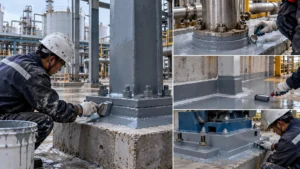
New bridge construction offers the most control over surface preparation — shop blasting of fabricated steel to Sa 2½, with site blasting of field joints and areas damaged during erection. This is the baseline that gives new bridge coatings their long service life.
Maintenance coating — overcoating an existing bridge — is a different challenge entirely. The existing coating may be in varying condition across the structure, lead paint may be present (requiring containment and specialist disposal), and access scaffolding constrains what preparation methods can be used.
For maintenance work, the preparation standard depends on what’s present:
- Intact, well-adhered existing coating: sweep blast or power tool preparation (SSPC-SP 11) to remove loose material and provide adhesion profile; overcoat with compatible system
- Failed or partially failed coating: full removal to Sa 2½ in failed areas, feathering edges to intact areas; prime, build coat, topcoat to match or slightly exceed original specification
- Lead paint: contained wet blasting or vacuum blasting; specialist contractor with appropriate disposal certification; confirm requirements with local regulatory authority before specifying
The temptation in maintenance work is to minimise surface preparation to reduce cost and programme time. Inadequate preparation is the most common cause of maintenance coating failure within 3–5 years of application — which triggers another maintenance cycle. The economics of proper preparation are clear over a multi-cycle view.
Long-Term Durability: What Determines Whether a Bridge Coating Reaches 25 Years
From a materials and specification standpoint, three factors dominate long-term durability of bridge coatings:
Zinc primer — yes or no, and zinc content. Bridge coatings without a zinc-rich primer rely entirely on barrier protection. At any point of damage — weld spatter, mechanical impact, abrasion — corrosion initiates immediately at the bare metal and undercuts the surrounding coating. A zinc-rich primer provides galvanic protection at these points, dramatically slowing corrosion spread from damage sites. It’s probably the single most important specification decision for long service life.
Film build. More DFT means longer diffusion path for moisture and oxygen. Within the practical range for bridge coatings, more film build correlates with longer service life — up to a point. The glass flake systems provide a higher effective barrier per unit of DFT than standard epoxy, because the flake geometry creates a much longer actual diffusion path through the film.
Edge coating quality. Coating naturally thins at edges, angles, and weld toes due to surface tension effects — the same volume of coating covers more surface area at a sharp edge than on a flat face. Stripe coating (a preliminary brush coat on all edges and welds) is specified for exactly this reason. Without it, edges are reliably thinner than the specification, regardless of what the flat-face DFT readings show.
For a detailed explanation of how zinc-rich primers work, zinc content requirements, and the difference between organic and inorganic zinc systems, see the zinc-rich primer guide for steel.
Fluoropolymer and FEVE Topcoats: When They’re Worth the Premium
Standard polyurethane topcoats provide good weathering resistance and colour retention for 10–15 years before significant chalking and colour fade. For most industrial steel structures this is acceptable.
For bridges in high-visibility locations — cable-stayed structures, iconic crossings, urban flyovers — colour retention over a 20–30 year interval matters. Fluoropolymer topcoats (PVDF, FEVE) provide significantly better UV stability and colour retention than polyurethane, maintaining gloss and colour for 20+ years in outdoor exposure. The material cost is higher, but when access cost is factored in, the economics of a single repainting cycle at 25 years versus two polyurethane cycles at 12–15 years often favours the fluoropolymer.
FEVE (fluoroethylene vinyl ether) crosslinking topcoats are the most commonly used fluoropolymer system in bridge applications — they can be applied cold in the field (unlike PVDF which requires baking) and are available as two-component systems compatible with standard zinc-rich primer/epoxy intermediate systems.
For coastal and marine zone steel on bridge substructures and pier columns, the splash zone coating approach — glass flake DFT requirements, application sequence, and inspection requirements — is covered in the splash zone coating guide for offshore and marine structures.
Questions from Infrastructure Projects
What coating system is specified for the underside of a concrete bridge deck?
Concrete bridge decks are typically not painted — the deck is waterproofed from above (bituminous waterproofing membrane) rather than coated from below. The structural steel components beneath a composite deck (steel girders, cross beams, bracing) are coated to the specification for the corrosivity zone they’re in. The exception is reinforced concrete that has carbonated or shows chloride-induced corrosion — this requires specialist concrete repair and a carbonation-barrier or chloride-barrier coating applied to the concrete surface.
Do bridge coatings need to meet any regulatory standards beyond ISO 12944?
Standards vary by country and client. In the UK, the National Highways Specification for Highway Works contains specific bridge coating requirements. In the USA, state DOT specifications vary but commonly reference SSPC standards. In the Middle East, many infrastructure projects reference both ISO 12944 and the owner’s specific technical specification. For international infrastructure projects, confirm the applicable owner specification early — ISO 12944 C5 corrosion protection compliance is usually necessary but may not be sufficient on its own.
Can I use water-based epoxy to reduce VOC emissions on a bridge project?
Water-based (waterborne) epoxy systems have improved significantly and are now used on bridge projects in jurisdictions with strict VOC regulations — California and several European countries, for example. Performance has improved considerably, but waterborne epoxy systems are generally more sensitive to application conditions (temperature, humidity) than solvent-borne systems, and the gap in long-term performance data compared to solvent-borne systems is still closing. For high-durability bridge applications in demanding environments, solvent-borne systems remain the more common specification. Water-based epoxy is a reasonable choice in C3–C4 environments where VOC restrictions require it — less so for C5 or splash zone applications.
Bridge and Infrastructure Coating Systems from Huili Coating
Huili Coating manufactures zinc-rich epoxy primers, glass flake epoxy intermediate coats, and polyurethane and FEVE topcoats for bridge and infrastructure steel — for new construction and maintenance recoating in C3 through CX environments.
- Three-coat zinc/glass flake/PU systems: C4–C5 bridge specification
- High-build glass flake epoxy: deck soffit, coastal zones, splash zone structures
- FEVE topcoats: long-term colour and gloss retention for high-visibility structures
- ISO 9001 certified; third-party ISO 9227 salt spray and adhesion test data
- Export supply for infrastructure projects in the Middle East, Southeast Asia, and Europe
Send your project zone data — bridge type and span, corrosivity zone classification, whether new construction or maintenance recoating, existing coating condition (if known), required design life, and any applicable owner or DOT specification — via the project inquiry form and our technical team will recommend a zone-specific system and provide TDS documentation for your specification review.