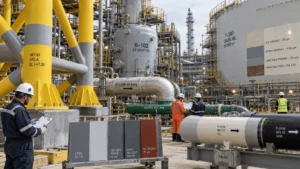
Refineries and petrochemical facilities are about as demanding an environment as industrial coatings get. You’ve got process temperatures that range from cryogenic to 400°C+, atmospheres loaded with H₂S and SO₂, hydrocarbon spills and splash, steam, fireproofing requirements, and equipment that simply cannot be taken offline easily for recoating. Get the coating specification wrong, and you’re looking at premature failure in an environment where maintenance access is difficult and the cost of corrosion-related incidents is high.
This isn’t a theoretical problem. Pipe rack corrosion, tank floor failure, and fireproofing degradation in petrochemical facilities are well-documented — and in most cases, they trace back to coating systems that weren’t specified for the actual service conditions.
Here’s a practical breakdown of the coating requirements by asset type in a typical refinery or petrochemical facility — and what distinguishes systems that hold up from those that don’t.
The Corrosion Environment: What Makes Refineries Different
A few things set petrochemical facilities apart from standard industrial environments, and they all push coating requirements toward the more demanding end of the spectrum.
H₂S is the main one. Hydrogen sulphide — present in many crude oil and gas process streams — is corrosive to steel and degrades some coating binders over time. Coatings in H₂S-rich environments need validated resistance to sour service, not just general chemical resistance. Standard epoxy systems may be adequate; some are not.
Process temperature variation is the second factor. Equipment in a refinery can range from -40°C (cryogenic units) to 400°C+ (fired heaters, reformer tubes). No single coating covers this range — the specification has to be zone-specific.
Hydrocarbon splash and spill is a constant. Process flanges leak, sampling points drip, and equipment is washed down regularly. Any coating on equipment in service areas has to tolerate intermittent hydrocarbon exposure without softening or losing adhesion.
And then there’s the fireproofing requirement. Most structural steel supporting process vessels, pipe racks, and equipment in a petrochemical facility is required to maintain structural integrity for a defined period in a hydrocarbon fire — which means UL 1709-rated fireproofing, not the cellulosic-rated systems used in commercial buildings.
Coating Systems by Asset Type
Structural Steel — Pipe Racks, Structures, Supports
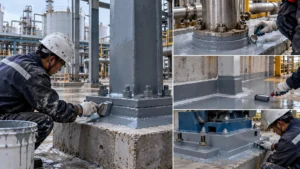
The corrosivity category for most refinery structural steel is C4 to C5 per ISO 12944, depending on location within the facility. Units close to process equipment with hydrocarbon release potential, or in coastal/humid locations, typically warrant C5 specification.
| Coat | System | Typical DFT |
| Primer | Zinc-rich epoxy (80%+ zinc by dry weight) | 60–75 µm |
| Intermediate | High-build epoxy or glass flake epoxy (2 coats) | 2 × 125–150 µm |
| Topcoat | Polyurethane or acrylic polyurethane | 60–75 µm |
| Total | C5 / High durability system | 370–450 µm |
Where fireproofing is also required — which covers most load-bearing structural steel in process areas — the fireproofing system sits over the anti-corrosion primer. The primer must be compatible with the fireproofing system; using an incompatible primer is one of the most common causes of fireproofing delamination. For the petrochemical environment, cementitious fireproofing is often preferred over thin-film intumescent for its hydrocarbon fire resistance and mechanical durability, though intumescent systems rated to UL 1709 are also used, particularly on shop-fabricated modules.
💡 For fireproofing compatibility guidance, see how to apply fireproof paint over anti-corrosion primer | For UL 1709 vs BS 476, see fireproof coating standards: UL 1709 vs BS 476 explained
Process Vessels and Columns — Exterior
The exterior of process vessels — columns, reactors, separators, heat exchangers — faces the same C4/C5 atmospheric environment as the structural steel. The same three-coat zinc/epoxy/polyurethane system is standard. Where insulation is present, the coating under insulation (CUI) specification is different — see below.
For vessels operating above 120°C, standard epoxy systems can’t be used. The coating selection shifts to silicone-based or high-temperature epoxy systems depending on the surface temperature. For more on the temperature band breakdown, see the high-temperature coating guide.
Coating Under Insulation (CUI)
Corrosion under insulation is one of the most persistent problems in petrochemical maintenance. Insulation systems that allow water ingress — at flange points, support rings, and damaged areas — create a warm, wet environment beneath the insulation that drives rapid corrosion. The coating under insulation has to tolerate: thermal cycling (as equipment heats up and cools down), water immersion during outages, and restricted access for inspection. Most standard atmospheric coatings are inadequate for this service.
For temperatures up to 120°C: solvent-free epoxy or thermal spray aluminium (TSA) are the preferred systems. TSA is particularly durable under insulation and is widely specified on North Sea and Gulf of Mexico facilities. For temperatures 120–250°C: modified silicone or epoxy-silicone systems. Above 250°C: inorganic zinc silicate or ceramic coatings.
API RP 583 (Corrosion Under Insulation and Fireproofing) is the key reference document for CUI coating specification.
Storage Tank Interiors
Crude oil storage tanks, intermediate product tanks, and finished product tanks all have different lining requirements depending on the product stored. The general framework:
- Crude oil (sweet): solvent-free epoxy lining, 300–500 µm DFT, per API 652
- Crude oil (sour, H₂S-containing): epoxy phenolic lining — better resistance to H₂S and aromatic hydrocarbons, 200–400 µm DFT, post-cure required
- Jet fuel / aviation fuel: epoxy phenolic — fuel compatibility is critical; specific approvals (DEF STAN 80-97 for Jet A) required
- Process chemical tanks: novolac epoxy or vinyl ester depending on the specific chemical; always confirm with manufacturer’s CRG
For the full tank lining selection framework, see the storage tank lining chemical resistance guide. For epoxy tank lining material and design specifics, see the epoxy tank lining guide.
The Fireproofing Question in Petrochemical Facilities
This is worth a separate section because it’s frequently misspecified. In a petrochemical facility, the design fire scenario is a hydrocarbon pool fire or jet fire — not the standard cellulosic building fire. The temperature rise in a hydrocarbon fire is dramatically faster: 1,093°C within 5 minutes under UL 1709, versus the slower rise of the cellulosic curve.
A fireproofing system that’s only been tested and rated to BS 476 / EN 13501-2 (cellulosic) is not adequate for petrochemical service. This distinction is sometimes missed when projects specify ‘intumescent coating’ without specifying the applicable fire curve. Always confirm: UL 1709 test data, at the required fire resistance period (typically 60, 90, or 120 minutes), on the specific section factors present in the structure.
💡 Huili Coating’s intumescent systems are rated to UL 1709 (hydrocarbon) for 60, 90, and 120-minute ratings. For passive fire protection principles, see passive fire protection vs active fire protection
Surface Preparation in an Operating Facility
One practical challenge in refinery coating projects that doesn’t come up in greenfield work: surface preparation in an operating facility. Open abrasive blasting may not be permitted in all areas due to explosion risk and product contamination concerns. In these situations, the options are vacuum blasting (dustless blasting that contains the abrasive), wet blasting, or mechanical preparation (power tool cleaning to SSPC-SP 11 or equivalent).
Mechanical preparation to SSPC-SP 11 achieves bare metal on the surface but doesn’t create the surface profile that abrasive blasting produces. Some coating systems — particularly zinc-rich primers — are specifically formulated for mechanically prepared surfaces, but they’re not the same product as blast-applied zinc-rich primers. Confirm that the specified product is qualified for the actual surface preparation method that will be used.
Questions We Get from Refinery Projects
Can the same primer be used under both the anti-corrosion system and the fireproofing?
Usually yes — but it must be confirmed with both coating manufacturers. The primer needs to be compatible with the anti-corrosion intermediate/topcoat AND with the fireproofing system. In the petrochemical world, many specifiers use the same manufacturer for both systems specifically to avoid compatibility questions. The fire test certificate for the intumescent or cementitious system will specify which primers are within the certified system.
How do we handle areas that run above 150°C but also need fireproofing?
This is a genuine conflict — most fireproofing systems can’t be applied on hot surfaces (the binder degrades), and standard anti-corrosion systems can’t handle the operating temperature. In practice, the design approach is usually to insulate the high-temperature section and apply CUI coating beneath the insulation, while the structural steel at ambient temperature gets the standard anti-corrosion + fireproofing stack. Where the high-temperature and structural steel interface, the transition requires careful engineering and is usually handled project-specifically.
What’s the typical recoating interval for a refinery coating system?
For a well-specified C5/high-durability system on structural steel, 15–20 years to first major maintenance is achievable in a typical refinery atmosphere. In practice, maintenance intervals in operating facilities are driven by turnaround schedules — coating inspection happens during planned shutdowns, and maintenance coating is prioritised on assets where corrosion is most advanced. Assets with good initial coating quality, no CUI issues, and regular inspection typically reach 15+ years without major intervention.
Coating Supply for Refinery and Petrochemical Projects
Huili Coating manufactures anti-corrosion and fireproofing systems for petrochemical and refinery applications — including zinc-rich epoxy primers, glass flake epoxy intermediates, UL 1709-rated intumescent coatings, high-temperature silicone systems, and epoxy phenolic tank linings.
- ISO 9001 certified manufacturing; third-party test data for all major systems
- Full documentation in English: TDS, SDS, fire test certificates, chemical resistance guides
- Technical support for system selection, compatibility confirmation, and application procedures
- Export supply to refineries and petrochemical projects in the Middle East, Southeast Asia, and beyond
Contact us via the project inquiry form with your project zone requirements.