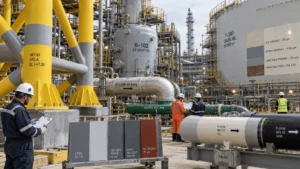
LNG (liquefied natural gas) facilities present a coating challenge that’s genuinely unusual: you need to protect steel in cryogenic service (−162°C for LNG at atmospheric pressure), combined with the aggressive marine or coastal atmospheric environment that most LNG import and export terminals sit in. Add the explosion and fire risk from LNG vapour clouds, and the fireproofing requirement for structural steel becomes non-negotiable.
The coating systems used in LNG facilities are not exotic — they’re mostly familiar industrial coating types. But the selection rationale is specific to this environment, and getting it wrong is expensive to fix in a facility where the consequence of coating failure is not just corrosion but potential process safety risk.
The Three Distinct Coating Challenges in an LNG Terminal
1. External Tank Coating — Marine Atmosphere, CX Environment
The outer surface of LNG storage tanks — typically full-containment or double-containment cryogenic tanks — sits in an aggressive coastal or marine atmosphere. ISO 12944 category is usually CX (extreme), particularly for facilities on or near the coast.
The recommended system for CX atmospheric service on the tank exterior:
- Zinc-rich epoxy primer: 60–75 µm — galvanic protection at any holidays in the film
- Glass flake epoxy intermediate (2 coats): 2 × 150–200 µm — the tortuous diffusion path of the glass flakes significantly outperforms standard epoxy in marine atmosphere
- Polyurethane topcoat: 60–75 µm — UV and weathering resistance; typically white or light colour for heat reflectance
- Total DFT: 420–550 µm
The glass flake epoxy intermediate is worth emphasising here. In CX marine environments, osmotic blistering — driven by chloride ions migrating through the coating film — is the primary failure mode for standard epoxy systems within 5–8 years. Glass flake epoxy at adequate DFT typically achieves 15–20 years in this environment without major maintenance. The cost premium is modest compared to the cost of early recoating on a large cryogenic tank.
For the differences between C5-M and CX classifications and what that means for system selection, see C5-M vs CX — ISO 12944 marine and coastal steel coating guide.
2. Cryogenic Steel — Inner Tank and Cold Service Pipework
The inner steel of a cryogenic LNG tank operates at −162°C. This creates a coating requirement that most people don’t think about initially: most organic coatings become brittle and crack at these temperatures. The thermal contraction of the coating film on cooldown can exceed the coating’s flexibility limit, causing cracking and delamination.
In practice, the inner steel of a full-containment LNG tank is often left uncoated — the 9% nickel steel or stainless steel used for cryogenic inner tanks doesn’t need organic coating protection because it doesn’t rust at cryogenic temperatures. Cathodic protection handles the small amount of ambient-temperature exposure the outer surface sees before commissioning.
For cold service pipework and equipment that operates at low but not cryogenic temperatures (down to around −40°C), modified epoxy systems specifically tested for cold-temperature flexibility are used. The key test is flexibility at the minimum service temperature — the coating film must not crack on thermal cycling from ambient to minimum service temperature.
3. Structural Steel and Pipe Supports — Fireproofing
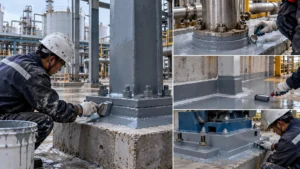
The structural steel in an LNG terminal that supports process equipment, pipe racks, and loading arms is subject to the same fireproofing requirement as refinery structural steel — but the fire scenario is an LNG vapour cloud fire or pool fire, which is a hydrocarbon fire scenario. UL 1709-rated fireproofing is required.
The practical difference from a refinery is that LNG terminals often have higher structural steel exposure to the marine atmosphere during the pre-fireproofing period (construction phase), so the anti-corrosion primer applied before fireproofing needs to be robust for the construction schedule.
💡 For fireproofing system selection in hydrocarbon fire environments, see passive fire protection vs active fire protection. For the difference between UL 1709 and BS 476 testing and when each applies, see fireproof coating standards: UL 1709 vs BS 476 explained.
Storage Tank Exterior: The CX Glass Flake System in Practice
A few practical points that come up when specifying the exterior coating on LNG tanks specifically:
Tank geometry. LNG tanks are large — typically 60,000 to 200,000 m³ capacity — with complex geometry including dome roofs, shell sections, secondary containment walls, and a significant amount of pipework and nozzle connections. Surface preparation on this scale requires careful planning: the tank shell is typically blasted by automated equipment, but dome roofs and nozzle areas require manual blasting. Chloride contamination from the marine atmosphere during the construction phase can be significant — ensure Bresle patch testing is conducted immediately before coating, not just at the start of the blast cycle.
Holiday detection. For the glass flake epoxy system at 300–400 µm DFT, high-voltage DC spark testing (NACE SP0188) is required. On a 200,000 m³ tank this is a substantial inspection task — plan for it in the project schedule.
Colour and heat reflectance. LNG tanks are typically specified with a white or light-coloured topcoat to minimise solar heat gain on the tank exterior, which affects boil-off rate. This is a functional specification, not just aesthetic — confirm the topcoat solar reflectance value with the project’s process engineering team.
Coating for LNG Facility Ancillary Structures
Beyond the tanks themselves, an LNG terminal has a significant amount of ancillary steel — marine jetties and loading arms, pipe bridges, compressor buildings, control rooms, and marine structures including quay walls and mooring dolphins.
Marine jetties and loading structures are Im2 / CX service — seawater splash, wave action, and the continuous marine atmosphere. The coating specification for these structures follows the same logic as offshore splash zone coating: heavy glass flake epoxy in the splash zone (600–1,000 µm), zinc/glass flake/PU system in the atmospheric zone above.
For the splash zone approach in detail — system selection, DFT targets, and application considerations for tidal and splash zone steel — see splash zone coating for offshore structures. For a full breakdown of C5-M vs CX system requirements for coastal and marine steel, see CX marine corrosion protection: ISO 12944 systems.
Inspection and Maintenance
LNG tanks are large assets with 30–50 year design lives. The coating system needs to last, and the maintenance approach needs to be realistic about access constraints.
For the tank exterior, a visual inspection programme during operation, combined with DFT spot checks at defined intervals (typically every 5 years), allows early identification of coating breakdown. The economic analysis usually favours a single high-quality coating system with a 20+ year service life over a lower-cost system requiring early maintenance — because the cost of access, surface preparation, and recoating on a large cryogenic tank is significant regardless of the coating material cost.
For tank interiors, the relevant inspection standard is API 653, which sets out internal inspection intervals based on corrosion rate, tank floor condition, and the presence of cathodic protection. For LNG inner tanks (which are typically uncoated cryogenic steel), the inspection regime focuses on tank integrity rather than coating condition.
For a full pre-service inspection checklist covering DFT measurement, holiday detection, adhesion testing, and cure verification for tank lining projects, see how to inspect a tank lining before service.
Questions From LNG Projects
Do LNG tanks need cathodic protection in addition to coating?
For buried components — tank foundations, underground pipework — yes. Impressed current cathodic protection or sacrificial anodes are standard for buried steel at LNG facilities, working in combination with the anti-corrosion coating. For above-ground tank exteriors, cathodic protection is not typically used — the coating system is the primary protection. For marine jetty structures in seawater, CP is standard alongside the coating system.
What’s the recommended coating for LNG facility pipe racks?
The same C5 three-coat system used for refinery pipe racks: zinc-rich epoxy primer / glass flake epoxy intermediate / polyurethane topcoat, at total DFT 400–500 µm. For pipe racks in areas where fireproofing is also required, the anti-corrosion primer goes on first, followed by the UL 1709-rated fireproofing, followed by a weather seal topcoat if the fireproofing manufacturer recommends one for the exposure environment.
Can standard marine coatings be used on LNG tanks, or do they need something specific?
Standard marine coating systems — zinc/glass flake epoxy/PU, qualified to NORSOK M-501 or ISO 12944 CX — are entirely appropriate for LNG tank exteriors operating in the atmospheric zone. There’s nothing chemically special about an LNG tank exterior compared to any other large steel structure in a marine CX environment. The specifics are in the cryogenic inner tank (usually uncoated) and the cold-service pipework (specialist flexible epoxy). Don’t let ‘LNG’ trigger an over-specification of the standard atmospheric zones.
Coating Supply for LNG Projects
Huili Coating supplies CX-rated marine coating systems, UL 1709 fireproofing, and high-build glass flake epoxy for LNG storage tanks, terminal structures, and jetty infrastructure.
- CX glass flake epoxy systems: NORSOK M-501 qualified, 420–550 µm total DFT
- UL 1709-rated intumescent fireproofing: 60, 90, 120-minute ratings
- Full documentation: TDS, SDS, NORSOK qualification data, ISO 9227 salt spray (4,200hr) test reports
- Export supply experience in LNG project markets: Middle East, Southeast Asia, Australia
Contact us via the project inquiry form for project-specific system recommendations.