Water treatment and desalination facilities have a coating challenge that’s different from most industrial environments: the coatings in contact with drinking water have to be safe, not just durable. A coating that performs perfectly from a corrosion standpoint but leaches compounds that affect taste, odour, or safety is not acceptable. This regulatory dimension — potable water contact compliance — sits alongside the standard industrial corrosion protection requirement and shapes the entire specification.
Desalination plants add a second layer of complexity. The process involves highly concentrated brine, aggressive chemical dosing (chlorine, anti-scalants, acids for cleaning), and high-pressure membranes — each creating distinct coating requirements in different parts of the plant.
The Regulatory Framework: Potable Water Compliance
Any coating in contact with water intended for human consumption must be approved under the applicable drinking water contact regulation for the project’s destination market. The main standards:
- NSF/ANSI 61 (North America): Drinking Water System Components — Health Effects. Widely referenced internationally, even outside North America. Products listed under NSF 61 have been tested for extraction of potentially harmful substances at defined contact conditions.
- WRAS (UK/Commonwealth): Water Regulations Advisory Scheme. Required for products used in contact with drinking water in the UK; commonly specified in Commonwealth markets and internationally.
- KTW / W270 (Germany): German federal guidelines for coating materials in contact with drinking water; referenced in European municipal water projects.
- ACS (France): Attestation de Conformité Sanitaire — French drinking water contact certification.
The key point: a coating that is approved under one scheme is not automatically approved under another. A product with NSF 61 listing is not necessarily WRAS-approved. When specifying for an international project, confirm which regulatory approval is required before selecting products.
💡 Huili Coating’s solvent-free epoxy lining systems are available with NSF 61 and WRAS approval options. Confirm the required approval with your project specification before ordering.
Coating Requirements by Asset Type
Raw Water and Treated Water Storage Tanks — Interior
The interior of steel water storage tanks — whether raw water, settled water, or treated potable water — requires a coating system that is both durable in continuous water immersion and compliant with the applicable potable water standard.
The standard choice is solvent-free (100% solids) epoxy lining, for several reasons: zero VOC content means no solvent residue that could affect taste or water quality; the dense, cross-linked film provides excellent barrier properties; and the product category is well-represented in NSF 61 and WRAS approvals.
| Parameter | Standard Requirement |
| Lining system | Solvent-free epoxy — NSF 61 or WRAS approved |
| Surface preparation | ISO 8501-1 Sa 2½ minimum; Rz 40–70 µm |
| Chloride contamination | ≤ 20 mg/m² before application (Bresle patch, ISO 8502-9) |
| DFT | 250–400 µm (2 coats minimum) |
| Holiday detection | 100% low-voltage wet sponge test (NACE SP0188 Method A) |
| Cure before service | MEK rub test — 50 double rubs, no colour transfer |
| Standard reference | AWWA C210 (USA), BS 6920 (UK) |
For large field-erected tanks, the tank floor and lower shell are the highest-risk areas — water settles there, sediment accumulates, and temperature gradients can drive condensation and corrosion in areas of coating damage. DFT inspection on the floor plate and lower 500mm of the shell warrants particular attention.
Clarifiers, Sedimentation Tanks, and Biological Treatment Tanks
These tanks hold water and sludge at ambient temperatures but may contain elevated levels of chloride, biological acids from treatment processes, or chemical dosing residues. The service conditions are less aggressive than full chemical tanks but more corrosive than clean potable water.
Solvent-free epoxy is again the standard choice. Where biological treatment tanks contain hydrogen sulphide from anaerobic processes, the coating needs to be validated for H₂S resistance — not all standard epoxy systems are. A glass flake epoxy system provides better long-term resistance in this scenario.
Brine Tanks and High-Salinity Process Vessels — Desalination
In a reverse osmosis (RO) desalination plant, the concentrate (brine) side contains water at 2–3× seawater salinity. This is a highly corrosive medium for steel — more aggressive than seawater itself.
Glass flake epoxy is the standard lining choice for brine vessels and concentrate disposal pipework. The glass flake reinforcement dramatically reduces chloride ion diffusion through the film, which is the primary mechanism for osmotic blistering in high-salinity service. At adequate DFT — typically 600–1,000 µm — glass flake epoxy provides reliable protection in full brine immersion. Standard solvent-free epoxy is not adequate for full brine immersion service at these concentrations.
For a more detailed comparison of lining chemistries for aggressive liquid service, see epoxy vs vinyl ester tank lining. For broader tank lining selection logic, including chemical resistance and service temperature, see storage tank lining chemical resistance guide.
Chemical Dosing Tank Linings
Desalination and water treatment plants use a range of dosing chemicals: chlorine/hypochlorite for disinfection, acid (HCl or H₂SO₄) for pH control and membrane cleaning, anti-scalants, and coagulants. Each chemical creates distinct coating requirements.
| Chemical | Concentration | Recommended Lining |
| Sodium hypochlorite (NaOCl) | Up to 15% | Vinyl ester — oxidising; epoxy is attacked |
| Hydrochloric acid (HCl) | Up to 36% | Epoxy novolac or rubber lining |
| Sulphuric acid (H₂SO₄) | Up to 70% | Epoxy novolac or glass flake epoxy |
| Sodium hydroxide (NaOH) | Up to 50% | Epoxy (amine-cured, not polyamide) |
| Coagulants / flocculants | Dilute solutions | Standard solvent-free epoxy |
For hypochlorite tanks specifically — a very common oversight — the oxidising nature of NaOCl attacks standard epoxy resins. Vinyl ester is the correct choice, not standard epoxy. Many premature tank lining failures in water treatment plants are traceable to this misspecification.
For tank lining systems and how to choose the right liner by chemical type and service condition, see tank lining types, materials and how to select the right tank liner. For a practical guide focused on design and materials for aggressive chemical tanks, see chemical tank lining materials design guide.
Structural Steel — Treatment Plant Buildings and Pipe Supports
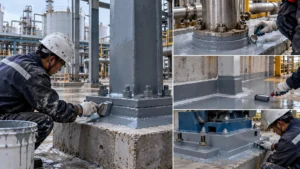
The atmospheric environment in a water treatment plant is typically C3–C4 — the indoor chlorine dosing areas can be more aggressive due to chlorine vapour. The standard three-coat epoxy/polyurethane system is appropriate. For indoor areas with continuous chlorine vapour exposure, a chemical-resistant epoxy topcoat is preferred over polyurethane.
For pipe supports in RO plants that carry seawater or brine, the external corrosion environment is aggressive — specify a C5-rated system with zinc primer. In coastal desalination plants, C5 or even CX specification for exposed structures is appropriate.
Practical Considerations for Water Infrastructure Projects
A few things that come up specifically in water treatment and desalination projects:
Tank pre-commissioning rinse. After lining and curing, water storage tanks are typically filled, held for 24–48 hours, and drained before being put into potable water service. This ‘conditioning’ rinse is required under most drinking water contact regulations. The water from the first rinse is disposed of rather than distributed. Confirm the required conditioning procedure with the regulatory authority before commissioning.
Concrete tank substrates. Not all water tanks are steel — many are reinforced concrete. Coating concrete is a different substrate preparation and application challenge from steel. The surface profile requirement is different (ICRI 310.2 CSP 3–5), moisture content must be below 4% by CM method, and concrete defects (honeycombing, cracks) must be repaired with epoxy mortar before lining. The lining system is typically solvent-free epoxy (NSF 61 or WRAS approved), but the surface prep and application procedure are different from steel.
Inspection access. Large water storage tanks have limited internal access points. Plan the holiday testing and DFT inspection sequence carefully so that all areas can be reached — particularly the tank dome/roof and the floor-to-wall junction.
Questions from Water Treatment Projects
How long should a water tank lining last?
A well-specified and correctly applied solvent-free epoxy lining in potable water service typically achieves 15–20 years before first major maintenance. The primary causes of early failure are: chloride contamination beneath the lining at application (drives osmotic blistering), insufficient DFT, or holidays not detected before service. For brine or chemical service tanks, service life depends on the specific chemical and the lining system selected — glass flake epoxy in brine service typically achieves 12–18 years.
Do we need to stop production to reline a tank?
Yes — tank relining requires the tank to be taken offline, emptied, cleaned, blasted, relined, and cured before being returned to service. The minimum out-of-service time for a standard solvent-free epoxy relining is typically 7–14 days (surface prep + application + 7-day cure at 20°C). For facilities with multiple tanks, scheduling relining during planned outages for one tank at a time maintains continuous operation.
Water Treatment and Desalination Coating Systems from Huili Coating
Huili Coating supplies NSF 61-approved and WRAS-approved epoxy lining systems, glass flake epoxy for brine and chemical tanks, and vinyl ester systems for oxidising chemical service — for water treatment, desalination, and water infrastructure projects worldwide.
- NSF 61 / WRAS-approved solvent-free epoxy: potable water storage tank lining
- Glass flake epoxy: brine tanks, seawater service, desalination concentrate
- Vinyl ester: hypochlorite, nitric acid, oxidising chemical tanks
- C5-rated anti-corrosion systems for plant structural steel
Contact us via the project inquiry form with your tank service conditions for a product recommendation.