A corrosion resistant coating is not a single product — it is a layered system where each coat performs a defined engineering function, and total performance depends on how those layers work together under real service conditions. Specifying “epoxy coating” without defining whether it serves as primer, intermediate build coat, or topcoat is the most consistent route to mismatched products, premature failure at edges and welds, and maintenance costs that exceed the original coating budget several times over.
This guide covers what a corrosion resistant coating system is, how each layer contributes to performance, how to select the right system for steel structures, and what to include in an RFQ to get a technically correct proposal.
For steel structure anti-corrosion coating solutions aligned to specific facility types and exposure conditions, see steel structure coating industrial anti-corrosion solutions.
What Is Anti-Corrosion Coating: Definition and System Logic
A corrosion resistant coating system is a coordinated combination of surface preparation and multiple coating layers — primer, intermediate, and topcoat — designed to protect steel under defined environmental exposure for a specified service life. ISO 12944 defines protective coating systems for steel structures in terms of corrosivity categories and durability expectations, reinforcing that system selection is driven by environment and service life, not by individual product preference.
The word “system” has a specific engineering meaning here: each layer has a role that the other layers do not replicate, and the system fails if any layer underperforms — regardless of how well the other layers are specified or applied. A premium topcoat over an incompatible primer on under-prepared steel will fail before a correctly designed system using standard products.
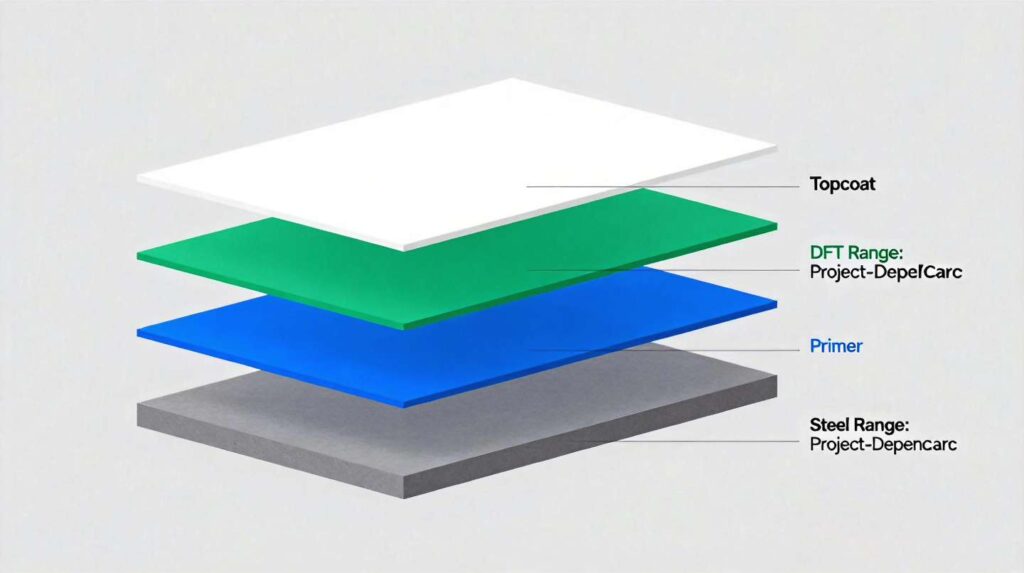
Why engineering projects require systems rather than single products:
-
Corrosion is driven by moisture, oxygen, chloride salts, and pollutants — a single coat rarely delivers sufficient barrier depth and defect tolerance for long service life under combined exposure
-
Different environments (C3 industrial, C4 coastal, C5 offshore) demand different resin chemistry, layer count, and DFT — no single product covers this range
-
Quality control is inherently system-based: surface preparation acceptance, DFT measurement per layer, and recoat window compliance are three separate inspection hold points that cannot be collapsed into a single pass/fail check
Anti-Corrosion Coating Materials: How Each Layer Works
The three-layer architecture — primer, intermediate, topcoat — is the standard structure for industrial corrosion resistant coating systems. Understanding what each layer actually does is the foundation for writing a specification that can be executed and inspected correctly.
Primer Layer: Adhesion and Corrosion Inhibition at the Steel Interface
The primer is the most technically critical layer in the system — it is the only coat in direct contact with the steel substrate, and its performance determines whether corrosion initiates at the interface regardless of how well the layers above it are applied.
-
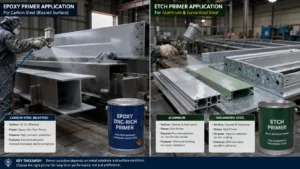
Zinc-rich primer (epoxy or inorganic zinc) provides sacrificial cathodic protection: zinc particles in the dried film corrode preferentially to protect the steel, including at holidays and minor damage points. Required surface preparation: Sa 2.5 minimum per ISO 8501-1. Correct choice for C4–C5 environments and any system where long service life or CP interface compatibility is specified
-
Epoxy primer (non-zinc) provides adhesion and a corrosion-inhibiting barrier without cathodic protection. Suitable for C2–C3 environments and maintenance repainting where full blast is not achievable
For zinc rich coating for steel and the full primer product range matched to corrosivity categories, see the anti-rust primer coatings series.
Intermediate Layer: Building Barrier Thickness
The intermediate coat is where most of the system’s barrier DFT is built. High-build epoxy is the standard intermediate coat for industrial corrosion resistant coating systems — it adds 80–200 µm per coat depending on the formulation, and it is the layer most directly responsible for reducing moisture and ion permeation to the primer/steel interface over the system’s service life.
ISO 12944 links system durability directly to total film build: Low durability (up to 7 years), Medium (7–15 years), and High (15+ years) systems have different minimum DFT requirements under the same corrosivity category. Skipping or reducing the intermediate coat to control cost is the most reliable way to shorten system service life.
Topcoat Layer: Environmental and UV Resistance
The topcoat provides resistance to the specific exposure at the outer surface — UV radiation, weathering, chemical splash, abrasion, or appearance retention — and seals the system against surface-level contaminant entry.
-
Aliphatic polyurethane topcoat: UV-stable, correct for all exterior exposed steel; retains gloss and color under prolonged solar radiation. Standard choice for C3–C5 atmospheric steel structures
-
Fluorocarbon (PVDF/FEVE) topcoat: enhanced UV and chemical resistance for demanding exterior environments or color-critical applications
-
Epoxy topcoat (interior only): standard epoxy resins chalk under UV exposure within 12–24 months — epoxy should not be used as the final coat on steel with outdoor UV exposure
Corrosion Resistant Coating for Mild Steel and Steel Structures: Where It Applies
Steel structures face a defined set of corrosion risk drivers that a correctly designed corrosion resistant coating system must address as a unit. For mild steel and structural steel specifically — the most common substrate in industrial, infrastructure, and energy projects — the coating system carries the full corrosion protection function because the substrate itself offers no inherent corrosion resistance.
Primary corrosion risk drivers for structural steel:
-
Atmospheric moisture and oxygen exposure — the baseline corrosion mechanism in all environments
-
Coastal chloride deposition — accelerates corrosion initiation and underfilm spread significantly in C4–C5-M environments
-
Industrial pollutant exposure — SOx, NOx, and process chemical splash in plant environments
-
Water traps at crevices, bolt joints, sharp edges, and weld toes — geometric features that accumulate moisture and concentrate corrosion risk at exactly the locations with lowest film build
Common steel structure application scenarios for industrial anti-corrosion coatings:
-
Industrial plants, warehouses, and process facilities (C3–C5)
-
Bridges and transportation infrastructure (C3–C4 atmospheric and splash)
-
Power and energy facilities — onshore and offshore-related steel (C4–C5-M)
-
Marine and coastal steelwork and jetty structures (C4–C5-M)
ISO 12944 frames system selection around corrosivity category and required durability — which is precisely why steel structures require a defined system rather than a single product: the environment category and service life target together determine primer type, intermediate DFT, topcoat chemistry, and inspection requirements.
How to Choose the Right Industrial Anti-Corrosion Coatings System
Selecting the right corrosion resistant coating system requires four parameters to be defined in sequence. Engineers who skip or assume any of these parameters produce a specification that looks complete but is not engineered.
Step 1: Define the environment category (ISO 12944-2 corrosivity category)
ISO 12944-2 classifies environments from C1 (very low corrosivity, heated indoor) through C5 (very high, industrial or marine) and CX (offshore/extreme). The corrosivity category drives primer chemistry, total DFT requirement, and topcoat selection. Underestimating the category is the most common cause of systems that appear correctly specified but fail earlier than the design life.
Step 2: Define the durability target (service life)
ISO 12944-5 associates system selection with durability categories: Low (L, up to 7 years), Medium (M, 7–15 years), High (H, more than 15 years). The durability target directly determines the minimum system build — a 15+ year system in C4 requires a different layer count and total DFT than a 7-year system in the same environment.
Step 3: Confirm surface preparation and application constraints
Even a correctly specified corrosion resistant coating system fails if execution is compromised:
-
Surface preparation below the specified blast grade reduces primer adhesion and eliminates cathodic protection function in zinc-rich systems
-
Edges and welds not stripe-coated before full-area spray produce DFT below specification at the highest-risk details
-
Recoat windows missed (minimum or maximum) produce intercoat adhesion failure under thermal cycling or mechanical stress
-
DFT thin spots — most common at edges, complex geometry, and vertical surfaces — initiate corrosion before the rest of the system reaches its design life
Step 4: Match system to execution reality
-
Shop-applied vs. site-applied: shop conditions allow full blast and controlled curing; site application introduces weather, humidity, and access constraints that affect system selection
-
New build vs. maintenance repaint: new build allows Sa 2.5 blast and full system build; maintenance repaint may require surface-tolerant epoxy systems where full blast is not achievable
-
If your contractor can only power-tool clean, specify a maintenance-grade surface-tolerant system rather than writing a blast-clean specification that will not be met on site — a Sa 2.5 spec applied to power-tool cleaned steel delivers neither the adhesion nor the cathodic protection of a correctly prepared system
Common Failures in Corrosion Resistant Coatings and How to Prevent Them
Early rust at edges and welds
Cause: geometric film thinning during spray application produces DFT below specification at sharp details, exactly where stress concentration and corrosion risk are highest.
Prevention: mandatory brush stripe coating at all edges, weld toes, bolt heads, and connections before each full-area spray coat. Inspect and record DFT at high-risk details as a separate hold point.
Blistering in coastal and high-humidity environments
Cause: soluble salt contamination on the steel surface before primer application — osmotic pressure under the film drives blistering as moisture permeates the coating.
Prevention: salt contamination testing (soluble salts ≤ 20 mg/m² for C4–C5 applications) and surface washing before blast or power-tool preparation. Coastal sites require active contamination control throughout the preparation and application sequence.
Intercoat delamination
Cause: recoat window exceeded (maximum interval) leaves the previous coat too cured for the next coat to achieve adequate chemical bond; or surface contamination between coats.
Prevention: track time and temperature between each coat application and compare to TDS recoat window. If the maximum recoat interval is exceeded, light sweep blast or mechanical abrasion plus cleaning is required before the next coat.
Topcoat chalking or UV degradation on exterior steel
Cause: aromatic epoxy specified as the final coat on exterior steel — standard epoxy resins are not UV-stable and degrade visibly within 12–24 months of outdoor exposure.
Prevention: specify aliphatic polyurethane as the topcoat on all exterior steel. If cost is a constraint, a thin aliphatic polyurethane finish coat over an epoxy system is more cost-effective than recoating a fully degraded exterior finish after 18 months.
Anti-Corrosion Coatings Applications: Quality and Inspection Checklist
Use this checklist to reduce coating failure claims and accelerate inspection approvals on industrial projects.
Surface preparation acceptance:
-
Verify oil and grease removal before blast or mechanical preparation
-
Confirm cleanliness grade and surface profile per project specification (blast grade, Rz profile)
-
Soluble salt testing and acceptance on coastal and marine sites — typical limit ≤ 20 mg/m² for C4–C5
-
Document and sign off surface preparation acceptance before primer application begins
DFT control:
-
Measure primer, intermediate coat, and topcoat DFT separately at each inspection stage
-
Record readings by structural member and separately at high-risk areas (edges, welds, bolted connections)
-
Compare to project acceptance criteria — both minimum (corrosion protection) and maximum (cracking risk at high DFT) limits apply
-
High-build epoxy systems are particularly sensitive to over-application at corners and edges: DFT above maximum on a single coat can crack under thermal cycling
Recoat interval control:
-
Record application time, temperature, and humidity for every coat
-
If maximum recoat interval is exceeded: light abrasion sweep plus cleaning is required before the next coat; document the conditioning step
-
Do not rely on visual appearance to judge coat cure — always use elapsed time and temperature relative to TDS values
RFQ Checklist: How to Get a Correct System Proposal
To receive an accurate quotation and a technically correct corrosion resistant coating system recommendation, provide the following in your RFQ:
Project basics:
-
Country/region and facility type (industrial plant, bridge, coastal structure, offshore-related steelwork)
-
Substrate: structural steel grade, new build or maintenance repaint
Exposure and performance:
-
ISO 12944 corrosivity category (C3 / C4 / C5 / C5-M / CX) or environment description (indoor/outdoor/coastal/industrial)
-
Required service life target (years) or ISO 12944-5 durability category (L / M / H)
Execution constraints:
-
Surface preparation method available: abrasive blast / power-tool / spot blast
-
Application method: shop coating / site application
-
Climate constraints: humidity range, temperature range, exposure during application
Technical scope:
-
Primer type required: zinc-rich (cathodic protection) / epoxy primer (barrier)
-
Intermediate coat build requirement: DFT target or request supplier recommendation
-
Topcoat requirement: UV resistance / chemical splash / appearance retention / interior only
-
Total steel area (m²) and structural complexity (edge/weld density)
Documents required from supplier:
-
TDS + SDS for each proposed product
-
Full system recommendation: primer + intermediate + topcoat, with DFT and recoat windows per layer
-
Method statement for surface preparation and application
-
Inspection checklist and DFT acceptance criteria
FAQ
What is the difference between a corrosion resistant coating and a regular epoxy coating?
A corrosion resistant coating is a complete system — primer, intermediate coat, and topcoat — engineered as a unit to protect steel under a defined corrosivity category and service life target. A “regular epoxy coating” describes a single product type (epoxy resin chemistry) that may function as a primer, build coat, or topcoat depending on formulation — but without system context, an epoxy product specification tells you nothing about whether it is fit for the environment or service life required. The distinction matters in RFQs: specifying “epoxy coating” without stating the layer role, DFT target, and corrosivity category causes suppliers to quote non-comparable products.
How does ISO 12944 define corrosivity categories for steel structure coating selection?
ISO 12944-2 classifies environments into six corrosivity categories: C1 (very low, heated indoor), C2 (low, unheated indoor or rural outdoor), C3 (medium, urban/industrial or coastal with low salinity), C4 (high, industrial or coastal with moderate salinity), C5 (very high, industrial with high humidity or offshore marine), and CX (extreme, offshore). Each category is defined by annual mass loss of carbon steel and zinc in standardised test coupons, and ISO 12944-5 links each category to minimum system requirements — primer type, total DFT, and surface preparation standard — for each durability class.
Why do edges and welds fail first in a corrosion resistant coating system?
Edges and welds fail first because spray application produces geometric film thinning at sharp surfaces — the coating film pulls back from edges under surface tension as it cures, leaving DFT at sharp geometry significantly below the target specified for flat surfaces. At the same time, edges and weld toes are stress concentration points where mechanical and thermal loading is highest. The prevention is mandatory stripe coating: brush application of each coat at all edges, weld toes, bolt heads, and connections before full-area spray application. This is not optional on industrial projects — it is the single most effective step for preventing premature corrosion at high-risk details.
What surface preparation is required for a zinc rich coating for steel?
Zinc rich primer requires Sa 2.5 per ISO 8501-1 (near-white blast, equivalent to SSPC-SP10) as the minimum surface preparation. This grade is required because zinc-rich primer relies on direct zinc-to-steel electrical contact to deliver cathodic protection — below Sa 2.5, residual mill scale and corrosion products interrupt this contact and the cathodic protection mechanism does not function. Surface profile should be confirmed against the TDS, typically 40–70 µm Rz. Soluble salt contamination must be within specification limits before application — typically ≤ 20 mg/m² for aggressive environment service.
How do I specify service life in a corrosion resistant coating system?
Service life is specified using the ISO 12944-5 durability categories: Low (L, up to 7 years), Medium (M, 7–15 years), and High (H, more than 15 years). Specifying the durability category, combined with the ISO 12944-2 corrosivity category, produces a defined minimum system requirement — primer type, total DFT, and surface preparation standard — that prevents bidders from substituting lower-performance systems on a cost-per-litre basis. Always define service life as a system performance requirement in the RFQ, not as a product guarantee from a single layer.