If your project needs a compliant fire rating (60/90/120 minutes), the fastest way to avoid delays is to choose a tested fireproof coating system and submit an RFQ with the right technical inputs (standard, steel schedule, exposure, primer). This landing-page guide is written to help buyers quickly understand what to order, what documents to request, and how to get a correct quotation.
This page targets EPC contractors, corrosion engineers, and procurement teams in the Middle East, Southeast Asia, and Central Asia who need manufacturer-level technical support (system recommendation + TDS/SDS + application guidance) rather than generic marketing.

Fireproof coating types & where they fit
Fire-resistant coatings for steel are usually specified as part of passive fire protection (PFP) to delay steel heating and help the structure maintain integrity for the required rating time.
On a landing page, buyers want a simple “selection map”:
Thin-film intumescent coatings: commonly used where aesthetics and lower weight matter (exposed steel, commercial/industrial buildings).
Epoxy intumescent systems / more robust PFP options: often considered for tougher industrial exposures (project-dependent).
Cementitious fireproofing: used in some projects where thickness and weight are acceptable and the spec allows it.
Unique value (manufacturer insight): Most RFQ delays happen because the buyer requests “fireproof paint” but doesn’t state the fire scenario (cellulosic vs hydrocarbon) or whether the steel is interior/exterior, which determines topcoat needs and durability expectations.
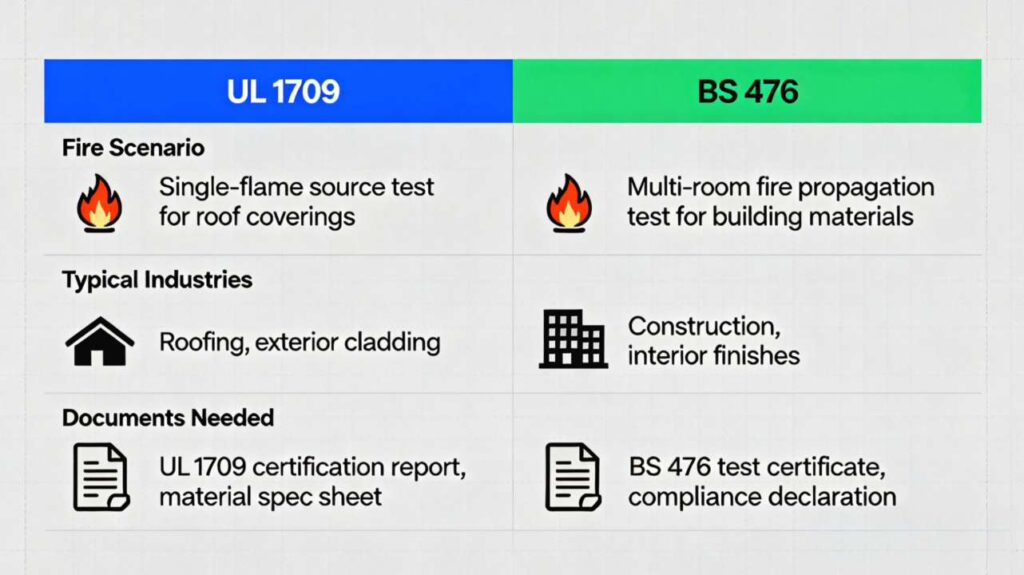
Standards: UL 1709 vs BS 476 (how to choose)
A compliant fireproof coating specification starts with the right standard. Two names often appear in international RFQs:
UL 1709 (hydrocarbon rapid-rise)
Typical for oil & gas / petrochemical / refinery / offshore projects where rapid-rise hydrocarbon fire exposure is considered.
BS 476-20/21 (building fire resistance testing)
Typical for building/infrastructure projects where the specification is written to BS fire resistance methods for loadbearing elements under BS heating conditions.
Landing-page conversion tip: Add a short selector block on the page:
“Which standard do you need?” → UL 1709 / BS 476 / Not sure
Then route users to the RFQ checklist fields below.
UL Solutions – Structural steel fire protection testing and certification:
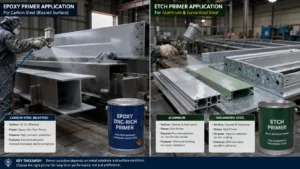
System structure: primer + fireproof layer + topcoat
Fireproof coatings should be treated as systems, not single products. A typical system includes:
Primer (anti-corrosion): corrosion protection + adhesion base
Fireproof layer: intumescent (or other) fire-resistive layer
Topcoat / sealer (when required): environmental protection (humidity, UV, washdown, abrasion)
Unique value (what buyers forget):
In humid Southeast Asia or coastal Middle East sites, skipping a sealer/topcoat often leads to premature degradation.
Primer/topcoat compatibility should be confirmed; “any primer” is not a safe assumption for fireproofing systems.
Go to Anti-Rust & Primer Coatings Series>>>
![Hp/A section factor drives intumescent coating thickness]](https://huilicoating.com/wp-content/uploads/2026/01/hp-a-factor-intumescent-thickness-guide.webp-1024x575.jpg "Fire-Resistant Coating Series (Steel): How to Specify, Buy & Apply 3")
Application & inspection checklist (site-ready)
To improve buyer confidence and reduce disputes, include a short, practical checklist that reflects real site execution.
Pre-application checks
Confirm surface preparation method (new steel vs maintenance repaint).
Confirm primer cure status and recoat window.
Confirm jobsite conditions (humidity / condensation risk).
Confirm approved system layers (primer + fireproof + topcoat).
During application
Apply in controlled passes (avoid sagging/mud-cracking at higher builds).
Measure WFT/DFT and record batch + mixing data (2K systems).
Stripe-coat edges/welds as needed for coverage consistency.
After application
Confirm final DFT acceptance vs project requirement.
Confirm topcoat/sealer application if exposure requires it.
Record inspection results for handover documentation.
Common failures & troubleshooting (reduce rework risk)
This section improves E‑E‑A‑T because it shows real-world understanding, not generic rewriting.
Delamination from primer
Causes: incompatible primer, contamination, exceeded recoat window, over-aged primer without conditioning.
Fix: confirm system compatibility; clean/condition primer (e.g., sweep blast) before applying fireproof layer.
Cracking / mud-cracking
Causes: excessive build per coat, poor curing conditions.
Fix: multi-pass application; follow product guidance for temperature/humidity limits.
Premature exterior degradation
Causes: missing or incompatible topcoat; insufficient sealing for humid/outdoor exposure.
Fix: specify approved sealer/topcoat for the environment; do not treat topcoat as optional when exposure is harsh.
RFQ Checklist (fast quote template)
Copy-paste this into your RFQ email or inquiry form to get a fast, accurate proposal.
Fire requirement
Standard: UL 1709 or BS 476-20/21
Rating time: 60 / 90 / 120 minutes
Fire scenario: hydrocarbon rapid-rise or building (cellulosic)
Steel data
Steel schedule (beam/column sizes + quantities)
Hp/A section factor (if available) or drawings
Exposure & durability
Interior dry / semi-exposed / exterior
Humidity, coastal salt, UV level
Topcoat required? (yes/no/unsure)
Coating system expectations
Primer type (or existing primer details) + primer DFT range
Any required corrosion protection system constraints
Color/finish requirements (if architecturally exposed)
Deliverables needed
Quote + consumption estimate
TDS + SDS
System recommendation (primer + fireproof + topcoat)
Application & inspection guidance
Contact Us
We would love to speak with you.
Feel free to reach out using the below details.