Choosing a fireproof coating for steel is not only about product type (intumescent vs cementitious) or price—it’s about specifying the right test standard for the fire scenario. The two names that commonly appear in international RFQs are UL 1709 (hydrocarbon pool fire exposure) and BS 476 (building “cellulosic” fire exposure), and confusing them can lead to incorrect system design or failed approvals.
![UL 1709 hydrocarbon fire curve vs cellulosic fire curve comparison]](https://huilicoating.com/wp-content/uploads/2026/01/ul1709-vs-cellulosic-fire-curves.webp-1024x575.jpg "Fireproof Coating Standards: UL 1709 vs. BS 476 Explained 1")
1) First decide the fire scenario: hydrocarbon vs cellulosic
Fire test standards are built around different fuel sources and fire growth rates. Broadly:
Cellulosic fire (building contents like wood/paper/plastics): slower temperature rise and is used by many building fire test standards.
Hydrocarbon pool fire (refineries, petrochemical plants, offshore): much faster and more severe temperature rise in the first minutes.
A common specification mistake is using a building-style rating for an oil & gas structure, where a hydrocarbon pool fire standard is expected.
2) What UL 1709 measures (and why it matters in oil & gas)
UL 1709 is specifically intended for evaluating protection materials for structural steel exposed to hydrocarbon pool fire conditions with rapid temperature rise.
Industry explanations note UL 1709 reaches roughly 1,093°C within 5 minutes and then stays near that level, creating severe thermal shock that demands engineered passive fire protection systems.
UL 1709-based testing and certification are commonly referenced in petrochemical and offshore contexts because the exposure is designed to represent high-intensity hydrocarbon fires rather than standard building fires.
3) What BS 476 measures (typical building fire exposure)
BS 476-21 describes procedures for determining fire resistance of loadbearing elements (beams, columns, floors, roofs, walls) when subjected to the heating and pressure conditions specified in BS 476-20.
In other words, BS 476 is typically associated with building construction fire resistance evaluation under a standard (cellulosic) fire exposure curve, not hydrocarbon pool fire.
This is why BS 476 is frequently used in civil/infrastructure and building-type steelwork projects, while UL 1709 appears more often in oil, gas, and petrochemical RFQs
4) Quick comparison: UL 1709 vs BS 476 (what changes in your spec)
Exposure severity
UL 1709: rapid-rise, high-intensity hydrocarbon fire exposure (pool fire scenario).
BS 476 (cellulosic): standard building fire exposure conditions defined by BS 476-20/21.
What it changes in practice
System thickness and design tables: Hydrocarbon exposure generally drives thicker or more robust passive fire protection designs than cellulosic exposure for the same time rating.
Approved system requirement: Fireproof coatings are usually approved as complete systems (primer + fireproof layer + topcoat where needed), and approvals depend on the tested standard.
5) How to choose the right standard (fast decision rules)
Use these rules before you write the RFQ:
Choose UL 1709 when:
The project is oil & gas / petrochemical / refinery / LNG / offshore, and hydrocarbon pool fire exposure is a realistic scenario.
The owner’s PFP philosophy references hydrocarbon pool fire protection and rapid-rise exposure.
Choose BS 476 when:
The structure is within building/infrastructure contexts where standard building fire resistance is required and the project spec calls BS 476-20/21.
Local authority approval pathways are tied to BS fire resistance testing of loadbearing building elements.
If the spec is unclear, do not guess—ask the EPC/owner whether the scenario is cellulosic or hydrocarbon and confirm the required listing/certification route.
Where intumescent coatings fit into both standards
Intumescent coatings can be designed and tested for different fire exposures, but the acceptance depends on the standard used and the approved system configuration.
Because of this, engineers should not treat “intumescent paint” as a single generic product; it is selected as part of a tested system for the required standard and rating.
7) Specification must include primer/topcoat compatibility
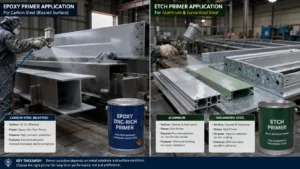
Fireproofing systems often require compatible and approved primers/topcoats; guidance emphasizes that using non-approved primers/topcoats can affect system performance and durability.
This is especially important in humid or semi-exposed environments, where a compatible topcoat may be required to protect the fireproof layer from moisture and damage.
Go to Anti-Rust & Primer Coatings Series>>>
Go to Polyurethane Anti-Corrosion Coatings>>>
8) RFQ Checklist (to get a compliant proposal + quote)
To quote a compliant system for UL 1709 or BS 476, provide:
Project country/region and facility type (building vs refinery/offshore).
Required standard: UL 1709 (hydrocarbon) or BS 476-20/21 (cellulosic).
Fire rating target: 60/90/120 minutes (or project-required duration).
Steel member schedule (beam/column sizes) and section factor data if available.
Exposure classification: interior dry / semi-exposed / exterior; humidity and UV conditions.
Coating system expectation: primer type, whether topcoat is required, and any corrosion protection requirement.
Required documentation: TDS/SDS, system approval/listing evidence, and application/inspection procedure.
Next step: request a standards-matched system recommendation
If your project is oil & gas or offshore, do not specify a building fire standard by default; confirm whether UL 1709 hydrocarbon exposure is required and select a tested, approved system accordingly. UL and industry guidance highlight UL 1709’s rapid-rise hydrocarbon exposure and its widespread use for hydrocarbon fire protection of structural steel.
Contact Us
We would love to speak with you.
Feel free to reach out using the below details.