Steel structures in industrial facilities face simultaneous attack from corrosion, UV exposure, moisture, thermal cycling, and chemical contamination — a single-product approach to protection fails in almost every industrial service environment. Building a correct anti-corrosion coating for steel structures means designing a multi-layer system where each coat performs a defined function, and where the system is matched to the actual service environment before any product is selected.
This guide is written for project engineers, EPC contractors, and procurement teams in the Middle East, Southeast Asia, and Central Asia who need to move from “which paint” to a defensible, inspectable coating system specification.
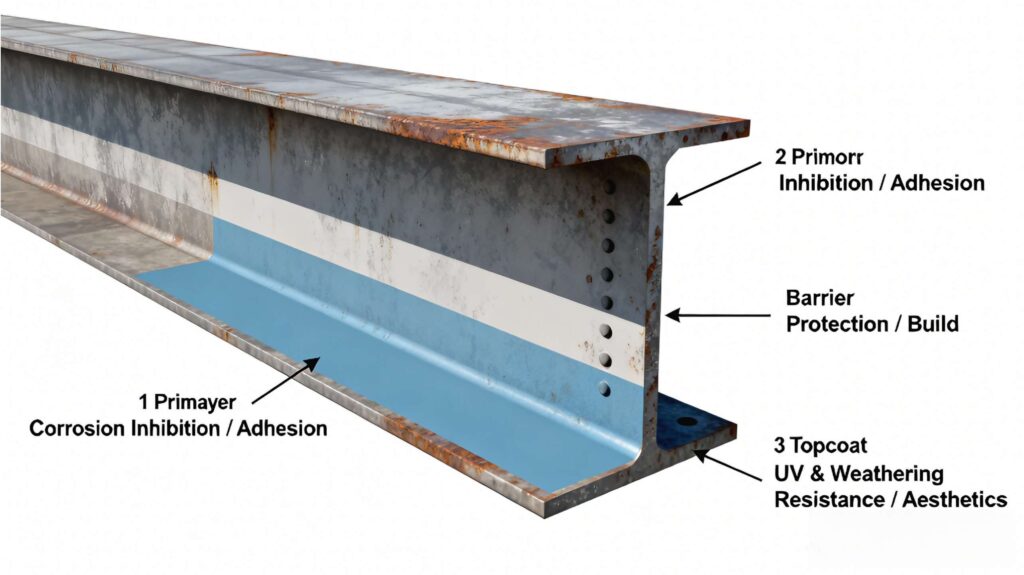
What a Steel Structure Coating System Includes
A steel structure coating system is a multi-layer protection design — not a single product — where each layer contributes a specific engineering function to the total system performance. For steel structure coating industrial anti-corrosion solutions, the standard three-layer architecture covers the majority of industrial service conditions:
-
Primer coat: adhesion to the prepared steel surface + initial corrosion inhibition — the foundation layer that determines whether the rest of the system stays bonded
-
Intermediate coat: film thickness build + barrier performance — the workhorse layer that controls permeability and mechanical durability
-
Topcoat: UV and weathering resistance + color and gloss retention + final environmental sealing — the layer that faces the service environment directly
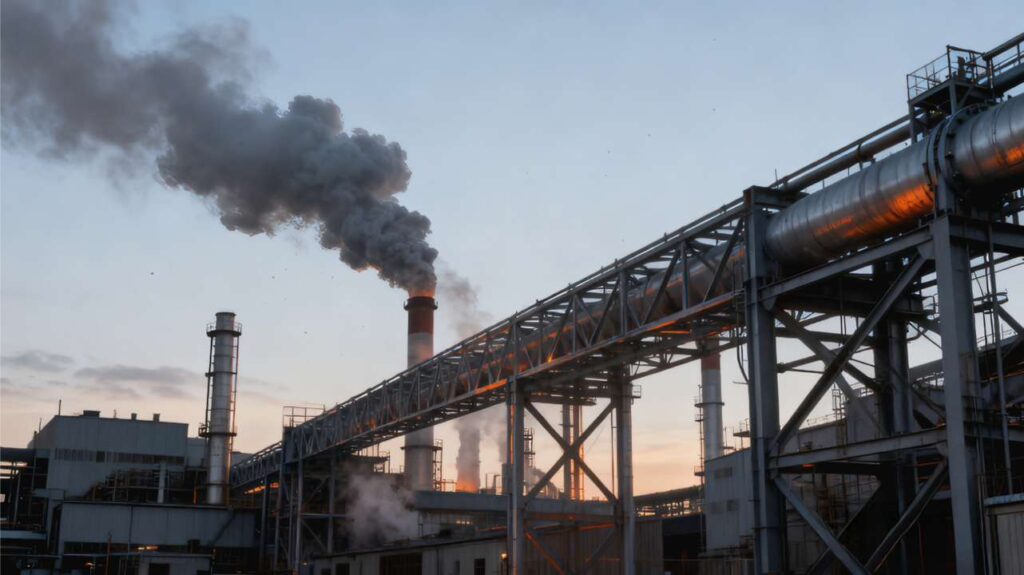
In aggressive environments — coastal industrial zones, offshore-influenced sites, chemical plants — the system architecture and layer compatibility are more important than any individual product name. A premium topcoat applied over an incompatible primer on inadequate surface preparation will fail before a correctly designed system using standard products.
Define the Service Environment Before Selecting Products
The service environment determines resin type, layer count, DFT targets, and maintenance cycle — specifying products before locking the environment is the most common steel structure coating specification error. Use this checklist to define the exposure profile before issuing any RFQ:
The corrosivity category per ISO 12944-2 is the most useful single output from this exercise — C3 (medium), C4 (high), and C5 (very high) each correspond to different system thickness requirements and primer selection logic, and using this classification aligns EPC, applicator, and inspector on the same baseline.
Category: Coating Systems & Solutions
SEO Title: Anti-Corrosion Coating for Steel: System Design Guide
URL Slug: steel-structure-coating-system-industrial-anti-corrosion
Meta Description: Anti-corrosion coating for steel structures: primer, intermediate & topcoat system design. ISO 12944 C3–C5, DFT ranges, zinc-rich primer options & RFQ checklist.
Primary Keyword: anti corrosion coating for steel
Secondary Keywords: steel coating system, structural steel coating, 3 coat paint system steel, industrial anti-corrosion coatings, anti corrosion coating materials, protective coating system
LSI and Semantic Terms: zinc-rich primer, epoxy intermediate coat, polyurethane topcoat, dry film thickness, surface preparation, ISO 12944, corrosivity category, coating system design, anti-rust primer, recoat interval, film build, coating system selection, weathering resistance, sacrificial protection
Insert Image Description: A structural steel pipe rack at an outdoor industrial facility showing three visible coating layers being applied — a zinc-rich primer on blast-cleaned steel members, an epoxy intermediate coat at mid-stage, and a grey polyurethane topcoat on completed sections — with an applicator using airless spray equipment under natural daylight.
Insert Image Filename: anti-corrosion-coating-steel-structure-three-coat-system.webp
Insert Image Alt Text: Three-coat anti-corrosion coating system on structural steel pipe rack showing zinc-rich primer, epoxy intermediate, and polyurethane topcoat application
Image Note: Showing all three system layers at different stages of application on a real pipe rack makes the coat sequence immediately clear — it reinforces the article’s core message that a steel structure coating system is a multi-layer engineering decision, not a single product choice.
Steel Structure Coating System: How to Build an Industrial Anti-Corrosion Paint System
Steel structures in industrial facilities face simultaneous attack from corrosion, UV exposure, moisture, thermal cycling, and chemical contamination — a single-product approach to protection fails in almost every industrial service environment. Building a correct anti-corrosion coating for steel structures means designing a multi-layer system where each coat performs a defined function, and where the system is matched to the actual service environment before any product is selected.
This guide is written for project engineers, EPC contractors, and procurement teams in the Middle East, Southeast Asia, and Central Asia who need to move from “which paint” to a defensible, inspectable coating system specification.
What a Steel Structure Coating System Includes
A steel structure coating system is a multi-layer protection design — not a single product — where each layer contributes a specific engineering function to the total system performance. For steel structure coating industrial anti-corrosion solutions, the standard three-layer architecture covers the majority of industrial service conditions:
-
Primer coat: adhesion to the prepared steel surface + initial corrosion inhibition — the foundation layer that determines whether the rest of the system stays bonded
-
Intermediate coat: film thickness build + barrier performance — the workhorse layer that controls permeability and mechanical durability
-
Topcoat: UV and weathering resistance + color and gloss retention + final environmental sealing — the layer that faces the service environment directly
In aggressive environments — coastal industrial zones, offshore-influenced sites, chemical plants — the system architecture and layer compatibility are more important than any individual product name. A premium topcoat applied over an incompatible primer on inadequate surface preparation will fail before a correctly designed system using standard products.
Define the Service Environment Before Selecting Products
The service environment determines resin type, layer count, DFT targets, and maintenance cycle — specifying products before locking the environment is the most common steel structure coating specification error. Use this checklist to define the exposure profile before issuing any RFQ:
The corrosivity category per ISO 12944-2 is the most useful single output from this exercise — C3 (medium), C4 (high), and C5 (very high) each correspond to different system thickness requirements and primer selection logic, and using this classification aligns EPC, applicator, and inspector on the same baseline.
Surface Preparation: Where Coating Systems Succeed or Fail
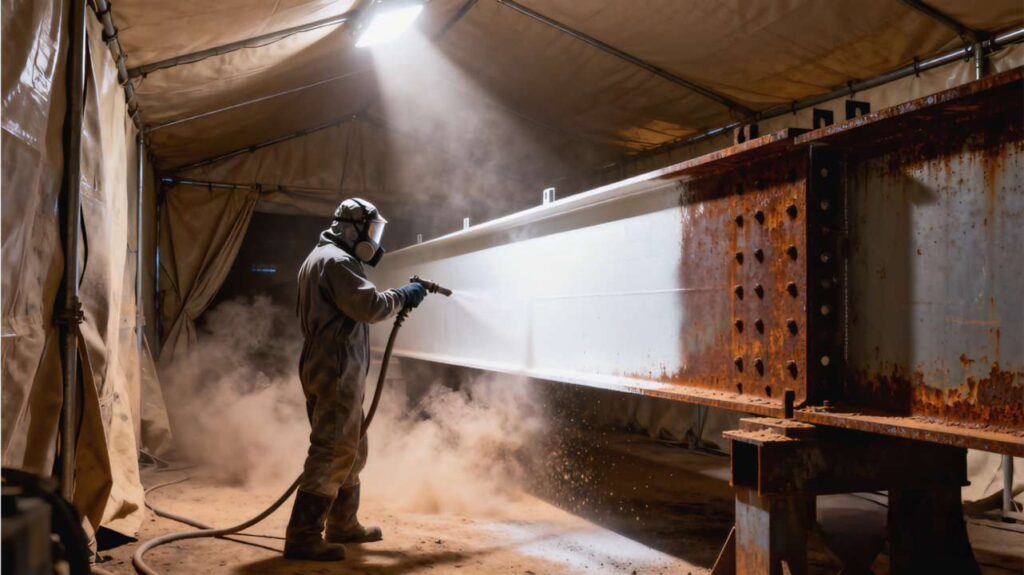
Surface preparation failure is the root cause of the majority of premature anti-corrosion coating failures on steel structures — even the most correctly specified protective coating system fails if the substrate condition does not meet the primer’s requirements. Surface preparation must be written into the coating specification alongside the product selection, not treated as a separate or optional scope item.
Practical surface preparation rules for steel structure coating systems:
-
Remove oil and grease first — solvent cleaning or detergent wash before any abrasive work, per ISO 8504-1; oil contamination under abrasive blast cannot be removed by blasting alone
-
New steel fabrication: abrasive blasting to Sa 2½ per ISO 8501-1 is the standard baseline for industrial anti-corrosion coatings in C3 and above environments — surface profile typically 40–70 µm Rz confirmed against the primer TDS
-
Maintenance repainting: define explicitly whether the scope is spot repairs, full blast, or power-tool cleaning — primer selection depends on the achievable preparation level, and not all primers are surface-tolerant
Epoxy Zinc Rich Primer and Other Primer Options for Steel
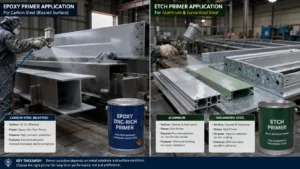
The primer is the most critical layer in any anti-corrosion coating for steel — it must bond to the prepared substrate, inhibit corrosion at the steel interface, and remain compatible with the intermediate coat under service conditions. Primer selection is driven by steel condition, preparation level, required corrosion resistance, and application constraints. The anti-rust primer coatings series covers the main primer families used in industrial steel structure coating systems:
Epoxy Zinc Rich Primer
Epoxy zinc rich primer provides sacrificial cathodic protection — zinc particles in the film corrode preferentially to protect the steel substrate, making it the preferred primer choice for industrial and coastal steel structures in C4–C5 environments. Epoxy zinc rich primer requires blast-cleaned steel (Sa 2½ minimum) to achieve the metal-to-metal contact needed for sacrificial protection — it does not perform correctly over inadequately prepared surfaces.
Anti-Rust Epoxy Primer
Anti-rust epoxy primers provide strong adhesion and a corrosion-inhibiting barrier layer without the zinc content — correct for general fabrication, less aggressive exposure conditions (C2–C3), and maintenance repainting scopes where full blast is not achievable and a surface-tolerant formulation is required.
Anti-Rust Primer — Standard Grade
Standard anti-rust primers are appropriate for indoor, sheltered, or low-corrosivity (C1–C2) steel structures where cost-effective protection with predictable application behaviour is the primary requirement. Not recommended for coastal, offshore-influenced, or chemical-exposure environments without additional barrier layers.
Build the Intermediate Coat: Barrier and Thickness Control
The intermediate coat is the barrier layer of the steel coating system — it builds total DFT, reduces film permeability, and bridges the mechanical and chemical performance gap between primer and topcoat. In most industrial anti-corrosion coatings for steel, epoxy-based intermediate coats are the standard choice because they build durable barrier layers with strong intercoat adhesion in both shop and site application conditions.
Key specification parameters for the intermediate coat:
-
DFT contribution: typically 60–100 µm per coat for standard epoxy intermediates; high-build formulations can achieve 100–150 µm per coat
-
Recoat interval: confirm minimum and maximum overcoat time from the TDS — exceeded recoat window is a leading cause of intercoat adhesion failure on site
-
Surface condition before application: dust removal and contamination check are mandatory hold points before applying the intermediate over the primer
Select the Topcoat for UV, Weathering, and Final Performance
The topcoat is the layer that directly faces the service environment — UV radiation, rain, thermal cycling, chemical splash, and mechanical abrasion all act on the topcoat first. For outdoor structural steel, topcoat selection is primarily driven by UV stability and long-term color and gloss retention requirements.
Aliphatic polyurethane topcoat is the standard choice for outdoor steel structures in industrial environments — it provides UV stability, color retention, and chemical splash resistance that epoxy finishes cannot maintain under direct sunlight. Aromatic polyurethane and epoxy topcoats chalk and fade within 12–24 months of outdoor UV exposure and are not acceptable as final coats for exterior steel in C3 and above environments.
Specialist topcoat selection is required when chemical splash, high temperature, or specific exposure conditions exist — topcoat chemistry must match the specific risk, not just the general “outdoor” category.
For polyurethane topcoat options matched to different corrosivity categories and industrial service conditions, see the polyurethane anti-corrosion coatings product range.
Recommended Anti-Corrosion Coating System Templates
Use these as engineering starting points — always validate the final system against the project environment, applicable corrosivity category, and each product’s TDS before specifying:
A 3 coat paint system for steel — zinc-rich primer, epoxy intermediate, and polyurethane topcoat — is the most widely specified configuration for outdoor industrial steel in C4–C5 environments because it combines sacrificial protection, barrier performance, and UV durability in a single compatible system.
Quality Control Checklist for Steel Coating Inspection
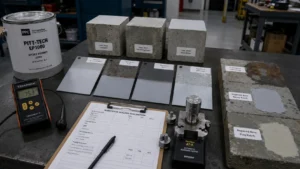
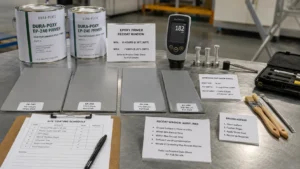
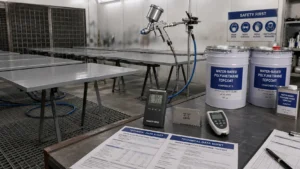
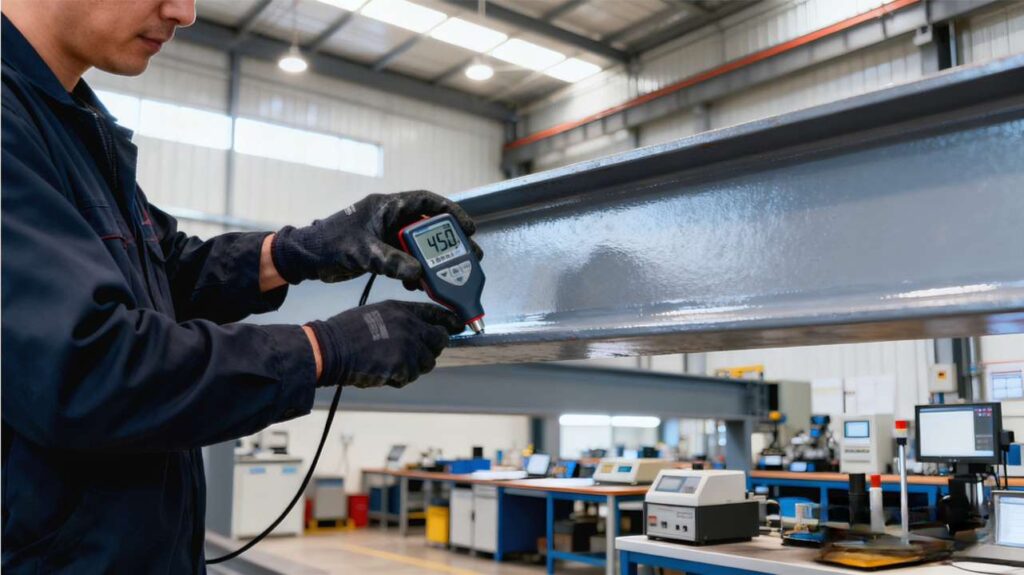
A correctly designed industrial anti-corrosion coating system can still fail if application QC is not documented and enforced at each stage. These are the mandatory QC hold points for structural steel coating inspection:
-
Ambient conditions: temperature, relative humidity, and dew point check before and during application — coating over steel near dew point is a leading cause of early adhesion failure
-
Surface cleanliness and profile: blast standard verification (ISO 8501-1) and surface profile measurement (ISO 8503) before primer application
-
Wet film thickness (WFT): checked during application using a WFT comb to control build rate and predict DFT
-
Dry film thickness (DFT): measured after cure using a calibrated magnetic gauge — recorded by zone and attached to the handover package
-
Adhesion testing: pull-off adhesion test per ISO 4624 when required by the project specification or when adhesion is in dispute
-
Holiday and pinhole testing: required for immersion-service barriers and critical coating zones where defect-free film is specified
Anti Corrosion Coating Services: RFQ Checklist
To receive a steel structure coating system recommendation, product TDS package, and accurate quotation, provide the following project data:
-
Project country and region: Middle East / Southeast Asia / Central Asia — corrosivity profile and humidity data
-
Structure type: pipe rack, tank support, platform, building frame, conveyor structure, module skid
-
Exposure conditions: coastal distance, chemical fumes, condensation frequency, industrial fallout
-
Surface preparation method: blast standard planned, maintenance repaint constraints, and whether shop or site application
-
Application method: airless spray, brush/roller, shop-applied or site-applied
-
Required durability or maintenance interval: design life target and acceptable maintenance cycle
-
Color, finish, and documentation requirements: RAL color, gloss level, TDS, SDS, COA, system recommendation letter
FAQ
What is the correct primer for structural steel in a C4 coastal environment?
Epoxy zinc rich primer is the correct baseline primer for structural steel in C4 coastal environments — the sacrificial zinc content provides cathodic protection at holidays and damaged areas, which is critical when salt-laden moisture is present. Epoxy zinc rich primer requires Sa 2½ blast preparation to achieve the zinc-to-steel contact needed for sacrificial protection; applying it over inadequately prepared surfaces eliminates the cathodic protection mechanism and reduces it to a standard barrier primer with lower corrosion resistance than its specification suggests.
How many coats does a steel structure coating system need for outdoor industrial service?
A three-coat system — anti-corrosion primer, epoxy intermediate coat, and polyurethane topcoat — is the standard minimum for outdoor industrial steel in C3–C4 environments with a 10+ year design life target. Two-coat systems (primer + topcoat only) are acceptable for C2–C3 environments with accessible maintenance, but omitting the intermediate coat in C4 and above reduces total DFT below the barrier threshold needed for long service life without unplanned maintenance.
Why does epoxy topcoat chalk on outdoor steel structures?
Epoxy topcoats chalk on outdoor steel because the aromatic amine cross-linking chemistry in standard epoxy resins degrades under UV radiation — the surface layer oxidises and forms a white powder within 12–24 months of direct sunlight exposure. Chalking does not mean the epoxy has failed as a barrier, but it indicates the surface layer is no longer protective, and continued UV exposure eventually breaks down the full film. Specify aliphatic polyurethane as the topcoat for any outdoor steel structure with direct UV exposure — confirm “aliphatic” in the product TDS chemistry section before accepting substitutions.
What surface preparation standard is required for anti-corrosion coating for steel?
Sa 2½ per ISO 8501-1 is the minimum required surface preparation for anti-corrosion coating systems on steel in C3 and above environments. Sa 2 is acceptable only for surface-tolerant maintenance primers in controlled conditions. St 3 power-tool cleaning is a maintenance repaint option only when blast cleaning is not achievable — it does not provide the surface profile or cleanliness level required for zinc-rich primers or high-performance epoxy systems.
How do you specify total DFT for a steel structure coating system?
Specify total DFT as a system target with individual coat ranges — not as a single number for the whole system. A typical specification format: epoxy zinc rich primer 50–75 µm DFT + high-build epoxy intermediate 80–120 µm DFT + polyurethane topcoat 40–60 µm DFT = total system 170–255 µm DFT. State minimum individual readings, minimum zone averages, and maximum permitted readings, and define the repair and retest workflow for out-of-specification readings before application begins.