
Are your storage tanks failing from the inside out, or are they degrading under harsh weather conditions? When specifying protective systems, treating the inside the same as the outside is a recipe for disaster. I see it all the time in the field: applying the wrong specification leads to catastrophic leaks, contaminated products, or premature recoating.
The fundamental difference in tank internal vs external coating design comes down to the environment. We are comparing the brutal reality of constant liquid immersion against the relentless assault of atmospheric exposure.
The Internal Lining: Constant Immersion
Inside the tank, the coating system (properly referred to as a “lining”) faces a non-stop battle. It must survive 24/7 contact with the stored product without breaking down.
- Constant Immersion: The lining is continuously submerged, leaving zero room for barrier failure.
- Hydrostatic Pressure Resistance: The sheer weight and volume of the liquid continuously force molecules deep into any microscopic pores in the coating film.
- Chemical Attack: Aggressive chemicals, high-temperature liquids, and solvents constantly attempt to break down the polymer chains of the resin binder.
- Purity Requirements: The lining cannot leach contaminants into the product. This is why a high-purity immersion grade epoxy lining is critical for maintaining the integrity of everything from crude oil to drinking water.
The External Coating: Atmospheric Exposure
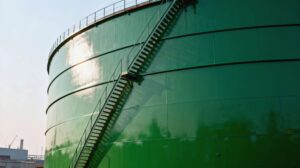
Outside the tank, the threat profile shifts entirely. The external coating battles the weather and the surrounding industrial environment rather than the stored product.
- Weathering & UV Radiation: Constant sun exposure destroys the chemical bonds of standard epoxies. To prevent chalking and degradation, we rely on a UV stable polyurethane topcoat.
- Atmospheric Corrosivity: Depending on your site’s specific atmospheric corrosion categories (C1-C5), the exterior must deflect relentless attacks from salt spray, industrial chemical gases, and high humidity.
- Aesthetics & Safety Color-Coding: The exterior serves a visual purpose. It must maintain its gloss and color retention for branding, while also adhering strictly to OSHA or international safety color-coding standards.
System Comparison
| Threat Vector | Internal Lining | External Coating |
|---|---|---|
| Primary Exposure | Constant liquid immersion | Atmospheric elements (sun, rain, salt) |
| Mechanical Stress | Hydrostatic pressure resistance | Thermal expansion/contraction |
| Chemical Threat | Stored product (acids, solvents, water) | Airborne pollutants, salt air |
| Key Requirement | Chemical resistance & purity | UV stability & corrosion resistance |
Internal Lining: System Design & Performance Requirements
When we analyze tank internal vs external coating strategies, the internal lining is where the stakes are highest. Unlike external paint, which battles the weather, the internal lining is in a constant state of immersion. This requires a completely different engineering approach focused on absolute impermeability and chemical compatibility.
The “Zero-Defect” Standard
In our industry, we operate under a “zero-defect” policy for internal linings. Because the coating is constantly submerged in media—whether it’s oil, wastewater, or aggressive chemicals—even a microscopic pinhole or “holiday” is fatal.
If the barrier is breached, the stored liquid will immediately attack the substrate. This leads to:
- Rapid under-film corrosion: The steel rots from the inside out.
- Product contamination: Dissolved coating or rust ruins the purity of the stored media.
- Catastrophic leakage: Environmental hazards and costly shutdowns.
Key Material Technologies
To meet these rigorous demands, we rely on specialized Chemical-Resistant Epoxy Lining Systems. These are not your standard paints; they are engineered barriers designed to withstand complex chemical attacks.
- High-Build Epoxies: We often utilize solvent-free or high-solids epoxy formulations. These allow us to apply a thick, dense film in fewer coats, reducing the risk of solvent entrapment and ensuring a solid barrier against the liquid payload.
- Chemical-Resistant Resins: For tanks storing aggressive acids, alkalis, or solvents, standard epoxies fail. We specify systems with enhanced cross-linking density to resist swelling or softening when exposed to harsh chemicals.
Critical Performance Metrics
Selecting the right lining isn’t just about picking a color; it’s about matching the tank internal vs external coating specs to the operational reality.
| Metric | Why It Matters |
|---|---|
| Chemical Resistance | The lining must be inert to the specific media (fuel, water, acid) to prevent softening or dissolving. |
| Adhesion Strength | The coating must bond aggressively to the substrate to resist hydrostatic pressure and blistering. |
| Abrasion Resistance | Critical for tanks containing slurries or wastewater where suspended solids act like sandpaper. |
| Curing Time | Fast-curing systems are essential to minimize facility downtime and get the asset back in service quickly. |
Our focus is always on preserving structural integrity and extending asset service life. A properly designed internal system prevents the costly nightmare of premature tank failure.
Tank Internal vs External Coating: External System Design
When we evaluate tank internal vs external coating systems, the exterior demands a highly specialized approach. While the inside handles constant immersion, the outside battles the elements. I always implement a multi-layer defense strategy to protect assets against harsh atmospheric corrosion categories (C1-C5) worldwide.
The Multi-Layer Defense Strategy
A single layer simply won’t survive the weather. We use a proven three-coat system to build an impenetrable barrier against the environment.
| Defense Layer | Coating Technology | Primary Function |
|---|---|---|
| Base Coat | Zinc-rich primer application | Acts as a sacrificial layer, stopping rust and corrosion at the steel surface. |
| Intermediate Coat | Epoxy intermediate resin | Builds necessary thickness and creates a dense, waterproof barrier. |
| Topcoat | UV stable polyurethane topcoat (or polysiloxane) | Seals the system, providing long-term resistance to sun damage, weathering, and chalking. |
External Key Performance Metrics
To guarantee long-term asset protection, the external coating must excel in a few specific areas. Accurate Dry Film Thickness (DFT) measurement is strictly enforced at every application stage to ensure these performance standards are met.
- UV Stability: The outer layer must resist degrading, chalking, or fading under intense and constant sunlight exposure.
- Thermal Flexibility: Steel tanks constantly expand and contract with temperature shifts. The external coating system must remain flexible enough to move with the steel without cracking or flaking.
- Sharp Edge Retention: Coatings naturally pull away from sharp corners during the curing process. We require formulations that maintain full protective thickness on hard angles, nuts, and welds to prevent premature spot failures.
SSPC Surface Preparation Standards
I always tell my team and clients that the most advanced coating systems will completely fail if the surface isn’t prepped correctly. When we look at tank internal vs external coating, the foundation of success entirely depends on getting the bare steel ready. The rules change depending on which side of the tank we are working on.
Immersion Grade Epoxy Lining Prep
For the inside of the tank, the environment is brutal. Because the lining faces constant liquid exposure, we enforce much stricter standards.
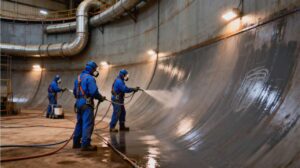
- White Metal Blast Cleaning: We require SSPC-SP 5 / NACE No. 1 for all internal immersion service.
- The Goal: Every square inch of the steel must be completely free of all visible oil, grease, dirt, dust, mill scale, rust, and old paint. This zero-defect standard guarantees the immersion grade epoxy lining bonds flawlessly to the steel.
External Coating Surface Prep
The outside of the tank fights weather and UV rays, not constant liquid pressure, so the prep standards shift slightly.
- Commercial or Near-White Metal Blast: We typically specify SSPC-SP 6 or SP 10 for external surfaces.
- The Goal: This level of blasting removes enough surface contaminants to give the primer a solid grip, providing heavy-duty atmospheric defense without the extreme cost of a white metal blast.
Dry Film Thickness (DFT) Measurement
Cleaning the steel is only half the job; creating the right texture is the other half. We have to match the physical roughness of the steel—the anchor profile—to the specific coating we are applying.
- Profile Depth: The anchor profile created by the blasting abrasive must match the target Dry Film Thickness (DFT) measurement.
- Mechanical Adhesion: If the steel’s jagged peaks are too high, the coating won’t cover them, leading to immediate pinpoint rust. If the profile is too shallow, the heavy industrial coating simply won’t stick, causing massive delamination down the line.
Tank Internal vs External Coating: Common Failures & Prevention
Understanding exactly how a system fails is how we build a resilient one. When I manage tank internal vs external coating projects, we have to look at completely different sets of risks.
Internal Failures: The High Stakes of Immersion
Inside the tank, the coating is constantly under attack. If the application isn’t perfect, the system breaks down fast.
- Osmotic Blistering: This happens when trapped contaminants pull moisture straight through the coating. Absolute cleanliness during surface prep is our only method for reliable osmotic blistering prevention.
- Cathodic Disbondment: We always verify cathodic protection compatibility. If the electrical current meant to stop corrosion actually ends up peeling the lining away, the system fails.
- Chemical Softening: If you don’t match the specific immersion grade epoxy lining to the stored chemical, the fluid will eventually eat right through it.
External Failures: Weather and UV Damage
Outside the tank, the environment dictates the wear and tear.
- Chalking: Heavy sun damage degrades the resin over time. Applying a tough UV stable polyurethane topcoat is how we prevent this chalky residue.
- Thermal Stress Cracking: Tanks expand and contract with temperature swings. If the coating system is too brittle, it will crack and expose the steel beneath.
- Under-Film Corrosion: This usually points to a weak foundation right before the zinc-rich primer application. Once moisture gets under the film, the rust spreads unseen.
Inspection Protocols: Catching Defects Early
We prevent these disasters through rigorous, environment-specific testing.
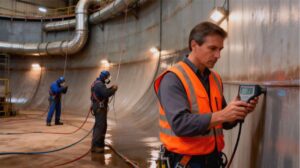
- Inside the Tank: We rely heavily on Holiday detection (Spark testing). We run a high-voltage brush over the surface to expose microscopic, invisible pinholes. For internal linings, we operate on a strict “zero-defect” standard.
- Outside the Tank: We enforce strict Dry Film Thickness (DFT) measurement and detailed visual checks to guarantee the exterior shell is fully sealed against the local climate.
Selecting Your Tank Internal vs External Coating System
When I evaluate a project, picking the right setup means looking closely at both sides of the steel. We rely on a strict consultation process to match the materials to your exact risks.
Environmental & Chemical Analysis
We don’t do guesswork. We break down two main factors before starting any job:
- The Micro-Climate: We assess your exact location, looking closely at atmospheric corrosion categories (C1-C5) to determine the weather resistance needed for the shell.
- The Chemical DNA: We analyze exactly what you are storing. This tells us if we need a heavy-duty chemical resistant tank coating or a safe potable water tank lining (NSF 61) for the inside.
Tailoring Custom Solutions
Off-the-shelf products usually fail in industrial settings. We build a custom strategy to handle your specific stressors:
- Temperature & pH Stress: We tailor the specific resin system to survive extreme heat swings and harsh acidic or alkaline environments.
- System Synergy: We make sure your immersion grade epoxy lining is fully integrated, maintaining strict cathodic protection compatibility to stop corrosion at the source.
Getting the tank internal vs external coating choice right during this stage is the only way to prevent rapid failures and keep your operations running smoothly.

 Chinese