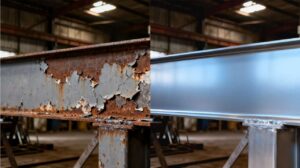
Surface preparation for industrial coatings determines coating performance before a single product is applied — industry data consistently shows that surface preparation accounts for approximately 60–70% of total coating system performance. Applying a high-performance epoxy to a poorly prepared substrate produces premature delamination and osmotic blistering regardless of product quality, because the failure is at the interface, not in the coating film itself.
For EPC contractors and asset owners in the Middle East and Southeast Asia, where high humidity and salinity accelerate corrosion, understanding the difference between preparation grades is not academic — a coating system applied over Sa 2.5 prepared steel can outlast a comparable system on Sa 2 prepared steel by a factor of 3–5 times under the same service conditions.
Quick Reference:
- Match the ISO 8501-1 or SSPC grade to the specific environment and coating system — do not default to the cheapest achievable standard
- Verify the abrasive blasting profile (anchor pattern) against the primer TDS requirements to prevent peak topping at high profiles
- Conduct Bresle salt tests per ISO 8502-6 — soluble salt limits are typically 20–50 mg/m² depending on project specification
- Keep substrate temperature at least 3°C above dew point during all preparation and application phases
Why Surface Preparation Determines Coating Adhesion and Durability
The importance of surface preparation for industrial coatings comes down to two simultaneous engineering requirements: creating a chemically clean surface and establishing a mechanical anchor profile that allows the primer to lock into the steel substrate.
Mechanical anchor pattern: abrasive blasting creates a microscopic peak-and-valley topography on the steel surface. This profile increases the effective contact area between primer and steel, allowing the coating to mechanically interlock with the substrate rather than relying on adhesion alone. Typical industrial blast profiles range from 50–100 µm depending on total system thickness and primer specification.
Surface energy: correct cleaning increases the surface energy of the steel, allowing the liquid primer to wet out completely and penetrate the profile. Contaminated or oxidised surfaces have lower surface energy — the primer beads rather than wets, producing weak adhesion and thin spots at the profile peaks.
Contaminant removal: residual chloride salts trapped under a coating draw moisture through the film by osmosis, building hydrostatic pressure that causes rapid blistering and spiderweb corrosion underneath the film. This failure mechanism operates continuously from the moment the coating is applied — it cannot be stopped by recoating over contaminated steel.
Industrial Coating Blast Cleaning: Main Surface Preparation Methods
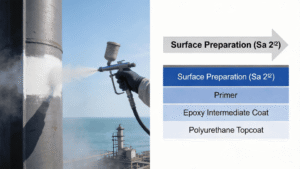
Industrial coating blast cleaning is the primary surface preparation method for heavy-duty steel assets — it is the only method that simultaneously achieves the required cleanliness level and creates a controlled anchor profile. The three methods used in industrial projects each have defined applications and limitations:
Abrasive Blasting
Abrasive blasting — using dry grit, steel shot, or vapor blast equipment — is the benchmark method for new steel fabrication and major maintenance recoating. It achieves the full range of ISO 8501-1 cleanliness grades from Sa 1 through Sa 3, and produces a measurable, consistent surface profile in the 50–100 µm range required by high-performance coating systems. Industrial coating blast cleaning in confined spaces requires controlled ventilation, dust extraction, and abrasive recovery planning — omitting these controls produces surface contamination from recycled abrasive that defeats the preparation work.
Power Tool Cleaning
Power tool cleaning — using needle guns, angle grinders, or MBX bristle blasters — is used for maintenance scopes where blasting is prohibited due to spark risk, restricted access, or proximity to operating equipment. MBX and similar impact tools can achieve near-white cleanliness appearances, but they do not produce a consistent anchor profile comparable to blast cleaning. Power tool cleaning limits the primer selection to surface-tolerant systems specifically formulated for lower-prep substrates.
Chemical Cleaning and Degreasing
Chemical degreasing per SSPC-SP1 is the mandatory first step before any mechanical preparation — abrasive blasting does not remove oil and grease, it embeds them deeper into the steel surface or spreads them across the blast area. Solvent cleaning, detergent wash, or alkaline degreasing must be completed and verified before blasting begins. Skipping this step is one of the most consistent routes to fish-eye defects and adhesion failure in the final coating system.
ISO 8501 Surface Preparation Standards Explained
ISO 8501-1 is the most widely used visual cleanliness standard for international industrial coating projects — it provides defined photographic references for each grade that align EPC, applicator, and inspector on the same acceptance criteria without subjective interpretation.
| Visual Grade | Description | Recommended Application |
|---|---|---|
| Sa 1 | Light blast-cleaning; loose scale and loose rust removed | Short-term protection; low-corrosivity environments (C1–C2) |
| Sa 2 | Thorough blast-cleaning; most mill scale removed | Standard industrial primers; moderate exposure (C3) |
| Sa 2.5 | Very thorough; only slight stains remain at 95%+ clean | High-performance systems; marine, offshore, and C4–C5 environments |
| Sa 3 | Blast-cleaning to visually clean steel; 100% clean | Chemical tank linings; extreme immersion; zero-failure-tolerance applications |
Sa 2.5 is the correct minimum standard for most industrial anti-corrosion coating systems in C3 and above environments — specifying Sa 2 for a system designed for Sa 2.5 reduces coating adhesion and service life without a corresponding cost saving, because the coating failure cost far exceeds the preparation cost difference.
SSPC Surface Preparation Standards (SP Series)
For projects following American engineering specifications, the SSPC-SP standards published by AMPP (Association for Materials Protection and Performance) are the benchmark. The SP series has direct functional equivalence to ISO 8501-1 grades, though the terminology differs — using both references in a project specification avoids disputes when contractors are familiar with only one system:
- SSPC-SP2 / SP3: Hand and power tool cleaning — removes loose material only; equivalent to Sa 1 range; acceptable only for low-corrosivity maintenance
- SSPC-SP6 (Commercial Blast): Equivalent to approximately Sa 2; suitable for moderate corrosivity environments with compatible primer systems
- SSPC-SP10 (Near-White Blast): Equivalent to Sa 2.5; the standard for bridge, infrastructure, and industrial anti-corrosion coating applications requiring long service life
- SSPC-SP5 (White Metal Blast): Equivalent to Sa 3; the highest cleanliness level, specified where zero failure is tolerated — chemical immersion, offshore splash zones, and critical structural elements
Industrial Coating Inspection: Surface Profile and Testing Requirements
Industrial coating inspection goes beyond visual assessment — true quality assurance requires measurable, documented data at each preparation stage before any coating is applied.
Surface profile measurement: use Testex Press-O-Film replica tape or a digital profilometer to verify the Rz surface roughness value against the primer TDS requirement. If the profile is too shallow (below the primer minimum), the mechanical anchor is insufficient and the coating may peel under stress. If the profile is too deep (above the primer maximum), the peaks protrude through the primer film and create pinpoint rust initiation sites — this is called peak topping and is a direct cause of early corrosion at the primer-steel interface.
Soluble salt testing (Bresle method): in coastal and offshore environments across Southeast Asia and the Middle East, chloride salts are the primary driver of osmotic blistering under coating films. Conduct Bresle patch tests per ISO 8502-6 before primer application — project specifications typically set limits of 20–50 mg/m² soluble salts, with offshore and immersion service specifications often requiring ≤ 20 mg/m². Exceeding this limit requires re-washing the blast-cleaned surface before proceeding.
Dust testing: blast-generated dust that is invisible to the naked eye acts as a bond-breaker between primer and steel. Conduct tape adhesion dust tests per ISO 8502-3 and verify the dust quantity and particle size rating are within the project specification before coating application.
Dew point control: measure and record substrate temperature and dew point before and during application. The substrate must remain at least 3°C above the dew point throughout preparation and coating — condensation on blast-cleaned steel produces flash rust within minutes in humid environments, which invalidates the preparation work and requires reblasting.
How to Select Surface Preparation Based on Project Environment
Surface preparation standard selection is driven by the service environment and the coating system requirements — specifying the lowest achievable standard without checking the coating system requirements is a common cause of coating failure at the first inspection:
Heavy industrial (refineries, power plants, petrochemical): Sa 2.5 with a surface profile of 60–85 µm is the standard baseline to support thick-film epoxy systems in C4–C5 environments. Salt contamination control is mandatory before blasting.
Marine and offshore: Sa 2.5 is the minimum; Sa 3 is preferred for splash zones and continuously immersed surfaces. High-pressure water jetting (WJ-2 per SSPC-SP WJ-2) is increasingly used in maintenance scopes to remove soluble salts effectively without creating new abrasive contamination.
Maintenance repainting with access or spark restrictions: SSPC-SP3 or MBX power tool cleaning is the practical limit. In these conditions, surface-tolerant epoxy systems from the epoxy anti-corrosion coating series must be specified — standard epoxy primers do not achieve adequate adhesion over power-tool-cleaned surfaces.
Common Surface Preparation Mistakes and Coating Failure Analysis
Industrial coating failure analysis consistently traces premature failures back to surface preparation errors — these are the five most frequent failure drivers identified in field inspection:
Flash rust from delayed primer application: blast-cleaned steel begins to oxidise within minutes in high-humidity environments. Epoxy primer over flash rust produces adhesion failure at the steel interface — the primer bonds to the oxide layer, not the steel. Apply primer within the maximum hold time specified in the TDS, or reblast if flash rust is visible before application.
Salt entrapment from blasting over contaminated steel: blasting over salt-laden steel without prior washing distributes and embeds chlorides across the entire blasted surface. The subsequent coating traps these salts, which then drive osmotic blistering from the first hours of service.
Profile mismatch (peak topping): specifying a coarse grit that produces a 120 µm profile for a primer designed for a 50–75 µm maximum creates uncoated or under-coated peaks across the entire surface. Pinpoint rust initiates at these peaks within months of service.
Oil contamination from skipped degreasing: applying abrasive blast over oiled steel without SSPC-SP1 degreasing first embeds oil into the blast profile. Fish-eye defects and adhesion loss follow — the failure appears as a product quality issue but is a preparation process failure.
Recoat interval violations: applying the next coat outside the minimum or maximum overcoat window produces intercoat adhesion failure independent of surface preparation quality. Record and enforce recoat intervals at each stage as a mandatory inspection hold point.
For a structured root cause framework for coating failures in industrial service, see industrial coating failure causes, fixes, and prevention.
Epoxy Zinc Rich Primer and Coating System Selection by Prep Level
The achievable preparation level determines which coating systems are technically viable — not all systems perform correctly on all preparation levels, and specifying a high-performance system without confirming the preparation standard is achievable produces guaranteed early failure:
| Achievable Prep Level | Compatible Primer Type | Recommended System |
|---|---|---|
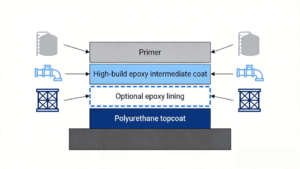
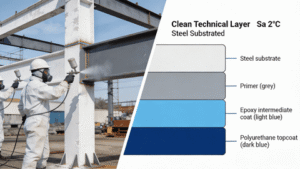
| Sa 3 / Sa 2.5 (blast) | Inorganic zinc silicate or epoxy zinc rich primer | Zinc-rich primer + high-build epoxy intermediate + polyurethane topcoat |
| Sa 2.5 (blast) | Epoxy zinc rich primer or high-build epoxy | Epoxy primer + epoxy intermediate + UV-stable topcoat |
| Sa 2 (blast) | Standard epoxy primer | Epoxy primer + epoxy intermediate + topcoat for moderate environments |
| SSPC-SP3 (power tool) | Surface-tolerant epoxy mastic | Surface-tolerant mastic primer + compatible topcoat for maintenance |
Surface prep for epoxy primer: epoxy zinc rich primers require Sa 2.5 minimum to achieve the zinc-to-steel electrical contact needed for sacrificial cathodic protection. Applying zinc-rich primer over Sa 2 or power-tool-cleaned surfaces eliminates the cathodic protection mechanism — the system then performs only as a standard barrier primer without the zinc protection benefit.
For system selection matched to your specific preparation level and service environment, request a technical recommendation from huilicoating.com.
Industrial Coating Inspection Services: RFQ Checklist
When requesting a coating system recommendation or project quotation, provide the following surface preparation and project data to enable a technically accurate system specification:
- Current substrate condition: new fabricated steel, pitted or corroded steel, or existing old coating status
- Achievable preparation level: can the scope achieve Sa 2.5 blast, or is only power-tool cleaning (SSPC-SP3) practical?
- Environmental zone: ISO 12944-2 corrosivity category (C3 urban industrial / C4 high industrial / C5 very high / CX extreme)
- Required service life: 10–15 years standard industrial or 20+ years long-term with defined maintenance intervals
- Testing capabilities on site: Bresle salt test kits, surface profile gauges, dew point meters, and DFT gauges available or to be supplied
- Application constraints: confined space, spark-sensitive zones, shutdown window, and ventilation availability
FAQ
What is the minimum surface preparation standard for industrial coating systems?
Sa 2.5 per ISO 8501-1 (equivalent to SSPC-SP10 Near-White Blast) is the minimum required surface preparation for high-performance industrial coating systems in C3 and above corrosivity environments. Sa 2 is acceptable only for standard industrial primers in moderate C3 conditions with accessible maintenance access. For immersion service — tank linings, submerged structures, and splash zones — Sa 3 (SSPC-SP5) is required to eliminate all surface contamination that could initiate blistering under continuous liquid contact.
How do you test for soluble salts before industrial coating application?
Soluble salt testing uses the Bresle patch method per ISO 8502-6 — a flexible adhesive patch is applied to the blast-cleaned steel surface, distilled water is injected and recovered, and the conductivity of the recovered water is measured to calculate chloride concentration in mg/m². Most industrial coating specifications require ≤ 50 mg/m² for atmospheric service and ≤ 20 mg/m² for immersion and offshore service. If the result exceeds the limit, the surface must be pressure-washed with fresh water and re-tested before primer application proceeds.
What causes epoxy primer to fail over flash rust?
Epoxy primer applied over flash rust bonds to the iron oxide layer rather than to the steel substrate — the adhesion is to a weak, friable oxide film, not to the base metal. Under service loading, moisture, or thermal cycling, the oxide layer delaminates from the steel and pulls the entire coating system with it. Flash rust forms within minutes on blast-cleaned steel in humid conditions (RH above 85%) — the solution is to apply primer within the TDS-specified maximum hold time after blasting, or to reblast if visible rust reddening appears before application begins.
What surface profile is required for zinc-rich primer on structural steel?
Epoxy zinc rich primer typically requires a surface profile of 40–75 µm Rz — confirm the specific range against the primer TDS before specifying the blast grit. Too shallow a profile (below 40 µm) reduces mechanical adhesion; too deep a profile (above 75–100 µm) causes peak topping where profile peaks protrude through the primer DFT and create exposed steel initiation points for corrosion. The abrasive type and size must be selected to achieve the profile range specified in the primer TDS, not a generic “industrial blast” specification.
How long can blast-cleaned steel be left before primer application?
The maximum hold time between blast cleaning and primer application depends on humidity and ambient temperature — in high-humidity environments (RH above 80%), visible flash rust can appear on blast-cleaned steel within 30–60 minutes. Most coating specifications define a maximum hold time of 4 hours in controlled shop conditions and 2 hours or less on site in tropical or coastal environments. If the hold time is exceeded or flash rust is visible, the affected areas must be reblasted to the original cleanliness standard before primer application — partial reblasting of a previously primed area requires feathering the repair margins and stripe-coating the transitions.