For engineers and procurement teams in the Middle East, Southeast Asia, and Central Asia, selecting the right epoxy primer and polyurethane topcoat system is a direct project risk decision — not just a product choice. This guide covers system selection logic, surface preparation requirements, DFT guidance, and common failure modes so you can move from specification to procurement with confidence.
When This System Is the Right Choice
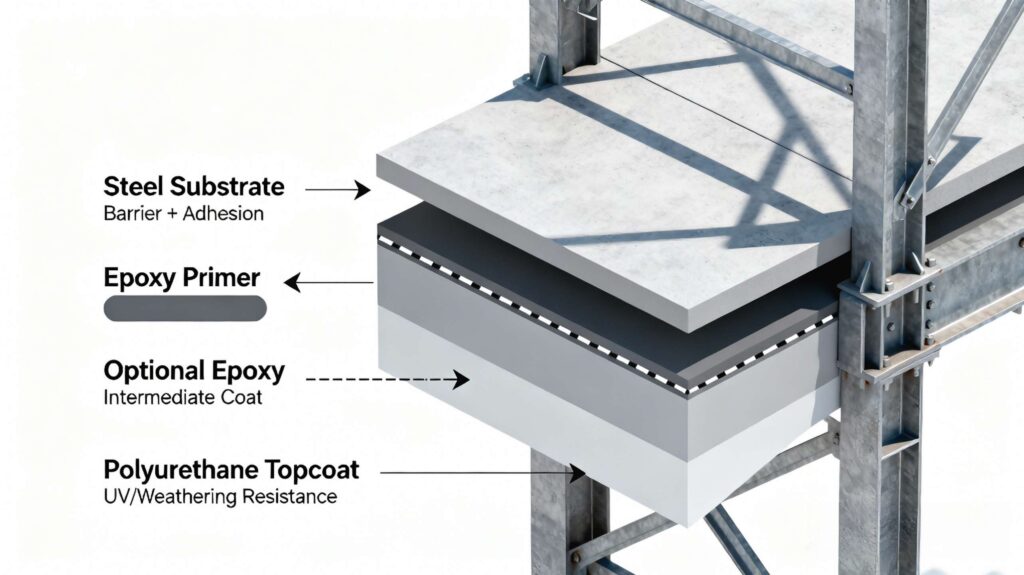
An epoxy primer + polyurethane topcoat system is the correct baseline when you need strong adhesion and corrosion resistance at the substrate layer combined with UV and weathering durability at the exposure face. The epoxy primer bonds to the steel and provides cathodic-grade corrosion resistance, while the aliphatic polyurethane topcoat resists UV degradation, color fade, and chalk formation that would occur with an epoxy finish in direct sunlight.
This two-coat system is appropriate for moderate corrosivity environments classified as C3 to C4 per ISO 12944-2, where the structure faces UV, humidity, rain, and periodic industrial fallout but is not in continuous splash or chemical immersion service.
When a Two-Coat System Is Not Enough
A standard two-coat epoxy primer + polyurethane topcoat is insufficient when the structure is in C5 or CX corrosivity conditions — severe coastal zones, offshore splash zones, or chemical-laden industrial atmospheres — without an additional high-build epoxy intermediate coat. In those conditions, relying on primer film alone for barrier thickness leads to osmotic blistering and underfilm corrosion within 3–7 years, regardless of topcoat performance.
Define Exposure Before Selecting Products
The exposure profile determines topcoat UV grade, total system DFT, and maintenance interval — specifying products before writing down the environment is the most common project specification error we see.
The harsher the UV and the higher the humidity, the more critical it is to specify a UV-stable aliphatic polyurethane topcoat and confirm minimum DFT is achievable on edges, welds, and complex geometry.
Surface Preparation: The Most Underspecified Step
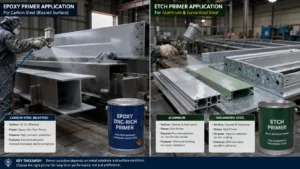
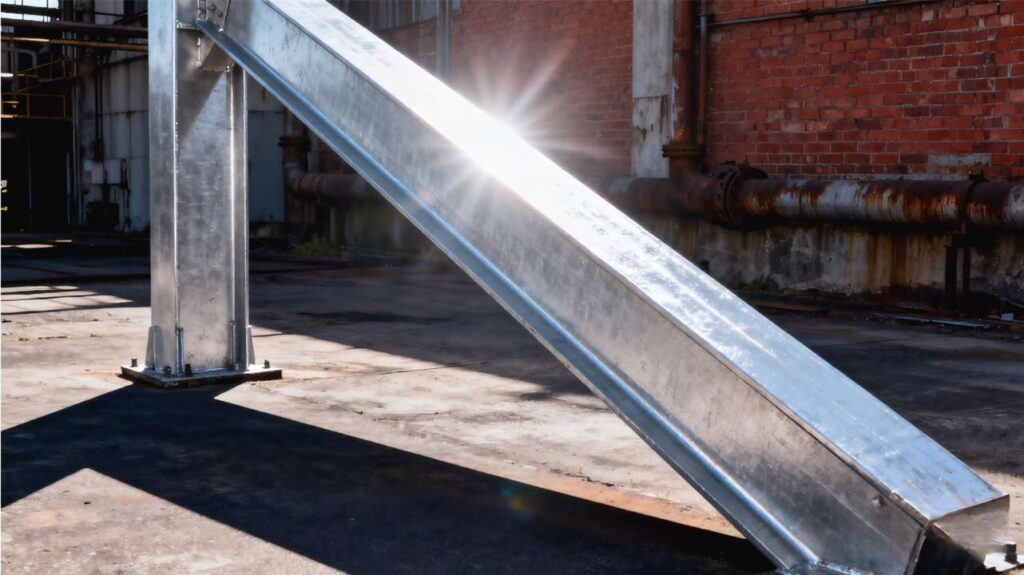
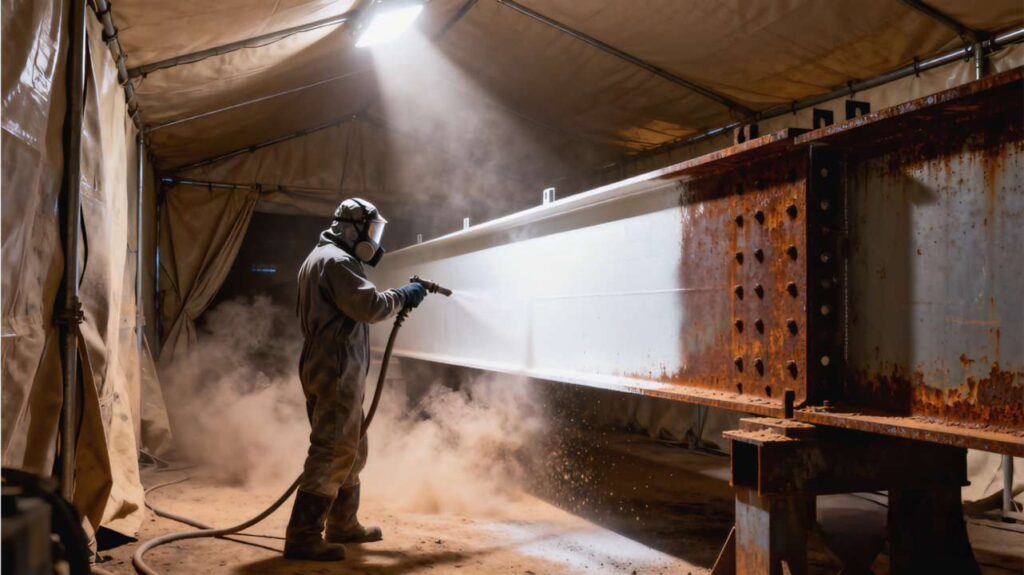
Surface preparation failure is the root cause behind the majority of early coating system breakdowns — insufficient prep on steel surfaces leads to adhesion loss, underfilm corrosion, and edge rusting regardless of which primer or topcoat brand is applied. For epoxy primers on carbon steel, the minimum preparation standard should be Sa 2½ per ISO 8501-1 for new fabrication or full blast maintenance repaints in C4+ environments.
Your specification or RFQ must state:
-
Cleaning sequence: solvent or detergent wash before abrasive blasting to remove oil and grease (ISO 8504-1 requirement)
-
Substrate condition: new steel, previously coated steel, or maintenance repaint with partial coating breakdown
-
Profile requirement: surface anchor profile typically 40–70 µm Rz for most epoxy primers — confirm against product TDS
-
Permitted repair scope: whether spot preparation is accepted or full strip-back is required for maintenance projects
Select the Right Epoxy Primer
The epoxy primer provides adhesion to the steel substrate and forms the corrosion-resistant base layer of the system — it is not interchangeable between project types. Selection must be driven by substrate type, application environment, and required recoat window.
Key Specification Parameters for Your RFQ
Include these in every epoxy primer inquiry to get an accurate, comparable response:
-
Substrate type: carbon steel / galvanized steel / previously coated steel
-
Application method: airless spray (shop) or brush/roller (site)
-
Pot life at site temperature: critical in Middle East summer — pot life at 40°C can be 30–50% shorter than at 23°C
-
Recoat window: minimum and maximum overcoat time must match the project schedule; exceeded recoat window is a leading cause of inter-coat adhesion failure
-
Required DFT per coat: typically 50–80 µm DFT for a single-coat epoxy primer, confirmed by TDS
When to Specify a 2K (Two-Component) Epoxy Primer
A 2K epoxy primer — mixed from a base and hardener component — is required for all C3 and above environments. Single-component primers do not provide adequate cross-link density for industrial corrosion protection on outdoor steel. Always specify the mixing ratio (by volume or weight) and confirm with the product TDS before application.
When to Add a High Build Epoxy Primer as Intermediate Coat
Adding a high-build epoxy intermediate coat increases the total barrier thickness of the system and is the most cost-effective way to extend design life without upgrading the primer or topcoat grade.
Specify an epoxy intermediate coat when:
-
The structure is within 1 km of a coastline or in a facility with continuous humidity above 85% RH
-
The steel has significant welds, bolted connections, and edges where film build is inherently lower
-
The target design life is above 10 years with minimal maintenance access
-
The project specification references ISO 12944 C4 or C5 corrosivity categories
A typical high-build epoxy intermediate in a 3-coat system contributes 80–150 µm DFT, bringing total system build to 200–300 µm — range confirmed against TDS and project spec.
Choose the Right Polyurethane Top Coat for Outdoor Steel
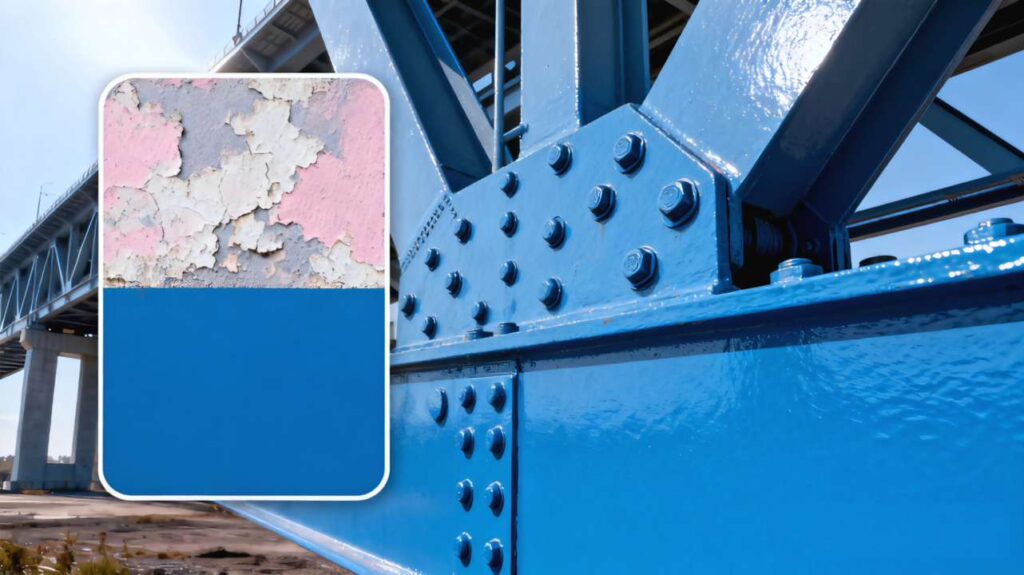
For outdoor steel, the polyurethane topcoat is the layer that directly faces UV radiation, rain, thermal cycling, and mechanical abrasion — selecting a non-UV-stable topcoat on outdoor steel is the single most common cause of premature chalking and color fade complaints in tropical and desert climates. Aliphatic polyurethane is required for full outdoor UV exposure; aromatic polyurethane is not suitable as a final coat in direct sunlight because its chemical structure degrades under UV and chalks within 12–24 months.
Topcoat Selection Checklist
DFT System Targets by Exposure Level
Use these as system design starting points — always confirm final DFT and coat sequence against the specific product TDS and project corrosivity classification:
Common Failure Modes and How to Prevent Them
Edge and weld rusting within 12–24 months is caused by insufficient film build on sharp geometry — steel edges concentrate stress and thin the wet film during application. Prevention requires specifying a stripe coat on all edges and welds before the full coat, and confirming edge rounding (≥ R2 mm) during fabrication.
Inter-coat delamination between epoxy primer and polyurethane topcoat occurs when the recoat window has been exceeded or when surface contamination (dust, salt, moisture) settled on the primer before topcoat application. Specify maximum recoat interval clearly and require surface cleanliness check (ISO 8502-3 dust tape test) before applying the topcoat.
Chalking and gloss loss within 2–3 years is almost always the result of applying an aromatic or semi-aromatic polyurethane outdoors — confirm the TDS chemistry section states “aliphatic” before accepting product substitutions on UV-exposed structures.
RFQ Checklist: Project Data to Send for a System Recommendation
To receive an accurate system recommendation and product TDS package, send the following data via the project inquiry form:
-
Country / region and facility type (refinery, power plant, building frame, conveyor structure)
-
Structure description: pipe rack, platform, building steel frame, conveyor support, module skid
-
Exposure conditions: distance to coast, humidity profile, industrial fumes or chemical splash
-
Surface preparation plan: blasting level available, maintenance repaint constraints
-
Application method: airless spray, brush/roller; shop or site application
-
Target design life and maintenance interval (e.g., 10-year design life, 5-year touch-up cycle)
-
Required documents: TDS, SDS, COA, system recommendation letter
For structures requiring marine and offshore corrosion protection standards or chemical-resistant lining systems, include service fluid data and operating temperature range to allow selection of the appropriate system grade.
FAQ
What is the correct surface preparation for epoxy primer on outdoor carbon steel?
For outdoor carbon steel in C3–C5 environments, the minimum required surface preparation is Sa 2½ per ISO 8501-1, with a surface anchor profile of 40–70 µm Rz. Lower prep levels such as St 3 hand-tool cleaning are not acceptable for epoxy primers in long-term outdoor service — adhesion tests at 12 months consistently show adhesion reduction above 30% compared to blast-cleaned surfaces.
Can I apply polyurethane topcoat directly over epoxy primer without an intermediate coat?
Yes, in C3 or moderate C4 environments, a direct epoxy primer + aliphatic PU topcoat 2-coat system is technically acceptable if total DFT is within the range of 100–160 µm and maintenance access is available every 5–7 years. For C4 high or C5 environments, omitting the epoxy intermediate coat reduces barrier thickness below the threshold needed for 10+ year design life, increasing the risk of osmotic blistering.
Why does polyurethane topcoat chalk on outdoor steel structures?
Chalking occurs when an aromatic or semi-aromatic polyurethane is applied as the final coat in direct UV exposure — the aromatic ring structure in the binder breaks down under UV radiation, causing white powder formation and gloss loss within 12–24 months. Specify “aliphatic polyurethane” explicitly in the product TDS and reject substitutions that do not confirm the chemistry type.
What is the typical pot life of a 2K epoxy primer at Middle East summer temperatures?
Most 2K epoxy primers have a pot life of 4–6 hours at 23°C, which reduces to 1.5–3 hours at 40°C — a common site temperature during Middle East summer application windows. Exceeding pot life leads to incomplete cross-linking, soft film, and poor adhesion under the topcoat. Always confirm the pot life at the expected application temperature in the product TDS, and schedule mixing batches accordingly.
What DFT should I specify for a 3-coat epoxy + polyurethane system on a coastal pipe rack?
For a coastal pipe rack in a C4–C5 environment, a practical 3-coat system target is 60–80 µm DFT for the epoxy primer, 80–120 µm for the high-build epoxy intermediate, and 40–60 µm for the aliphatic polyurethane topcoat — giving a total system DFT of 180–260 µm. Confirm exact minimum and maximum DFT against each product’s TDS and cross-check with the corrosivity category requirements in ISO 12944-5.