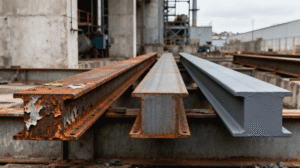
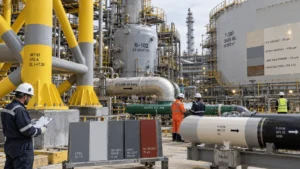
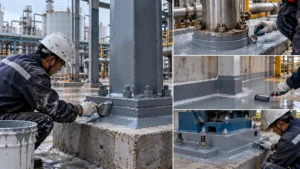
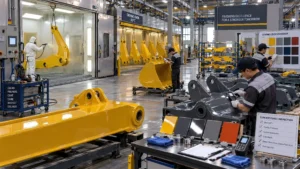
O revestimento interno de tanques de aço destinados à água produzida em campos de petróleo deve ser selecionado para imersão contínua em fluidos salinos e potencialmente corrosivos, e não apenas com base na resistência ao petróleo bruto. Os sistemas de epóxi de alta espessura, epóxi fenólico e epóxi novolac são opções possíveis, mas sua adequação depende da composição química da água, da temperatura operacional, dos gases dissolvidos e do desempenho documentado pelo fabricante em condições de imersão.
Para operadores de campos de petróleo, engenheiros de corrosão, empreiteiras EPC e compradores de revestimentos industriais no Oriente Médio, Sudeste Asiático e Ásia Central, a decisão fundamental não é escolher o revestimento com a lista mais longa de benefícios anunciados. É identificar qual sistema de revestimento interno pode proteger um tanque específico em suas condições reais de operação e como essa proteção será verificada antes de sua entrada em serviço.
Por Que a Água Produzida em Campos de Petróleo É Mais Agressiva do Que a Água Industrial Comum
A água produzida em campos de petróleo pode provocar vários mecanismos de corrosão simultaneamente, pois pode conter altas concentrações de sais dissolvidos, gases corrosivos, hidrocarbonetos residuais, sólidos em suspensão e microrganismos.
Água produzida é a água que chega à superfície durante a produção de petróleo e gás. Sua composição varia consideravelmente entre os reservatórios e pode mudar ao longo da vida operacional de um campo.
Ao contrário da água industrial limpa, ela pode expor a superfície interna do tanque de aço a uma combinação de ataque químico, corrosão eletroquímica, abrasão e formação de depósitos.
Cloretos e Sais Dissolvidos
A água rica em cloretos aumenta a condutividade do líquido e pode contribuir para a corrosão localizada quando a barreira protetora está danificada.
Uma pequena falha no revestimento, ou descontinuidade, pode permitir que o eletrólito entre em contato com o aço-carbono. Quando a corrosão começa sob o revestimento, os danos podem se espalhar para além do defeito original.
Os sais dissolvidos que permanecem sobre o aço antes da aplicação do revestimento representam outro risco. Mesmo quando o novo revestimento parece inicialmente intacto, a contaminação sob a película pode contribuir para a formação de bolhas osmóticas e a perda de aderência.
Exposição ao CO2 e ao H2S
O CO2 dissolvido pode formar ácido carbônico na água, contribuindo para a corrosão do aço exposto. Ambientes de produção que contêm H2S apresentam preocupações químicas adicionais e questões de compatibilidade dos materiais.
A presença desses gases não significa automaticamente que todo revestimento epóxi irá falhar. No entanto, torna necessário confirmar se uma formulação específica de revestimento foi qualificada para a exposição prevista aos gases, a composição da água e a temperatura de operação.
O espaço de vapor acima do líquido também pode exigir proteção, pois a condensação e os gases corrosivos podem afetar superfícies que não ficam continuamente submersas.
Microrganismos, sedimentos e corrosão localizada
A corrosão influenciada microbiologicamente (MIC) ocorre quando a atividade microbiana contribui para processos de corrosão localizada.
Os depósitos no fundo do tanque podem criar zonas estagnadas e condições químicas diferenciadas. A areia e as partículas em suspensão podem causar abrasão, especialmente nas áreas próximas às entradas.
Um revestimento selecionado apenas por sua resistência ao óleo pode não oferecer proteção adequada contra a imersão em água salgada, a permeação de produtos químicos, a corrosão sob depósitos e os sólidos abrasivos.
Essas diferentes condições de exposição explicam por que os tanques de água produzida em campos petrolíferos precisam de uma especificação de revestimento específica para imersão.
Quais sistemas de revestimento industrial são adequados para água produzida?
Revestimentos epóxi de alta espessura e revestimentos à base de epóxi fenólico ou epóxi novolaca especialmente formulados são opções iniciais comuns para a proteção de tanques de água produzida, desde que o produto específico tenha resistência documentada para as condições de serviço previstas.
Formulações com maior resistência química não são automaticamente melhores para todos os projetos. A temperatura, a compatibilidade química, a preparação do substrato, a viabilidade da aplicação e os custos totais de manutenção influenciam a escolha final.
Compare as principais opções de revestimento
| Sistema de revestimento | Condições potenciais de serviço | Vantagens técnicas | Principal limitação |
|---|---|---|---|
| Epóxi de alta espessura, isento de solventes | Imersão em água e exposição moderada a meios mistos dentro de uma faixa de serviço validada | Película de barreira espessa, boa aderência ao aço devidamente preparado e baixo teor de solventes | Nem todas as formulações suportam salmoura quente, gases dissolvidos ou hidrocarbonetos |
| Epóxi fenólico / epóxi novolaca | Misturas mais exigentes de água produzida, salmoura e hidrocarbonetos | Química de resina resistente a produtos químicos; determinados produtos são projetados para imersão em temperaturas elevadas | A resistência varia conforme a química de cura, a formulação e a composição real do líquido |
| Epóxi / novolaca reforçado com flocos | Aplicações específicas envolvendo permeação, desgaste mecânico ou exposição ao fundo de tanques | O reforço pode melhorar o percurso da barreira e o desempenho mecânico | É necessário confirmar a resistência à abrasão, a flexibilidade e a espessura de aplicação |
| Revestimento interno de éster vinílico reforçado com flocos de vidro | Ambientes quimicamente agressivos selecionados que excedem a capacidade de um sistema epóxi específico | Pode oferecer uma ampla faixa de resistência química quando formulado adequadamente | Requisitos de aplicação e compatibilidade mais exigentes; não é uma substituição automática do epóxi |
Nota sobre a seleção: As condições operacionais acima são categorias de triagem, não aprovações universais de produtos. As fichas técnicas publicadas de revestimentos de imersão fenólicos e novolac incluem faixas de espessura de película seca de aproximadamente 300–900 μm para determinados produtos. Esses são exemplos de referência, não especificações de produtos HUILI nem uma espessura recomendada para todos os projetos.
Quando um epóxi de alta espessura é suficiente?
Um revestimento de epóxi de alta espessura pode ser adequado quando a composição da água produzida e as condições operacionais estão dentro dos limites de resistência à imersão comprovados do produto.
As formulações de epóxi isentas de solventes são frequentemente consideradas para aplicações de revestimento interno de tanques industriais, pois podem atingir uma espessura substancial de película seca, minimizando os problemas relacionados a solventes.
No entanto, os termos solvent-free e high-build describe formulation and application characteristics. Neither term, by itself, confirms chemical compatibility.
For projects requiring a broader understanding of epoxy chemistry and lining types, the epoxy tank coating and lining selection guide explains the differences between internal epoxy lining systems.
When Should You Consider Phenolic Epoxy or Epoxy Novolac?
Phenolic epoxy and epoxy novolac systems deserve consideration when conventional epoxy formulations cannot demonstrate sufficient resistance to the combination of water, salts, hydrocarbons, and operating temperature.
Epoxy novolac is a family of epoxy resin systems designed around novolac-type resin chemistry. Its potential advantages depend on the complete cured formulation rather than the resin name alone.
Selected commercial formulations are designed for produced water and other oil-and-gas immersion services.
However, two products described as epoxy novolac can have substantially different:
- Maximum immersion temperatures
- Chemical resistance profiles
- Mixing ratios and working times
- Dry film thickness requirements
- Curing and return-to-service conditions
A purchaser should therefore request the actual product TDS and relevant chemical-resistance documentation instead of choosing by resin category alone.
Why Oil-Resistant Coatings Are Not Always Suitable for Oilfield Wastewater
Oil-resistant coatings can still fail in produced-water tanks when they have not been designed or qualified for continuous aqueous immersion.
This distinction is particularly important because different industrial coating products may all advertise excellent resistance to petroleum products while serving completely different purposes.
Polyurethane Topcoats
Conventional polyurethane topcoats are commonly selected for external steel protection, where weathering, UV exposure, color retention, and appearance matter.
These advantages do not establish suitability for continuous immersion inside a produced-water tank.
Some specially formulated polyurethane systems can be designed for immersion applications, but the approval must come from the specific product’s technical documentation.
An external polyurethane coating should not be substituted for an internal epoxy lining simply because both products have good chemical-resistance descriptions.
Conductive and Anti-Static Epoxy Coatings
Conductive epoxy coatings are formulated to provide controlled electrical properties.
They may be required in certain petroleum storage or handling environments where electrostatic management is part of the project specification.
However, electrical conductivity is a separate property from resistance to hot saline water.
An anti-static epoxy coating is not automatically a produced-water lining, and its electrical performance does not prove immersion durability.
Both functions must be verified independently where required.
Perchloroethylene and Other Chemically Resistant Coatings
Perchloroethylene-based and other chemically resistant coatings may perform adequately in particular atmospheric or chemical-exposure environments.
Nevertheless, a general claim of acid, alkali, or oil resistance cannot establish compatibility with long-term immersion in produced water.
Before considering these systems, confirm the applicable immersion conditions, temperature limits, exposure duration, and available test evidence.
Match the Lining System to the Actual Tank Conditions
The most reliable selection process starts with the tank’s operating conditions and eliminates coating systems that cannot demonstrate compatibility with those conditions.
A useful selection process does not begin with a product catalogue. It begins with four technical questions.
1. What Is the Water Chemistry?
The chemical composition of produced water determines much of the lining’s exposure severity.
Important parameters include:
- Chloride concentration and total dissolved solids (TDS)
- pH and relevant dissolved salts
- Dissolved or vapor-phase H2S and CO2
- Residual oil and hydrocarbon composition
- Chemical treatment additives
- Suspended solids and sediment characteristics
- Evidence of microbiological activity
Water chemistry should be based on representative sampling, not just a broad description such as “oilfield wastewater.”
For example, a coating that performs well in neutral laboratory water may behave differently in hot brine containing hydrocarbons and dissolved gases.
Where the proposed product has no sufficiently relevant chemical-resistance data, additional qualification may be needed.
2. What Is the Actual Immersion Temperature?
The lining must be qualified for the maximum operating temperature of the liquid, including reasonably foreseeable process excursions.
Consider two illustrative design cases:
| Design case | Example operating conditions | Selection priority |
|---|---|---|
| Tank A | Produced water normally around 20–40°C, with measured salinity and limited chemical variability | Evaluate immersion-qualified epoxy products against water chemistry, temperature, and inspection requirements |
| Tank B | Produced water reaching approximately 60–90°C, with variable salinity and hydrocarbon exposure | Require explicit hot-immersion qualification; investigate suitable phenolic/novolac or alternative lining systems |
These temperature bands describe example project conditions, not guaranteed performance limits for any coating family.
A product’s published maximum dry-heat resistance must not be used as its continuous wet-immersion limit.
3. Will the Tank Experience Abrasion or Pressure Changes?
Produced-water tanks can experience different mechanical conditions depending on their design and operation.
Tank floors may encounter sediment accumulation, and inlet zones can experience particle impact or localized wear.
Pressurized process vessels may introduce additional pressure, gas-permeation, and decompression considerations.
A coating selected for a relatively calm storage tank may not be appropriate for high-velocity internal piping or a pressurized separation vessel.
These differences should be considered before adopting a common lining specification for every asset in the facility.
4. Is the Surface Continuously Immersed?
The tank floor, submerged walls, liquid-level transition zone, and upper vapor space may not experience the same conditions.
Continuously immersed areas need liquid-resistant barrier protection. Areas above the liquid may encounter condensation, corrosive vapor, or alternating wet and dry exposure.
A single compatible lining may protect the entire interior, but this should be confirmed rather than assumed.
For larger assets involving both internal and external protection, sistemas de revestimento para tanques de armazenamento e dutos should be evaluated according to the different exposure conditions of each surface.
Prevent Premature Failure Through Surface Preparation and Inspection
Even a chemically compatible lining can fail prematurely when salts, oil contamination, poor weld preparation, inadequate thickness, or incomplete curing compromise the protective barrier.
For immersion service, specification and inspection quality are especially important because small coating defects can remain hidden until the tank is returned to operation.
Remove Oil, Salts, and Corrosion Products
Surface preparation should remove hydrocarbon residues, loose corrosion products, and other contaminants before the specified abrasive blasting process.
For steel tanks, projects commonly specify blast-cleaning grades such as ISO 8501-1 Sa 2½, although the exact requirement must be established by the lining manufacturer and project specification.
Surface profile also matters. Excessively smooth steel can impair mechanical adhesion, while an unsuitable profile may create difficulties achieving uniform coverage.
Soluble salt contamination should be checked using an appropriate method and acceptance criterion because blasting alone does not guarantee that salts have been removed.
Inspect Welds and Difficult Geometry
Floor-to-shell joints, weld seams, reinforcement connections, edges, and penetrations need particular attention.
Sharp edges, weld spatter, undercut, and irregular fabrication details can prevent a coating from forming a continuous film.
O AMPP standards for tank and vessel linings, including SP0178, address design and surface-finish considerations for immersion linings. SP0188 covers discontinuity testing of protective coatings on conductive substrates.
These principles are especially relevant when planning a lining project before the tank is fabricated or refurbished.
Verify Dry Film Thickness and Holiday Testing
Dry film thickness (DFT) is the measured thickness of a cured coating film.
Insufficient DFT can leave weak areas, while excessive application may produce problems such as incomplete curing, cracking, or other coating-specific defects.
The inspection plan should therefore define the approved target and tolerance range according to the specific coating system.
Holiday testing identifies discontinuities that may expose the conductive substrate beneath a nonconductive lining.
It should be performed using the appropriate equipment and test parameters for the lining type and thickness.
Before filling the tank, also confirm:
- Surface preparation and cleanliness records
- Recorded application conditions and mixing data
- DFT measurements and acceptance
- Holiday test results and completed repairs
- Curing and return-to-service requirements
O guia de inspeção pré-serviço do revestimento do tanque explains these checks in greater detail.
Understand the Most Common Lining Failure Risks
Blistering, delamination, localized corrosion, and premature softening are warning signs that the lining system or its application may not match the service conditions.
| Observed defect | Possible contributing cause | Recommended investigation |
|---|---|---|
| Bolhagem | Soluble salts, moisture, permeation, or osmotic effects | Examine surface contamination, adhesion, and immersion compatibility |
| Delamination | Inadequate preparation, contamination, or intercoat adhesion failure | Inspect the coating interface and preparation records |
| Localized rust at welds | Insufficient edge coverage or coating discontinuities | Check weld preparation, stripe coating, and holiday records |
| Softening or chemical attack | Chemical incompatibility or insufficient curing | Review chemical-resistance data and cure history |
| Abrasion damage | Suspended solids or localized fluid impact | Evaluate solids loading, flow conditions, and mechanical resistance |
A coating failure investigation should not assume that every blister or adhesion defect is caused by the resin formulation.
The same visible defect may result from different mechanisms. Understanding the failure mechanism is necessary before undertaking localized tank lining repairs or a complete relining project.
Verify Chemical Resistance Before Approving a Product
Chemical resistance should be demonstrated using relevant exposure data rather than inferred from broad marketing descriptions.
A product described as resistant to oil, seawater, or dilute chemicals may not have been evaluated against the actual produced-water composition.
ISO 2812-1:2017 provides methods for evaluating the effects of liquids other than water on coating systems. For an oilfield project, any test program must use representative media and appropriate exposure conditions if the results are to support a specific service decision.
Perguntas importantes incluem:
- Was the coating tested against a similar chemical mixture?
- Did the exposure temperature represent the intended service?
- Was the complete coating system tested?
- Were blistering, adhesion loss, softening, and visible defects evaluated?
- Does the qualification cover continuous immersion or only temporary chemical contact?
Where available evidence is insufficient, laboratory exposure testing or a controlled field qualification may be appropriate.
For critical assets, the coating supplier, engineer, and asset owner should agree on acceptance criteria before approval.
Prepare the Right Information for a Produced-Water Lining RFQ
A useful coating RFQ should describe the tank, fluid, temperature, application conditions, and required inspection criteria—not simply ask for an oil-resistant epoxy price per kilogram.
For industrial coating procurement, the following information helps the manufacturer assess compatibility and prepare a technically meaningful proposal.
| Required information | Why it matters |
|---|---|
| Tank construction and dimensions | Determines substrate, coating area, access, and application method |
| Produced-water analysis | Establishes chemical exposure and compatibility requirements |
| Normal and maximum temperatures | Helps screen immersion-temperature limitations |
| Operating pressure and vapor conditions | Identifies additional mechanical or gas-exposure requirements |
| Existing substrate and lining condition | Determines surface preparation and repair scope |
| Required project lifetime and inspection standards | Helps establish specification and qualification expectations |
| Application site and environmental conditions | Affects curing, humidity control, and construction planning |
| Required documents and delivery schedule | Supports TDS review, testing requirements, packaging, and quotation |
A complete technical comparison should consider the entire installed lining system.
Lower material cost per kilogram does not necessarily mean lower project cost when the system requires different thicknesses, preparation standards, curing time, or maintenance frequency.
Perguntas Frequentes
Can ordinary epoxy coating protect a produced-water tank?
An ordinary epoxy coating should not be used solely on the basis of its general corrosion resistance. The selected formulation must be qualified for continuous immersion, actual water chemistry, and operating temperature.
Products without relevant immersion evidence can experience blistering, delamination, or softening even when they perform well in atmospheric service. ISO 2812-1 provides a framework for evaluating resistance to non-water liquids.
Is epoxy novolac always better than standard epoxy for oilfield wastewater?
No. Epoxy novolac may provide advantages in certain chemically demanding or elevated-temperature environments, but it is not automatically the most suitable or economical option.
Some published phenolic/novolac lining specifications include DFT ranges of approximately 300–900 μm. The selected product’s chemical-resistance data, curing conditions, and actual service limits matter more than the resin family name.
Can polyurethane coating be used inside an oilfield produced-water tank?
A conventional atmospheric polyurethane topcoat should not be assumed suitable for continuous produced-water immersion.
Only a polyurethane formulation specifically qualified for the intended liquid and temperature should be considered. Otherwise, an immersion-rated epoxy or another appropriately tested lining system is generally a more relevant starting point.
How thick should an internal produced-water tank lining be?
The required DFT depends on the approved product and service conditions, rather than one universal oilfield value.
Certain published high-build phenolic and novolac systems specify films in the several-hundred-micrometre range, including approximately 300–900 μm. The project should establish an actual approved thickness range and measure it using appropriate DFT inspection procedures.
Is holiday testing necessary for epoxy tank linings?
Holiday testing is commonly specified for nonconductive immersion linings applied over conductive steel because pinholes and other discontinuities can expose the substrate to corrosive liquid.
AMPP SP0188 provides an applicable discontinuity-testing reference. The testing method, voltage selection, and acceptance criteria should be appropriate for the coating system and manufacturer instructions.
Select a Produced-Water Coating System With HUILI
For produced-water service, reliable corrosion protection starts with understanding the fluid and the tank’s operating conditions.
HUILI manufactures industrial protective coatings and supports coating-system selection for storage tanks, pipelines, and industrial facilities.
If you are evaluating a new produced-water storage tank, replacing a failed lining, or preparing an industrial coating specification, provide your tank dimensions, fluid composition, operating temperatures, existing surface condition, applicable inspection requirements, and project schedule.
Our technical team can review the requirements, identify potential coating-system options, and discuss relevant TDS documentation, compatibility verification, and commercial quotation requirements.
Submit your specifications through the HUILI industrial coating technical inquiry form for a project-specific review.