When a fire breaks out in an industrial facility, two fundamentally different systems are at work. One fights the fire — suppressing flames, sounding alarms, directing evacuations. The other simply holds the structure together long enough for people to escape and emergency services to respond.
Understanding the difference between passive fire protection (PFP) and active fire protection (AFP) is not an academic exercise. For structural engineers, project managers, and procurement teams specifying protection for steel-framed buildings, process plants, and offshore facilities, it determines how the building is designed, what coatings are specified, and how the system is maintained and inspected.
This guide explains both systems, how they work together, the specific role of intumescent and cementitious coatings within the PFP framework, and how to specify PFP correctly for industrial steel structures.
The Core Distinction: Passive vs Active
| Passive Fire Protection (PFP) | Active Fire Protection (AFP) | |
| How it works | Built into the structure — operates without human or mechanical intervention | Responds to fire detection — requires activation (automatic or manual) |
| Examples | Intumescent coatings, cementitious fireproofing, fire-rated walls, fire doors, compartmentation | Sprinkler systems, fire suppression gas, smoke detectors, fire alarms, emergency lighting |
| Primary function | Contains fire spread; maintains structural integrity during fire | Detects fire; suppresses or extinguishes fire; alerts occupants |
| Activation | None required — always ‘on’ | Triggered by heat, smoke, or manual operation |
| Regulatory basis | Building codes, structural fire engineering standards (e.g. BS 476, EN 13501, UL 1709) | Fire detection and suppression standards (NFPA 13, EN 12845, BS 5306) |
| Maintenance | Periodic inspection — typically 1–5 years | Regular testing and servicing — typically annual or more frequent |
Both systems are required by most building codes and project specifications. They are complementary, not alternatives — a building with sprinklers still requires structural fireproofing; a building with intumescent coating still requires fire detection and alarm systems.
What Is Passive Fire Protection?
Passive fire protection encompasses all measures that are permanently built into a structure and require no activation to function during a fire. The term ‘passive’ refers to the mode of operation — not to the level of protection provided.
PFP serves three primary engineering objectives:
- Structural integrity: maintaining the load-bearing capacity of steel elements (columns, beams, connections) at elevated temperatures for a defined fire resistance period — typically 30, 60, 90, or 120 minutes.
- Compartmentation: limiting the spread of fire, smoke, and hot gases between defined fire compartments using fire-rated walls, floors, ceilings, and penetration seals.
- Means of escape: protecting escape routes (stairwells, corridors, exit routes) from fire and smoke ingress for the duration required for safe evacuation.
For structural steel specifically, PFP addresses a critical vulnerability: unprotected steel loses approximately 50% of its yield strength at 550°C — a temperature that can be reached within 5–10 minutes of a fully developed fire. Without fireproof coating, a steel frame can collapse long before evacuation is complete.
Types of Passive Fire Protection for Steel Structures
1. Intumescent Coating (Thin-Film)
Intumescent coatings are the most widely specified PFP system for structural steel in commercial and industrial buildings. Applied at 1–6 mm dry film thickness (thin-film systems), they appear as a normal paint finish at ambient temperature. On exposure to fire (typically activating at 150–200°C), the intumescent chemistry causes the coating to expand dramatically — typically 20–50 times its original thickness — forming an insulating carbonaceous char layer that protects the steel beneath.
- Fire resistance ratings: 30, 60, 90, and 120 minutes — per UL 1709 (hydrocarbon fire curve) or BS 476 Part 20/21 / EN 13501-2 (cellulosic fire curve)
- Substrate: structural steel (I-beams, H-columns, hollow sections, connections)
- Application: spray, brush, or roller; typically shop-applied in controlled conditions or site-applied
- Finish: can be overcoated with decorative topcoat — aesthetically suitable for architectural applications
- Key standard: UL 1709 for petrochemical/offshore hydrocarbon fires; BS 476 / EN 13501-2 for building cellulosic fire scenarios
💡 Huili Coating manufactures thin-film intumescent coatings rated to 60, 90, and 120 minutes under both UL 1709 and BS 476 Part 21. Full third-party test certificates available. See our intumescent fireproof coating rating guide for full system specifications.
2. Cementitious (Spray) Fireproofing
Cementitious fireproofing is a spray-applied, cement-based or gypsum-based material applied at significantly higher thickness than intumescent systems — typically 10–50 mm. It provides fire resistance through the thermal mass and moisture content of the material, which absorbs heat energy and slows temperature rise in the steel.
- Fire resistance ratings: 60 to 240 minutes achievable at appropriate thickness
- Best for: petrochemical plants, offshore topsides, power generation facilities — environments where hydrocarbon fire exposure is the primary hazard
- Advantage: lower cost per unit of fire resistance compared to thin-film intumescent at longer ratings (>120 min)
- Limitation: bulky appearance; susceptible to mechanical damage and moisture ingress in exposed environments; not suitable for architectural applications
3. Passive Board and Encasement Systems
Fire-rated board systems (calcium silicate, mineral fibre, vermiculite) are mechanically fixed around steel members to provide thermal protection. Used primarily where spray application is not practical or where high mechanical durability is required.
- Applications: car parks, tunnels, areas subject to mechanical impact or wash-down
- Ratings: up to 240 minutes for heavy steel sections
Thin-Film Intumescent vs Cementitious Fireproofing: Selection Guide
| Factor | Thin-Film Intumescent | Cementitious Fireproofing |
| Applied DFT / thickness | 1–6 mm | 10–50 mm |
| Fire curve | Cellulosic (BS 476 / EN 13501) or hydrocarbon (UL 1709) | Primarily hydrocarbon; cellulosic also available |
| Maximum fire rating | 120 min (standard); 180 min (specialist) | 240 min achievable |
| Appearance / finish | Smooth, paintable — architectural quality | Rough textured — not suitable for visible applications |
| Mechanical durability | Moderate — requires protection in high-traffic areas | High — resistant to impact in industrial environments |
| Moisture resistance | Good (if correctly topcoated) | Lower — can absorb moisture; requires inspection in wet environments |
| Best application | Commercial buildings, industrial structures, offshore modules | Petrochemical plants, refineries, offshore topsides, power plants |
| Cost (material) | Higher per unit area | Lower per unit of fire resistance at longer ratings |
| Application method | Spray, brush, roller — versatile | Spray-applied — specialist equipment required |
💡 The fire curve is a critical specification decision. UL 1709 (hydrocarbon) assumes a fast-developing, high-temperature hydrocarbon fire — typical in petrochemical and offshore environments. BS 476 / EN 13501 (cellulosic) models a slower, lower-peak-temperature building fire. A coating rated only to BS 476 will not provide adequate protection in a UL 1709 hydrocarbon fire scenario. Always confirm the applicable fire curve before specifying.
The UL 1709 vs BS 476 Decision
This is the most common specification error in industrial fireproof coating projects. The two standards model fundamentally different fire scenarios:
- UL 1709 (ASTM E1529): rapid-rise hydrocarbon fire — reaches 1,093°C within 5 minutes. Applicable to: oil refineries, petrochemical plants, offshore platforms, LNG facilities, fuel storage areas. Any facility with hydrocarbon process fluids should specify UL 1709.
- BS 476 Part 20/21 / EN 13501-2: standard cellulosic fire curve — reaches peak temperature more gradually. Applicable to: commercial buildings, warehouses, car parks, general industrial buildings without hydrocarbon fire risk.
In offshore and petrochemical projects, the specification will typically state UL 1709 or NORSOK S-001 (which mandates UL 1709-equivalent performance). In EPC and building projects, the applicable standard is usually defined by the local building code or the fire engineering consultant’s report.
For a detailed breakdown of both standards and how to choose, see Fireproof Coating Standards: UL 1709 vs BS 476 Explained.
How PFP and AFP Work Together: The Layered Fire Safety Model
Building codes and fire engineering standards in most jurisdictions use a layered approach to fire safety. PFP and AFP are both required layers — neither replaces the other. The interaction works as follows:
- Detection (AFP): smoke and heat detectors identify fire in its early stage — typically within 1–3 minutes of ignition.
- Alarm (AFP): fire alarm activates, initiating evacuation.
- Suppression (AFP): sprinkler or suppression system activates — ideally containing the fire in its early stage.
- Compartmentation (PFP): fire-rated walls, floors, and doors limit fire spread to the compartment of origin — buying time for evacuation and emergency response.
- Structural protection (PFP): intumescent or cementitious fireproofing on steel members prevents structural collapse for the rated fire resistance period — 60, 90, or 120 minutes — ensuring the building remains standing during evacuation and firefighting.
The fire resistance rating required for the structural PFP system is determined by fire engineering calculation — specifically, the time needed to: evacuate the building + allow firefighting access + prevent progressive collapse. This is not a product decision — it is a structural fire engineering decision that must be made before the coating is specified.
Specifying Intumescent Coating for Steel Structures: Key Parameters
When specifying thin-film intumescent coating, the following parameters must be defined — each affects which product is selected and at what thickness:
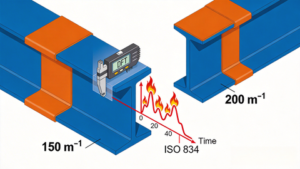
- Steel section factor (Hp/A): the ratio of heated perimeter to cross-sectional area. Higher section factors (lighter, more exposed sections) require thicker intumescent coating to achieve the same fire rating.
- Fire resistance period: 30, 60, 90, or 120 minutes — defined by fire engineering analysis or building code requirement.
- Fire curve: cellulosic (BS 476 / EN 13501) or hydrocarbon (UL 1709) — defined by the fire hazard scenario.
- Steel critical temperature: the temperature at which the steel section loses structural capacity — typically 550°C for standard structural steel, but may be lower for highly stressed members.
- Primer system: intumescent coatings require a compatible primer for adhesion and corrosion protection. The primer must be specified and supplied by the same manufacturer as the intumescent to ensure compatibility and maintain the certified system.
- Topcoat: for architectural or corrosion protection purposes, most intumescent systems can be overcoated with a compatible polyurethane or epoxy topcoat.
💡 Huili Coating provides section-factor-based DFT specification tables for all rated intumescent systems. Send us the structural steel schedule (section sizes and fire rating requirements) and our technical team will produce a project-specific DFT specification at no charge.
Maintenance and Inspection of Passive Fire Protection
PFP systems require periodic inspection and maintenance to remain compliant and effective. Key inspection points for intumescent coatings:
- Visual inspection: check for cracking, delamination, impact damage, and areas of coating loss. Any breach in the intumescent film compromises fire resistance at that location.
- DFT verification: dry film thickness measurement confirms the coating remains at specified thickness. DFT can be measured non-destructively using calibrated magnetic induction gauges.
- Adhesion testing: periodic pull-off adhesion testing (ISO 4624) confirms the coating remains bonded to the substrate.
- Moisture and corrosion check: in wet or offshore environments, check for moisture ingress beneath the intumescent layer and any undercutting corrosion at the steel surface.
Inspection frequency varies by environment: for internal protected environments, 5-yearly inspection is typical; for external or offshore applications, annual inspection is recommended. A detailed inspection checklist is available in our maintenance schedules for fireproof coatings guide.
Frequently Asked Questions
Does passive fire protection replace the need for sprinklers?
No. Passive and active systems are complementary — most building codes and fire engineering standards require both. Sprinklers suppress fire in its early stages; structural fireproofing (PFP) maintains structural integrity if the fire cannot be suppressed before it fully develops. In some jurisdictions, the presence of a sprinkler system may allow a reduction in the required fire resistance period for structural elements — but it does not eliminate the PFP requirement entirely. Always consult the applicable building code and a qualified fire engineer.
How thick does intumescent coating need to be?
The required dry film thickness (DFT) of intumescent coating depends on three variables: the section factor (Hp/A) of the steel member, the required fire resistance period (30/60/90/120 minutes), and the applicable fire curve (cellulosic or hydrocarbon). For light steel sections in a 60-minute cellulosic scenario, DFT may be as low as 1–2 mm. For heavy sections in a 120-minute UL 1709 hydrocarbon scenario, 4–6 mm or more may be required. Section-factor DFT tables are provided by the coating manufacturer for each certified system. See our fireproof coating thickness guide for steel structures for detailed specification tables.
Can intumescent coating be applied over anti-corrosion primer?
Yes — in fact, an anti-corrosion primer is typically required beneath the intumescent layer for structural steel exposed to corrosive environments. However, the primer must be compatible with the intumescent system — specifically, the primer type and DFT must be within the parameters used when the intumescent system was fire-tested. Substituting a different primer can invalidate the fire rating certification. Always use primer from the same manufacturer and confirm compatibility. For a compatibility guide, see how to apply fireproof paint over anti-corrosion primer.
What is the difference between fire resistance and fire retardancy?
These terms are often confused. Fire resistance refers to the ability of a structural element or assembly to maintain its load-bearing function, integrity, and/or insulation for a defined period under standardised fire conditions — expressed in minutes (e.g. R60, REI 90). Fire retardancy (or flame retardancy) refers to the ability of a material or coating to resist ignition or slow the spread of flame across a surface — it does not imply structural fire resistance. A fire retardant coating on timber reduces flame spread; an intumescent coating on steel provides structural fire resistance. Both terms appear in specifications but describe fundamentally different protection mechanisms.
How do I specify passive fire protection for an offshore structure?
Offshore PFP specification is governed primarily by NORSOK S-001 (Technical Safety) and the project’s fire and explosion risk assessment (FERA). The key differences from onshore specification: the fire curve is typically UL 1709 (hydrocarbon); deluge systems affect the required PFP rating (structures protected by active deluge may have reduced PFP requirements); and the corrosive offshore environment requires the intumescent and anti-corrosion coating system to be fully compatible and tested to offshore atmospheric conditions. Always work with the project’s fire engineer and coating manufacturer from the earliest specification stage on offshore projects.
Passive Fire Protection Systems from Huili Coating
Huili Coating manufactures a complete range of passive fire protection coatings for structural steel in commercial, industrial, and offshore applications.
- Thin-film intumescent coatings: 60, 90, and 120-minute ratings under UL 1709 and BS 476 Part 21
- Compatible anti-corrosion primer and topcoat systems — tested and certified as complete systems
- Section-factor DFT specification tables provided for all projects at no charge
- Third-party fire test certificates from accredited laboratories
- ISO 9001 certified manufacturing; export supply to Europe, Middle East, and Southeast Asia
- Full technical documentation in English: TDS, SDS, fire test certificates, application procedures
- Complete system overview: fireproof coating system for steel structures covering types, standards, and system design.
Provide your steel schedule, fire resistance period, and applicable fire curve — our technical team will specify the correct system and DFT requirements. Send your project details via the project inquiry form.
.