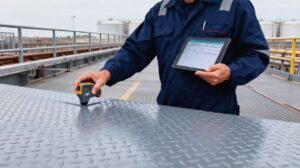
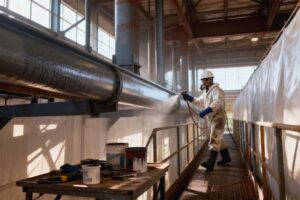
Concrete fire protection is more nuanced than steel fire protection because concrete already has inherent fire resistance, yet severe heat can still cause cracking, spalling, and loss of protection around reinforcement.
For that reason, the right fireproof coating for concrete depends on fire rating, exposure conditions, finish expectations, weight limits, and maintenance strategy rather than on product type alone.
This guide focuses only on concrete fireproof coating selection.
It compares intumescent and cementitious systems for concrete substrates, then shows how to prepare the surface, avoid specification mistakes, and build a better RFQ.
Quick Guide
- Use intumescent systems when finish quality, lower weight, and decorative compatibility matter most.
- Use cementitious systems when outdoor durability, thicker insulation, and lower upfront cost matter more.
- Check substrate moisture, surface soundness, and flatness before choosing the system.
- Do not copy steel fireproofing logic directly into concrete specifications.
- Send fire rating, location, substrate condition, and finish requirement before requesting TDS or pricing.
Why Concrete Structures Need Fireproof Coatings
Concrete performs better in fire than many exposed metals, but reinforced concrete structures can still lose carrying ability under high-temperature fire exposure.
When the temperature rise is severe enough, the concrete cover may crack or spall, which increases the risk of exposing reinforcement and accelerating structural damage.
In practical projects, fireproof coatings on concrete are mainly used to:
- Protect reinforcement when cover is limited.
- Reduce heat transfer into the substrate.
- Help maintain surface integrity during fire exposure.
Typical demand scenarios include:
- Tunnel linings.
- Basement and underground slabs.
- Concrete walls in industrial facilities.
- High-rise concrete surfaces with fire-rating requirements.
Intumescent Fireproof Coating for Concrete
Intumescent coatings protect the substrate by expanding under heat and forming an insulating char layer that slows temperature rise.
For concrete, they are usually selected where lower weight, smoother appearance, and finish compatibility are important.
Typical advantages:
- Lower dead load on soffits and walls.
- Smoother finish for visible areas.
- Better compatibility with paint and architectural finishing.
- Easier use where decorative appearance matters.
Typical limitations:
- Higher material cost than cementitious options.
- Greater sensitivity to substrate condition and finish package.
- Outdoor use usually needs a compatible protective top layer when weathering is a concern.
Typical use areas:
- Interior concrete beams and columns.
- Decorative wall surfaces.
- Basement ceilings.
- Concrete areas that remain visible after completion.
Typical planning ranges for intumescent systems
| Fire rating | Typical thickness | Typical weight |
|---|---|---|
| 60 minutes | 1.0-1.5 mm | 1.5-2.0 kg/m² |
| 120 minutes | 2.0-3.0 mm | 2.5-4.0 kg/m² |
These ranges are useful for early design and RFQ planning, but final thickness and loading should always be confirmed against the tested system and approved TDS.
Cementitious Fireproof Coating for Concrete
Cementitious fireproofing is typically based on cementitious or mineral materials, often combined with aggregates or fibres, to create a thicker thermal barrier layer.
Compared with intumescent systems, cementitious systems are generally thicker, rougher in finish, and more tolerant of rugged service conditions.
Typical advantages:
- Stronger suitability for outdoor and utility areas.
- Lower upfront cost in many projects.
- Better fit for heavier-duty, less decorative applications.
- Durable service where appearance is not the main driver.
Typical limitations:
- Higher added weight than intumescent systems.
- Rougher surface finish.
- Less suitable where an exposed decorative finish is required.
- More difficult to integrate into high-end visible interiors.
Typical use areas:
- Exterior concrete walls.
- Tunnel linings.
- Bridge substructures.
- Utility buildings and industrial concrete zones.
Typical planning ranges for cementitious systems
| Fire rating | Typical thickness | Typical weight |
|---|---|---|
| 60 minutes | 15-20 mm | 30-40 kg/m² |
| 120 minutes | 25-35 mm | 50-70 kg/m² |
For many large-area utility applications, cementitious systems remain attractive because the thicker mineral barrier approach aligns well with durability-focused fireproofing practice.
Compare Intumescent vs Cementitious for Concrete
The core selection question is not which system is universally better.
It is which system better fits the concrete asset, fire rating, exposure, finish requirement, and maintenance plan.
| Decision factor | Intumescent | Cementitious | Recommended direction |
|---|---|---|---|
| Fire rating | 30-180 minutes | 60-240 minutes | For >120 minutes, cementitious is often the easier route |
| Substrate temperature tolerance | Lower critical temperature range | Better fit for higher thermal barrier demand | For more severe thermal scenarios, cementitious is usually preferred |
| Indoor / outdoor | Better for interior visible areas | Better for exposed exterior utility areas | Exterior walls and tunnels often favor cementitious |
| Finish requirement | Can be painted and finished | Usually needs plaster-like acceptance or concealment | Visible decorative surfaces favor intumescent |
| Weight limit | Lightweight | Heavyweight | Soffits and weight-sensitive zones often favor intumescent |
| Upfront cost | Higher | Lower | Budget-driven projects often favor cementitious |
| Maintenance cycle | Shorter in exposed service | Longer in rugged service | Long-term low-maintenance areas often favor cementitious |
At a system level, the broad pattern is consistent across passive fire protection practice: thin-film intumescent solutions are chosen more often for finish-sensitive applications, while cementitious systems are chosen more often for thicker, more rugged, cost-driven fire protection.
If your team also reviews adjacent product families during specification, our specialty coatings portfolio is a useful starting point for project coordination and product grouping.
Prepare Concrete Surface for Fireproof Coatings
Surface preparation has a direct effect on adhesion, long-term integrity, and risk of delamination.
That matters even more on concrete because the substrate may vary in porosity, moisture content, laitance, and flatness from one area to another.
For intumescent systems, focus on:
- Higher flatness and smoother surface condition.
- Suitable sealer or primer where required.
- Control of alkalinity-related surface issues.
- Moisture control before application.
For cementitious systems, focus on:
- Removal of loose material and weak surface zones.
- Adequate substrate dampening where the system requires it.
- Repair of honeycombs, voids, and friable concrete.
- Stable curing conditions after application.
Common requirements for both systems:
- Remove dust, laitance, oil, and loose particles.
- Check moisture before coating.
- Confirm the substrate is sound enough for the specified build.
- Test bond strength on old or repaired concrete where condition is uncertain.
Old concrete needs extra care.
Loose layers should be removed first, and pull-off testing is often the safest way to confirm whether the substrate can carry the fireproof system.
Specify the RFQ for Concrete Fireproof Coating
The most useful RFQ is the one that lets the manufacturer recommend a system, not just quote a unit price.
For concrete fireproof coating, the RFQ should define fire performance, substrate condition, environment, and finish requirement in the same package.
Include these items:
- Fire rating requirement, such as 60, 90, 120, or 180 minutes.
- Application position, such as wall, soffit, tunnel lining, or exterior facade.
- Finish expectation, such as paintable, plastered, concealed, or exposed.
- Substrate type and condition, such as new concrete, old concrete, or repaired concrete.
- Environmental exposure, such as indoor humidity, outdoor weather, sand, or industrial chemicals.
- Maintenance expectation, such as medium-cycle or long-cycle service.
- Site constraints, including scaffolding, spray access, shutdown window, and ventilation.
Standard selection needs special care.
UL 1709 is a rapid-rise fire test used for structural steel protection, so buyers should verify whether a client-named standard actually matches a concrete fireproof coating scope before copying it into the RFQ. UL Solutions
Likewise, GB 14907 is titled as a fire resistive coating standard for steel structure, which means project teams should confirm applicability before using it as a concrete acceptance basis.
For documentation support before bidding, you can prepare a preliminary package through our fireproof coating RFQ support page.
Avoid Common Mistakes in Concrete Fireproof Coating Selection
One of the most common mistakes is treating concrete exactly like steel during passive fire protection design.
That usually leads to the wrong thickness logic, the wrong adhesion assumptions, or the wrong acceptance criteria.
Avoid these mistakes:
- Using a steel-structure intumescent system on concrete without checking substrate compatibility.
- Using an interior intumescent system outdoors without a suitable protection package.
- Comparing only product unit price instead of installed and maintenance cost.
- Ignoring substrate preparation and then blaming the coating for delamination.
- Copying thickness logic from steel fireproofing into concrete protection without system-specific test data.
Buyers also often forget to ask about repairability.
That matters because patching, recoating, and cosmetic matching are much easier on some systems than on others.
FAQ
Can I use steel structure intumescent coating on concrete?
Generally, no.
Intumescent systems for concrete should be selected by tested substrate compatibility, adhesion behavior, and fire-performance data rather than assumed interchangeability.
Which is cheaper for concrete fireproofing?
Cementitious systems are usually lower in upfront material cost, while intumescent systems are usually chosen when weight and finish quality justify the extra spend.
How long do concrete fireproof coatings last?
Service life depends on exposure, substrate stability, maintenance, and the exact tested system rather than on category name alone.
As a planning rule, protected indoor intumescent systems often have a shorter maintenance cycle than rugged cementitious systems used in utility environments.
What is the weight difference for concrete applications?
Intumescent systems are usually much lighter, while cementitious systems can add several times more dead load because they rely on a much thicker insulating build.
Technical Note
The planning ranges in this article are for early comparison and RFQ preparation only.
Final thickness, weight, substrate preparation, primer need, curing method, and fire rating must be confirmed by tested system data, applicable standards, and the approved project specification.
Where a client names fire test or acceptance standards, confirm that they are valid for concrete fireproof coating scope before procurement.
Request a Concrete Fireproof Coating Recommendation
Concrete fire rating, finish requirement, substrate condition, and maintenance expectation should drive the system choice.
Send your project location, required fire duration, concrete condition, exposure environment, and finish requirement through our contact page to get an intumescent or cementitious system recommendation plus TDS support.