Corrosion risks that hit infrastructure hardest
Infrastructure corrosion is driven by multiple stressors that repeat daily and seasonally, and these stressors concentrate at details.
- Atmospheric pollution and wet dry cycling accelerate underfilm corrosion once the barrier is compromised.
- Salt exposure is a bridge multiplier, sea spray, coastal windborne salts, and winter de-icing splash create chloride loading at joints and ledges.
- Vibration, impact, and abrasion from traffic and maintenance access damage coatings at edges, handrails, gratings, and contact points.
Decision rule for bridge owners: treat edges, connection plates, and water traps as the controlling locations for service life, not the mid-span flat steel.
Design life planning that engineers can actually execute
Design life is not just a thicker coating. It is a package of exposure definition, system architecture, surface preparation capability, and maintenance window reality.
What 20 to 30 year thinking changes
ISO 12944 uses durability planning as time to first major maintenance, which pushes teams to define realistic expectations, not marketing claims.
If the owner cannot access the structure often, choose systems that are more damage-tolerant and easier to repair with controlled touch-up procedures.
Practical design life bands for decision-making
Use planning bands to align budgets with shutdown windows.
- 10 to 15 years, faster access and easier maintenance, common for secondary steel and easy-to-reach assets
- 20 to 25 years, typical target for major bridge steel with planned maintenance windows
- 25 to 35 years, higher initial scope but lower disruption risk for critical corridors
What buyers forget: the best system fails early if the project cannot actually achieve the assumed surface preparation and QC hold points.
Typical coating systems for bridges and public infrastructure
These are system families frequently used on steel infrastructure. Final product selection should follow the supplier system recommendation and datasheets.
Zinc-rich + epoxy + polyurethane system
Best for: general bridge steel and public infrastructure where corrosion control, barrier build, and weathering are all required.
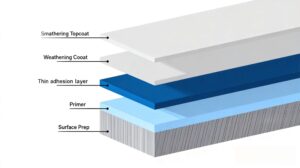
Why it works: the zinc-rich primer provides corrosion control at defects, epoxy provides barrier build, and polyurethane provides durable weathering performance.
What to enforce: stripe coats at edges and welds, and extra DFT readings at those details.
For primer selection and zinc-rich and anti-rust primer options used across steel and infrastructure scopes, reference your internal primer series page in the system section, not as a keyword dump: Anti-Rust and Primer Coatings for Steel Structures.
High-durability fluorocarbon systems
Best for: high visibility infrastructure where long-term color and gloss retention matter and repaint access is costly.
Why it converts on lifecycle value: fluorocarbon finish systems are often chosen to reduce aesthetic degradation and extend repaint intervals on exposed steel.
What to enforce: strict surface prep and intercoat control, since high-end finishes do not compensate for poor adhesion foundations.
System comparison table for RFQs
| System family | Best-fit exposure | Strengths | Watch-outs in execution |
|---|---|---|---|
| Zinc-rich + epoxy + PU | General atmospheric, coastal, mixed zones | Balanced corrosion control and weathering | Detail stripe coats and DFT at edges decide results |
| High-durability fluorocarbon finish | High UV, high visibility, limited repaint access | Longer finish durability and appearance retention | Requires strong foundation coats and tight QC discipline |
Cost vs lifecycle performance, where decisions should be made
Initial coating cost is only one part of infrastructure ownership. The hidden costs are traffic disruption, access equipment, and emergency repairs.
- Initial cost includes material plus surface prep plus access.
- Maintenance cost includes spot repairs, recoats, inspection labor, and traffic control.
- Downtime loss is often the largest number, lane closures, safety risk, penalties, and public impact.
Decision rule for procurement: compare bids using the same deliverables and QC dossier requirements, not just product names and dry film thickness totals.
For project teams that need heavy-duty anti-corrosion options for harsh environments and long-life planning, a relevant internal reference is Heavy Duty Anti-Corrosion Coatings for Industrial Projects.
Where infrastructure coating designs go wrong
Common failure patterns are predictable and preventable.
- Ignoring long-term maintenance reality, the system cannot be repaired consistently once access becomes difficult.
- Over-compressing film build, thin edges and fast passes look fine at handover but fail early at details.
- Underestimating exposure severity, coastal bridges and polluted corridors need a higher barrier strategy than inland structures.
- Treating touch-up as minor, but field repairs often become the controlling weakness for years.
Troubleshooting tip: when corrosion appears early, inspect edges, welds, and connection zones first, then verify DFT records and surface prep acceptance records.
Recommended infrastructure coating system approach
Start with a system architecture and then tune it by zone.
- Zone A, fully weathered steel, use corrosion-control primer, barrier epoxy build, durable topcoat.
- Zone B, joints, edges, water traps, use extra stripe coats, higher barrier build, and tighter inspection density.
- Zone C, impact and abrasion points, add a tougher finish strategy and define repair rules.
If you want to align the language and expectations across packages, use a system-first explanation internally so all stakeholders quote and build the same thing: What Is an Anti-Corrosion Coating System and Why It Matters.
Note: you asked for an internal link to the Infrastructure application page, but the exact URL was not provided in your brief and is not visible in the materials I can access right now. Share the Infrastructure page URL and I will insert it naturally in this section as the primary internal link for infrastructure projects.
Quality and inspection checklist for long-life results
Use this as an execution baseline that prevents the most expensive failure modes.
- Surface preparation hold point before priming, acceptance criteria and records signed off.
- Stripe coat required at edges, welds, bolts, and crevices, verified before full coats.
- DFT verified by layer as ranges, with extra readings at critical details and water traps.
- Recoat window control documented, including surface condition checks between coats.
- Repair procedure defined before work starts, repairs logged and re-inspected with the same rules.
RFQ checklist to get comparable bids
Send these inputs so suppliers can recommend a long life coating system instead of guessing.
- Asset type and steel scope, bridge members, handrails, parapets, bearings, accessories
- Location and exposure, coastal distance, de-icing salts, pollution level, sheltered condensation zones
- Target maintenance window and service life band, for planning such as 20 to 25 years vs 25 to 35 years
- Surface preparation capability, shop or site, blasting availability, containment limits, access constraints
- QC deliverables, DFT logs by layer, stripe coat requirements, hold points, repair method, handover dossier
- Appearance needs, color stability, gloss retention, markings requirements
Technical Note
Final system build-up, surface preparation level, DFT ranges, and acceptance criteria must be confirmed by the applicable TDS and project specification.
CTA
Contact us for long-life corrosion protection systems for infrastructure projects, share your exposure conditions, access constraints, and target maintenance window via Contact.