
Many RFQs arrive with lines like “ISO 12944 coating” or “C4 paint” but without clear environment, durability, or surface preparation information, so the resulting system ends up either overdesigned or under-protective.
This article explains how to use ISO 12944 thinking to choose an anti-corrosion coating system for steel structures and what information to include so your supplier can give a realistic system recommendation instead of a guess.
Quick Guide:
- Use ISO 12944 to combine three inputs: corrosivity category, durability range, and reference paint system logic.
- Decide the corrosivity category (C1–C5, including marine and extreme cases) before asking “which paint is best.”
- Choose the durability target (Low / Medium / High / Very High) based on expected years to first major maintenance.
- Match system architecture (primer / intermediate / topcoat and DFT range) to category and durability, not to habit.
- Put environment, durability, substrate condition, surface preparation, and constraints into the RFQ so the system can be tuned properly.
What ISO 12944 brings to system selection
ISO 12944 is commonly used as a framework to connect environment, design life, and coating system choice rather than just as a label to print on drawings.
In practice, the standard contributes three key inputs for system design: corrosivity category (C1–CX), durability range (Low to Very High), and example protective paint systems for different combinations.
HUILI’s ISO 12944 corrosion protection guidance emphasizes this role: engineers can use the categories and durability ranges to define protection levels, while system design is then built around those targets.
Your project does not need to reproduce the standard text; it needs to use ISO 12944 as a decision tool to narrow down realistic system options.
Step 1 – Define the corrosivity category
The first step in choosing an ISO 12944 anti-corrosion system is to decide whether the structure is in a very low, low, medium, high, or very high atmospheric corrosivity environment (C1–C5, plus CX and immersion categories in newer revisions).
In practical terms, C3 covers many urban and light industrial atmospheres, C4 covers more aggressive industrial and coastal exposures, and C5 and CX cover very high and extreme conditions associated with harsh industrial and marine environments.
HUILI already provides dedicated pages that explain what C3, C4, and C5 mean in real projects, so this article only reminds you that you must choose the category before specifying the system.
If you are unsure which category best matches your project, start with the ISO 12944 corrosion protection guide and then refine with the C3, C4, and C5 pages.
What buyers often forget is that skipping this step and simply asking for “C4 paint” or “ISO 12944 coating” leaves too much room for misinterpretation, especially when several environments coexist on the same site.
Step 2 – Choose the durability target
ISO 12944 durability ranges (Low, Medium, High, Very High) are not promises of coating life; they are design ranges for years to first major maintenance.
Low durability might correspond to a shorter period before significant refurbishment, while High or Very High ranges reflect longer expected intervals for heavy-duty structures.
For the same C4 environment, a Medium durability target can lead to a different total DFT and system architecture compared to a High or Very High target.
This is why telling a supplier “C4, High durability” is more useful than saying “we want 10–15 years without rust,” which is too vague.
The decision rule is: define how long the system should perform before major maintenance and check that this expectation matches a realistic durability range in ISO 12944 guidance.
That expectation then guides layer count, DFT range, and system type selection more reliably than informal wording.
Step 3 – Match system architecture to category and durability
Once corrosivity category and durability are set, you can start thinking in terms of system architecture rather than individual paints.
HUILI’s anti-corrosion system guidance highlights that an anti-corrosion coating system is a layered structure—primer, intermediate coat, and topcoat—that works together as one system.
System logic for moderate categories (C2–C3)
For moderate corrosivity categories, such as many C2 and C3 situations, systems may range from primer + topcoat to primer + build coat + topcoat, depending on the durability target and asset importance.
A simple two-coat system may be enough for shorter durability or less critical steel, while a three-coat system with a higher total DFT is more suitable when maintenance intervals and access constraints matter more.
System logic for higher categories (C4–C5 and severe marine)
For C4 and C5 environments, and for severe marine atmospheres, systems usually require primer + high-build intermediate coat + UV-resistant topcoat, with stricter DFT and surface preparation expectations.
HUILI’s steel structure guidance often uses zinc-rich primer plus epoxy intermediate plus polyurethane topcoat logic for more demanding categories, or high-build epoxy systems where appropriate, but always as part of a coherent build rather than stand-alone products.
The key point is that ISO 12944 reference systems are examples, not fixed recipes; they show what kind of system architecture and DFT ranges support certain environment/durability combinations.
Actual project systems must still be adjusted for compatibility, product technology, application constraints, and inspection capability.
If you need a more system-focused view for steelwork before finalizing your own specification, see HUILI’s anti-corrosion coating system guide for steel structures.
Step 4 – Confirm surface preparation and application constraints
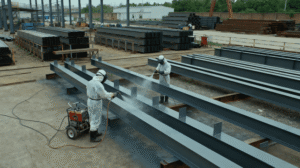
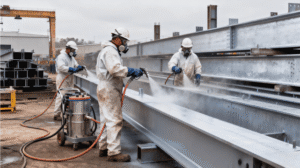
Many system decisions fail not because the category is wrong but because surface preparation and application conditions were underestimated.
ISO 12944 and related surface preparation standards highlight the critical role of appropriate blast cleaning or mechanical cleaning in achieving the intended system performance.
Higher categories such as C4 and C5, and severe marine cases, typically require stricter surface preparation (for example Sa 2.5 or SSPC-SP 10) and more disciplined application control; simply specifying a higher DFT without preparation control rarely solves the problem.
In RFQs, you should state whether full blast cleaning is possible, whether shop priming is involved, and what access or climate limitations exist at site.
Suppliers often have to adjust system recommendations when they learn that the real surface preparation will be power-tool cleaning only or that humidity and temperature cannot be controlled; this is easier and cheaper to handle at the specification stage than during execution.
Step 5 – Write a clear ISO 12944-based specification
A clear specification makes ISO 12944 work for you instead of against you.
Rather than simply stating “ISO 12944 C4 system,” you can structure your project information so that system design is traceable and defensible.
ISO 12944-based RFQ/specification checklist
Include:
- Project location and general environment (industrial, urban, coastal, marine, offshore).
- Corrosivity category (C1–C5, CX where relevant), referencing ISO 12944 guidance.
- Required durability range (Low, Medium, High, Very High) as years to first major maintenance.
- Substrate type and condition: new steel, shop-primed steel, or maintenance repaint.
- Surface preparation standard and method (e.g. ISO 8501/SSPC equivalent, blast or power-tool cleaning).
- Coating system architecture: primer / intermediate / topcoat, and target total DFT range.
- Any special performance requirements, such as UV durability, chemical splash resistance, colour retention, or fire protection interface.
HUILI’s guidance for steel structures repeatedly shows that RFQs with clear environment, durability, and system-architecture expectations produce faster and more accurate system recommendations.
It also reduces the risk that a product brochure is used as the entire specification.
Examples of system logic for typical projects
The examples below are simplified logic snapshots rather than full specifications or product recommendations.
Example 1 – C3 Medium, general industrial building steel
For a C3 Medium scenario in a typical industrial building, a two- or three-coat system can be sufficient, depending on importance and maintenance philosophy.
A common logic would be an anti-corrosion primer plus topcoat, or primer plus intermediate coat plus topcoat with a moderate total DFT range, if a longer maintenance interval is desired.
Example 2 – C4 High, coastal industrial steel
For C4 High exposure, such as exterior steel near coastal or more aggressive industrial atmospheres, ISO 12944 design logic and HUILI’s system guidance both point toward a more robust multi-coat system and higher DFT.
In many projects this means a primer plus high-build intermediate coat plus UV-resistant topcoat with tighter demands on surface preparation and application control.
Example 3 – C5 Very High, harsh industrial or marine-adjacent steel
For C5 Very High, including harsh industrial or heavily salt-laden coastal exposures, example systems in ISO 12944 and typical practice show higher total DFT ranges and often increased complexity in system architecture.
HUILI’s C5 guidance and marine systems articles note that system selection in these cases is strongly influenced by access, structural criticality, and inspection discipline.
If your project sits near marine or extreme exposure and needs more focused marine logic, see the C5-M & CX marine corrosion protection systems page once you have the basic ISO 12944 inputs in place.
Common mistakes when “choosing an ISO 12944 system”
Frequent mistakes include choosing a system only by corrosivity category, or simply writing “C4 paint” without durability, surface preparation, or application information.
Another common issue is ignoring the actual site constraints and copying an old system that does not match current access, climate, or maintenance requirements.
Other pitfalls:
- Using a product brochure as a full system specification with no mention of preparation or inspection.
- Treating every coastal or humid project as if it needed the heaviest possible system, leading to unnecessary complexity and cost.
- Not including complete project data in the RFQ, which forces multiple rounds of clarification and still leaves system responsibility unclear.
In HUILI’s project support experience, most early coating failures are linked to incomplete specifications and execution errors rather than to a lack of paint options.
FAQ
Can I choose a coating system only by corrosivity category?
No. Corrosivity category is only one input; durability target, surface preparation standard, and application constraints must also be considered for a realistic system choice.
Do I always need a zinc-rich primer for C4 or C5?
Zinc-rich primers are common in higher categories, but ISO 12944 also permits alternative systems such as high-build epoxies; the best choice depends on exposure, preparation, and inspection capability.
How do I decide between two- and three-coat systems?
Use environment severity, durability range, asset importance, and preparation quality to decide; higher categories and longer durability usually favour three-coat builds or heavier systems.
What information does a supplier need to recommend a system?
Suppliers need corrosivity category, durability target, substrate condition, preparation standard, application constraints, and any special performance requirements to give a system-level recommendation instead of a generic answer.
Technical Note
ISO 12944 is a framework that links environment, durability, and paint systems, but project teams must still align it with local conditions, surface preparation capability, and inspection scope.
Final system selection should always be confirmed against current ISO 12944 guidance, supplier TDS, and approved project specifications before purchase or application.
CTA
Send your project environment (with ISO 12944 category if known), durability target, steel structure type, surface preparation conditions, and any special performance requirements so our technical team can propose a suitable ISO 12944 anti-corrosion system for your steel structures and provide the corresponding TDS package.


 Chinese