Epoxy primer over rust can work only in limited maintenance conditions where the rust is tight, dry, clean, and allowed by the coating specification. For maintenance managers, EPC repair teams, coating applicators, and procurement teams, the real decision is not whether epoxy primer is “strong,” but whether the rusted steel can provide a stable and clean surface for adhesion.
This guide helps you decide when rust must be removed, when power tool cleaning may be acceptable, when abrasive blasting is required, and why epoxy primer fails over contaminated rust. It focuses on industrial steel repair, not automotive touch-up or DIY coating.
The Short Answer: Do Not Apply Epoxy Primer Over Loose Rust
Epoxy primer should not be applied directly over loose rust because the primer will bond to an unstable rust layer instead of sound steel. Loose, flaky, powdery, or laminated rust must be removed before priming, because these layers can detach under coating stress, moisture movement, or thermal cycling.
Epoxy primer over rust is sometimes acceptable only when the remaining rust is tightly adherent, the surface is dry, soluble salts are controlled, and the product TDS allows maintenance-grade application. In long-life systems, C4/C5 environments, immersion service, chemical exposure, or heavily corroded steel, abrasive blasting back to a specified cleanliness grade is usually safer.
A practical rule is simple: if the rust can be scraped, flaked, brushed off, or lifted at the edges, it is not a reliable base for epoxy primer.
First Diagnose the Rust Condition Before Choosing a Primer
Rust condition must be diagnosed before choosing a primer because loose rust, tight rust, mill scale, and flash rust have different adhesion risks. The same epoxy primer may perform well on abrasive-blasted steel but fail quickly on salt-contaminated rust or unstable mill scale.
Loose Rust Means the Primer Has No Stable Base
Loose rust means the corrosion layer is mechanically weak, so epoxy primer applied over it can peel with the rust instead of protecting the steel. In field repair, loose rust often appears as flakes, layers, powder, or scale that can be removed with scraping, wire brushing, or chipping.
The main failure mode is adhesion failure. The primer may appear to cover the surface at first, but moisture and oxygen can continue moving through the rust layer. Over time, the film may lift, crack, blister, or peel from the steel.
Tight Rust May Still Hide Active Corrosion
Tight rust may look stable, but it can still contain moisture, salts, and active corrosion cells under the surface. Some rust-tolerant maintenance coatings are designed to handle limited tightly adherent rust, but a standard epoxy primer may not be suitable unless the TDS clearly allows that condition.
For industrial repair, “tight rust” should not be judged only by appearance. The repair team should check whether the area is indoor or outdoor, whether the environment is coastal or chemical, whether the old coating is still bonded, and whether the required service life is short maintenance or long-term corrosion protection.
Mill Scale Is Not the Same as Sound Steel
Mill scale is a hard iron oxide layer formed during steel production, and it is not a reliable base for long-life epoxy primer systems. Although mill scale may look smooth and stable, it can detach locally and allow underfilm corrosion once moisture reaches the interface.
For severe service, mill scale is normally removed by abrasive blasting. If epoxy primer is applied over remaining mill scale, failure may appear as localized rust creep, blistering around breaks in the scale, or peeling after temperature and humidity cycling.
Flash Rust After Blasting Needs Fast Control
Flash rust is the light rusting that can appear after blast cleaning when bare steel is exposed to humidity, condensation, or delayed coating application. A very light and allowed flash rust grade may be acceptable for certain maintenance systems, but heavy or contaminated flash rust should not be ignored.
The risk is highest when blasted steel is left overnight, exposed to high humidity, or coated after the surface temperature falls close to the dew point. For epoxy primer on bare metal, timing matters: the prepared steel should be primed within the project’s allowed coating window.
Use This Rusted Steel Decision Table
A rusted steel decision table helps separate surfaces that can be primed after maintenance preparation from surfaces that must be cleaned more aggressively. Use this table before asking whether epoxy primer can go over rust.
| Site Condition | Can You Prime Over It? | Required Action | Main Failure Risk | Buyer Check |
|---|---|---|---|---|
| Loose, flaky rust | No | Remove rust completely by tool cleaning or blasting | Peeling, adhesion failure | Confirm rust removal method and inspection |
| Dry tight rust | Sometimes | Use approved maintenance preparation and compatible primer | Rust creep, shorter service life | Confirm TDS allows tightly adherent rust |
| Salt-contaminated rust | No | Wash, test, and remove soluble salts before coating | Osmotic blistering | Check chloride or salt contamination limits |
| Mill scale | No for long-life systems | Remove by abrasive blasting for severe service | Underfilm corrosion | Confirm surface cleanliness requirement |
| Flash rust after blasting | Depends | Control humidity and check allowed flash rust grade | Early blistering or adhesion loss | Confirm project specification and TDS |
| Bare metal after blasting | Yes | Control profile, cleanliness, and DFT | Low peak coverage if DFT is too low | Check surface profile and primer DFT |
| Old coating with local rust | Sometimes | Feather edges, clean rust, and check compatibility | Edge lifting, intercoat failure | Confirm recoatable epoxy primer compatibility |
For industrial maintenance projects, the table should be used together with the primer TDS, surface preparation standard, and exposure class. A short-term indoor repair may accept a lower preparation level than a coastal steel structure or tank exterior expected to perform for many years.
Match Surface Preparation to the Repair Risk
Surface preparation should match the repair risk, not just the available tool on site. A small indoor spot repair may be handled differently from a coastal steel structure, chemical plant pipe rack, or storage tank exterior.
Low-Risk Spot Repair
Low-risk spot repair may use hand tool cleaning or localized power tool cleaning when the rust area is small, dry, non-immersed, and outside severe industrial exposure. This level is usually a maintenance compromise, not the best long-life specification.
Hand tool cleaning can remove loose rust, loose coating, and visible contamination, but it cannot create the same profile and cleanliness as abrasive blasting. For epoxy primer over rust, this approach should be limited to low-risk areas where shorter service life is acceptable.
Medium-Risk Maintenance Recoating
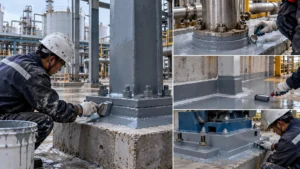
Medium-risk maintenance recoating usually requires power tool cleaning, edge feathering, spot priming, and compatibility checks with the existing coating. This is common when the old coating is mostly bonded but localized rust appears at welds, edges, bolts, or damaged areas.
A recoatable epoxy primer can be useful in this situation if it is compatible with the old coating and allowed surface condition. However, the repair team should still remove loose rust, clean salts and dust, and confirm whether the next coat can bond to both old coating and repaired areas.
High-Risk Long-Life Protection
High-risk long-life protection usually requires abrasive blasting to a specified cleanliness level, especially for C4/C5 exposure, coastal sites, chemical plants, immersion areas, or heavily corroded steel. Near-white metal blast cleaning such as SSPC-SP 10 / NACE No. 2 is used when most rust, coating, and mill scale must be removed, with staining limited to a small percentage of the surface; AMPP describes this standard as a dry abrasive blast method for preparing carbon steel to near-white metal cleanliness.
For blasted steel, surface profile also matters. ASTM D4417 covers field, shop, and laboratory methods for measuring the profile of abrasive blast-cleaned surfaces, which helps verify whether the profile matches the primer’s required DFT range.
Why Epoxy Primer Fails When Rust Is Left Under the Film
Epoxy primer often fails over rust because contamination, moisture, weak rust layers, or mill scale remain trapped under the coating film. These failures may not appear immediately after application, but they can develop after wet-dry cycles, temperature changes, or exposure to salts.
Blistering from Soluble Salts
Blistering from soluble salts occurs when chlorides or other salts remain on the rusted steel and attract moisture through the coating film. This can create osmotic blistering, especially in coastal, marine, chemical, or high-humidity environments.
The coating may look smooth after application, but pressure builds under the film as moisture moves toward the salt-contaminated surface. This is why salt removal and testing are critical before applying epoxy primer over rusted steel.
Peeling from Weak Rust Layers
Peeling occurs when epoxy primer bonds to loose rust instead of mechanically sound steel. In this case, the coating failure is not always caused by poor primer chemistry; it is caused by a weak substrate layer.
This failure is common when rust is only covered visually but not removed mechanically. Once the rust layer expands or detaches, the primer film lifts with it.
Rust Creep from Edges and Welds
Rust creep starts at edges, welds, bolts, scratches, or coating breaks where DFT is often lower and surface preparation is harder to control. Even when flat areas are cleaned well, weld spatter, sharp edges, and old coating transitions can create weak points.
Stripe coating is often needed in industrial repair because spray application may leave thin film on edges and corners. Without edge control, rust can move under the coating from small defects and expand beyond the original repair area.
Underfilm Corrosion from Mill Scale
Underfilm corrosion can develop when epoxy primer is applied over mill scale or partially detached oxide layers. Mill scale may delay visible rusting at first, but once moisture enters cracks or breaks, corrosion can spread below the coating.
This is why epoxy primer on bare metal after proper blasting is usually more reliable than epoxy primer over a mixed surface of mill scale, rust, and old coating. Bare metal preparation gives the applicator better control over cleanliness, profile, and DFT.
Bare Metal Is Not Always Required, But It Is the Safer Specification
Bare metal is not always required for every repair, but it is usually the safer specification for severe exposure, long service life, and high-value steel assets. The decision depends on risk level, shutdown time, budget, exposure environment, and the owner’s durability target.
For small indoor maintenance, removing loose rust and using an approved maintenance primer may be acceptable. For outdoor steel in coastal or industrial environments, abrasive blasting and a full coating system are usually more reliable. For tanks, pipelines, and chemical exposure, the tolerance for rust and contamination should be much lower.
ISO 8501-1 is commonly referenced for rust grades and preparation grades of steel surfaces before coating, including uncoated steel and steel after previous coating removal. This type of visual grading helps specifiers avoid vague instructions such as “remove rust” and instead define a measurable preparation target.
For projects where rust is widespread, it may be better to move from spot repair to full removal and recoating. A lower preparation level can reduce immediate cost, but it may increase future failure, rework, and shutdown frequency.
Send These Details Before Asking for a Maintenance Primer
A useful maintenance primer request should include rust photos, old coating condition, surface preparation limits, exposure environment, and expected service life. Without these details, a supplier can only give a generic epoxy primer recommendation, not a reliable repair system.
Before requesting advice, prepare:
- Close-up photos of rust, welds, edges, and coating breaks
- Wide-view photos showing the asset and affected area
- Asset type: steel structure, tank exterior, pipeline, platform, machinery, or equipment
- Rust condition: loose rust, tight rust, flash rust, or mill scale
- Approximate rusted area percentage
- Old coating type, if known
- Whether old coating is peeling, chalking, blistering, or still bonded
- Available preparation method: hand tool, power tool, abrasive blasting, or water washing
- Exposure: indoor, outdoor, coastal, chemical, immersion, or high humidity
- Shutdown time and access limitations
- Target service life, such as 2–3 years maintenance or 8–15 years protection
- Required topcoat, color, or weathering resistance
For repair coating selection, connect the primer decision with an anti-rust and primer coating series and a practical surface preparation for industrial coatings review. If the project already shows blistering, peeling, or underfilm corrosion, the broader steel structure coating failure causes should also be checked before repainting.
FAQ About Epoxy Primer Over Rust
Can epoxy primer be applied directly over rusted steel?
Epoxy primer should not be applied directly over loose, wet, salt-contaminated, or flaky rusted steel. It may be used over tightly adherent rust only when the surface is dry, cleaned to the specified level, and the primer TDS allows that maintenance condition.
What happens if I apply epoxy primer over loose rust?
If epoxy primer is applied over loose rust, the coating may peel because the primer bonds to the rust layer instead of sound steel. The most common failure modes are adhesion loss, rust creep, blistering, and underfilm corrosion within wet-dry or temperature cycling.
Is tight rust acceptable under epoxy primer?
Tight rust may be acceptable only in limited maintenance applications where the primer is designed for that surface condition. For severe C4/C5 exposure, immersion service, or long-life systems, abrasive blasting to a defined preparation grade is normally more reliable.
Is epoxy primer better on bare metal than over rust?
Epoxy primer is usually more reliable on properly prepared bare metal because cleanliness, anchor profile, and DFT can be controlled. After abrasive blasting, surface profile should be checked by a method such as ASTM D4417, and the primer DFT must be high enough to cover the profile peaks.
Can power tool cleaning replace abrasive blasting before epoxy primer?
Power tool cleaning can be acceptable for localized maintenance repair, but it does not usually replace abrasive blasting for severe rust, mill scale, C4/C5 exposure, chemical service, or long-life coating systems. Power tool cleaning is a compromise when blasting is not practical, not an equal substitute for all specifications.
Why does epoxy primer blister over rust?
Epoxy primer blisters over rust mainly because soluble salts, moisture, or active corrosion remain under the coating film. Osmotic blistering is common when chloride contamination is trapped below the primer and continues attracting moisture through the coating.
Request a Rusted Steel Coating Review
The safest way to decide whether epoxy primer over rust is acceptable is to review the rust condition, contamination risk, surface preparation level, and target service life together. A primer recommendation should be based on field photos, surface condition, exposure environment, DFT target, and whether blasting or power tool cleaning is possible.
For maintenance repair support, send rust photos, old coating history, available preparation method, exposure condition, shutdown window, and expected service life through the maintenance coating technical support form. HUILI can help check whether the project needs spot repair, a recoatable epoxy primer, abrasive blasting, or a more complete anti-corrosion coating system.