Global industrial projects face growing pressure to lower cost without sacrificing coating performance, documentation quality, or long-term asset protection. In practice, the decision to buy industrial coating is rarely just a price comparison, because the wrong supplier can trigger coating failure, delivery delays, and expensive maintenance later in the project lifecycle.
This guide is written for engineers, EPC contractors, procurement teams, and distributors in the Middle East, Southeast Asia, and Central Asia who need to evaluate manufacturers in China with more discipline. After reading, you will be able to compare supplier types, audit factory capability, match coating systems to exposure class, and build a cleaner procurement workflow from RFQ to shipment.
What buying industrial coating really means in B2B projects
In industrial projects, to buy industrial coating means selecting both a coating system and the supplier capability behind it, not simply ordering a drum of paint. That is why experienced buyers check corrosion environment, system compatibility between primer and topcoat, expected service life, and the manufacturer’s ability to support specification, inspection, and export delivery before they approve a vendor.
This is also why supplier background matters early in the process. A good first check is the manufacturer’s company background and production profile, because it helps buyers confirm whether they are dealing with a direct factory rather than a trader with limited control over production and quality.
China remains attractive for industrial coating sourcing because buyers often find a combination of broad product range, scalable production, and export-oriented support in one market. For large projects, that matters more than headline price, since lifecycle cost is usually driven by coating durability, maintenance frequency, and the supplier’s ability to keep batch quality stable across repeated orders.
Compare supplier types before you audit the factory
Not every supplier in China plays the same role in your project supply chain, and that difference affects risk, speed, and accountability. In practice, buyers usually encounter three models: direct manufacturers, mid-size specialized factories, and trading companies.
The core evaluation checklist should cover five areas.
- Production capability, including annual capacity, product families, and whether the supplier can support epoxy, polyurethane, zinc-rich, and other relevant systems in one workflow.
- Quality control, including raw-material inspection, batch consistency, and documented inspection records.
- Technical capability, including whether the team can recommend systems by corrosivity class instead of only pushing stock products.
- Export experience, including dangerous goods packaging, labeling, and shipment documentation for international transport.
- Project relevance, including experience with steel structures, pipelines, tanks, offshore work, or other application areas that resemble your own scope.
A factory audit should then move from brochure claims to physical evidence. On site, buyers should review production lines, laboratory capability, warehousing, and logistics handling; if a China visit is not practical, the fallback option is a remote video tour combined with document review and sample testing.
When reviewing manufacturer capability, it also helps to compare the supplier’s public technical footprint with its product and industry pages. Huili’s site structure includes dedicated content for industrial coating manufacturers in China, steel structures, pipelines, marine projects, and corrosion categories, which is the kind of breadth buyers usually expect from a direct manufacturer rather than a pure trader.
Match the coating system to the exposure, not just the product label
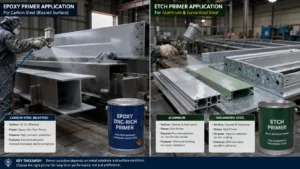
One common sourcing mistake is buying “paint” as a standalone product instead of specifying a full coating system around environment, service life, and application method. In real projects, performance usually depends on how primer, intermediate, and topcoat work together, as well as whether the system is designed for the correct corrosivity range under ISO 12944-5.
A practical starting point looks like this:
The exact system should always be adapted to substrate condition, application method, and maintenance strategy, but the procurement lesson is simple: system design should come before price comparison. Buyers who skip that step often end up with incompatible layers, underbuilt film thickness, or a low-cost topcoat placed over the wrong primer for the service environment.
This matters across different asset types. Structural steel usually needs long-term atmospheric corrosion protection, pipelines may require different logic for internal and external service, storage tanks often introduce lining and chemical-resistance issues, and offshore assets combine humidity, salt spray, and difficult maintenance access in one specification challenge.
Build a cleaner procurement workflow and avoid common sourcing mistakes
A stronger procurement process usually follows six steps.
- Define project requirements, including environment class, substrate, service conditions, target service life, and application method.
- Request a coating system recommendation instead of only asking for a unit price.
- Evaluate the supplier through document review and, where possible, a factory audit.
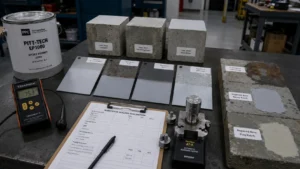
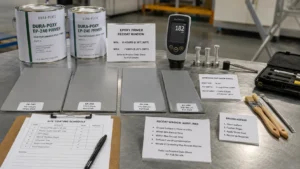
- Confirm samples or panels before full production when the project is technically sensitive.
- Lock the order scope, color, packaging, inspection points, and delivery plan.
- Review production, quality inspection, and shipment documents before dispatch.
Lead time and MOQ also need early discussion because standard items and custom systems do not move at the same speed. Standard products may ship faster, while customized color, packaging, or system adjustments can extend planning, batch approval, and export preparation time.
Shipping matters too. Industrial coatings often move under dangerous-goods rules, so labeling, packaging, and vessel documentation should align with the IMDG Code for maritime transport. Buyers who ignore that step can face avoidable delays even after production is complete.
The most common sourcing mistakes are consistent across markets: choosing the cheapest supplier without checking system design, skipping the factory audit, and sending vague technical requirements that leave too much room for interpretation. Working with a direct manufacturer reduces those gaps because buyers usually get better control over formulation, technical support, and repeat-order stability than they do through a trading chain.
FAQ and project inquiry
How to find reliable industrial coating manufacturers in China?
Start by screening whether the supplier is a direct factory, whether it publishes meaningful technical content across product and application areas, and whether it can discuss system selection rather than only price. Then verify production, QC, export handling, and project-fit evidence through a document review and, ideally, a factory audit.
What should I check during a coating factory audit?
Focus on production line control, lab capability, raw-material and batch records, storage conditions, and export documentation readiness. If the supplier cannot show clear control over those points, it will be difficult to trust consistency on larger orders.
Is it safe to buy industrial coatings from China?
It can be safe and commercially effective when the supplier has documented QC, export experience, and the technical ability to recommend systems based on exposure class rather than generic product claims. The bigger risk usually comes from weak supplier screening, not from the country of origin itself.
What is the typical lead time for industrial coatings?
Lead time depends on whether the order is standard or customized, how large the batch is, and how much export handling is required. Buyers should confirm production window, packaging plan, dangerous-goods documentation, and dispatch schedule before placing the PO.
How to ensure coating quality consistency?
Ask for raw-material control records, batch inspection logic, retention samples, and a clear explanation of how the supplier manages repeat production. Consistency is much easier to maintain when the same factory controls formulation, production, QC, and shipment preparation under one system.
What certifications should a coating supplier have?
The answer depends on your project and market, but buyers should at minimum review the supplier’s quality-management documents, relevant test references, and the standards logic behind system recommendations. If the project is export-sensitive, packaging and transport compliance documents are also important.
What is the difference between a manufacturer and a trading company?
A manufacturer controls production, QC, and formulation decisions directly, while a trading company usually coordinates communication and sourcing across external plants. For technically demanding projects, that difference often affects accountability, traceability, and the supplier’s ability to solve problems when site conditions change.
Request a sourcing-ready proposal
If your goal is to buy industrial coating for steel structures, pipelines, tanks, or offshore assets, the best next step is to send complete project data rather than ask only for a price list. A useful inquiry should include corrosivity class such as C2–C5, substrate type, asset details, expected service life, application method, surface condition, drawings, and any temperature, humidity, chemical, coastal, or offshore service conditions that affect system design.
With that information, the supplier can return a more accurate system recommendation, relevant TDS documents, and a project-based quotation instead of a generic offer. To move forward with Huili, send your requirements through the industrial coating contact page so the technical team can review the project and prepare a sourcing-ready proposal.