Industrial tank lining for chemical storage is a chemically engineered barrier system for immersion service, not a standard internal coating choice. For EPC contractors, corrosion engineers, asset owners, and procurement teams in the Middle East, Southeast Asia, and Central Asia, the main decision is whether the selected lining chemistry, surface preparation, DFT range, cure control, and inspection plan can match the stored media.
Chemical tank lining fails quickly when resin chemistry, concentration range, temperature, surface preparation, or cure condition is mismatched. A lining that looks smooth after application can still blister, soften, crack, or delaminate after service if the chemical list and tank zones were not defined before specification.
For broader tank corrosion protection packages, many projects start by reviewing storage tank and pipeline coating systems before narrowing the internal lining selection by chemical exposure, immersion type, and inspection requirements.
Quick Guide for Industrial Tank Lining Selection
Industrial tank lining selection should start with chemical exposure, not product category names. Before choosing chemical tank liners, define the stored media, concentration range, temperature range, immersion zones, surface preparation standard, and inspection hold points.
| Selection Item | Required Project Input | Typical Engineering Check | Failure Risk If Missed |
|---|---|---|---|
| Chemical list | Acid, alkali, solvent, waste media, cleaning chemicals | Confirm compatibility with resistance data | Softening, swelling, chemical attack |
| Concentration range | Normal and worst-case concentration | Check whether dilution or concentration changes occur | Unexpected resin breakdown |
| Temperature range | Operating, cleaning, hot-fill, thermal cycling | Confirm resistance at temperature, not only ambient | Faster permeation, cracking |
| Tank zone | Floor, lower shell, upper shell, roof, nozzles, vapor zone | Separate immersion, splash, and vapor exposure | Unprotected vapor corrosion |
| DFT range | Commonly 400–600 µm; 800 µm+ for heavier-risk zones | DFT mapping by zone | Pinholes, thin spots, stress cracking |
| Surface preparation | Often Sa 2.5 with 50–75 µm profile | Confirm profile, salts, dust, weld condition | Delamination at steel interface |
| Inspection | Holiday test, DFT, cure, recoat interval | Hold points before immersion service | Early blistering and repair risk |
Chemical tank lining should be specified as a system: resin type, primer or lining build, stripe coat plan, surface preparation, DFT map, cure verification, and repair workflow.
Why Chemical Storage Tanks Require Specialized Lining Systems
Chemical storage tanks require specialized lining systems because continuous immersion, vapor condensation, and thermal cycling create stronger failure drivers than atmospheric exposure. In immersion service, chemical compatibility and permeation resistance are more important than gloss, hardness, or simple dry film thickness.
Continuous Chemical Immersion
Continuous chemical immersion exposes the lining film to constant liquid contact, which increases permeation risk. In this condition, even small holidays, pinholes, weld defects, or under-cured areas can become starting points for blistering and underfilm corrosion.
A tank lining epoxy used in immersion service must be matched to both the stored medium and the exposure duration. A system suitable for intermittent splash may not be suitable for 24-hour liquid contact over several years.
Acid and Alkali Attack
Acid tank lining and alkali resistant tank liner requirements can be completely different because acids and caustics attack different polymer structures. A single line item such as “chemical resistant coating for steel” is not enough for procurement or engineering control.
For acid service, engineers normally define acid name, concentration range, temperature range, cleaning cycle, and vapor exposure. For alkali service, caustic type, concentration, hot cleaning conditions, and wet-dry cycling should be confirmed before selecting chemical tank liners.
Solvent Penetration
Solvent resistant tank liner selection must consider aromatic content, blend variability, and vapor phase exposure. Solvents can penetrate and soften many polymers even when the lining does not visibly dissolve.
In solvent storage, cure completeness becomes critical. An under-cured film can absorb solvent faster, lose hardness, and develop blistering or softening under immersion conditions.
High Temperature Chemical Exposure
High temperature chemical exposure increases permeation rate and reaction rate, reducing the safety margin of many lining systems. A lining that performs at ambient temperature may not perform at 50–80°C if the chemical concentration is high or thermal cycling is frequent.
High temperature tank lining selection should therefore use the full operating temperature range, not only the average tank temperature.
Vapor Phase Chemical Corrosion
Vapor zones can concentrate chemicals through condensation and evaporation cycles, so the upper shell, roof, nozzles, and vent areas should be treated as their own exposure zones. A common field mistake is specifying only “internal lining” without defining vapor zone protection, stripe coating, inspection points, or repair methods.
Chemical Resistance Mechanisms in Chemical Tank Liners
Chemical tank liners survive aggressive storage through a combination of film continuity, polymer chemistry, crosslink density, and permeation control. No single property can guarantee performance if the chemical list or application control is incomplete.
Key resistance mechanisms include:
- Barrier protection: Continuous film build, defect control, and proper DFT reduce pathways for underfilm corrosion.
- Crosslink density: Tighter polymer networks often improve resistance to swelling and softening in aggressive media.
- Chemical compatibility: Some chemicals attack specific functional groups, so resistance is not interchangeable between acids, alkalis, and solvents.
- Permeation resistance: A lining may resist visible dissolution but still allow slow chemical diffusion that causes blistering at the steel interface.
- Thermal stability: Elevated temperature and thermal cycling can reduce chemical resistance margin and increase stress cracking risk.
Decision rule: if the stored medium includes strong acids, alkalis, aromatic solvents, mixed chemical waste, or elevated temperature, require chemical resistance data during RFQ review rather than relying on a generic “chemical resistant” claim.
Industrial Tank Lining Materials for Chemical Storage
Industrial tank lining materials should be selected according to chemical type, concentration, temperature, immersion duration, and inspection capability. The most common mistake is choosing a material family first, then trying to make the service condition fit that product.
Novolac Epoxy Chemical Tank Lining
Novolac epoxy tank lining is often selected for aggressive chemical storage where standard epoxy systems may not provide enough resistance margin. Its higher crosslink density can improve resistance against certain acids, solvents, and elevated-temperature service when properly cured.
Where it fits:
- Strong acids and aggressive chemical storage where standard epoxy systems are risky.
- Solvent exposure and petrochemical storage where softening risk must be controlled.
- Higher temperature chemical service where operating temperature affects permeation rate.
What buyers often forget:
- A “novolac” label does not replace chemical list and temperature confirmation.
- Chemical resistance depends on cure quality, ventilation, mixing ratio, and recoat interval control.
- Surface preparation and holiday testing remain mandatory because even strong resin chemistry cannot protect exposed steel defects.
Phenolic Epoxy Tank Liner
Phenolic tank liner systems are often evaluated when solvent resistance and chemical resistance exceed standard epoxy capability. Epoxy phenolic lining is commonly considered for fuel, solvent, and petrochemical storage where long-term softening and permeation must be controlled.
For procurement teams, epoxy phenolic lining should be reviewed with resistance data for the actual solvent blend, operating temperature, and vapor phase. A generic statement such as “solvent resistant” is too broad for chemical storage tank lining specifications.
Glass Flake Reinforced Chemical Tank Lining
Glass flake tank lining uses flake reinforcement to increase the diffusion path through the lining film. This can improve permeation resistance and mechanical durability where chemical exposure is combined with abrasion, cleaning cycles, or localized impact.
Glass flake reinforced systems are often considered for aggressive chemical tanks, wastewater tanks, and heavy-duty immersion service coating where both chemical and mechanical resistance matter.
Vinyl Ester Tank Lining
Vinyl ester tank lining is often considered for advanced chemical storage where certain acids, solvents, or elevated temperatures exceed the comfort zone of many epoxy-based systems. It can be a strong option in specific chemical services, but it requires strict control of surface preparation, application conditions, cure, and repair method.
Vinyl ester should be treated as a system decision, not a simple material substitution. Rework and field repair may differ from common epoxy lining practices.
Practical Material Comparison
| Lining Material | Typical Strength | Main Limitation | Common Chemical Storage Use |
|---|---|---|---|
| Standard epoxy | Good general barrier protection | Limited resistance to strong acids, solvents, or high heat | Mild chemical service, water, moderate immersion |
| Novolac epoxy | Higher chemical and temperature resistance | Requires strict cure and media confirmation | Stronger acids, petrochemical storage, elevated temperature |
| Epoxy phenolic lining | Better solvent and fuel resistance than many standard epoxies | Must confirm blend and vapor exposure | Fuel, solvent, aromatic chemical service |
| Glass flake lining | Longer diffusion path and better mechanical durability | Application control and repair details are important | Abrasive chemical service, wastewater, heavy immersion |
| Vinyl ester lining | Strong resistance for selected aggressive chemicals | More demanding application and repair workflow | Specialized acids, high chemical exposure, elevated temperatures |
Chemical Tank Lining by Acid, Alkali, and Solvent Type
Chemical tank lining should be selected by chemical type, concentration, temperature, and tank zone. Acid, alkali, solvent, and waste services create different attack mechanisms, so one universal chemical tank liner specification is unsafe.
Acid Tank Lining
Acid tank lining must separate strong acids from diluted acids and define temperature range before material selection. Stronger acid service often pushes engineers toward novolac epoxy tank lining, glass flake reinforced lining, or other high-resistance systems, but final selection must be confirmed against resistance data.
RFQ data should include acid name, concentration range, normal and peak temperature, cleaning chemicals, and whether the tank experiences water flushing. Acid dilution and residue can change the actual corrosion mechanism inside the tank.
Alkali Resistant Tank Liner
Alkali resistant tank liner selection should define caustic type, concentration, temperature, and cleaning regime. Caustic tank failures often result from incomplete media definition, poor surface preparation, or under-cured lining film rather than only product selection.
For high-pH service, verify both immersion resistance and recoat interval control. Thin spots around weld seams, nozzles, and floor-to-shell transitions are common starting points for underfilm corrosion.
Solvent Storage Tank Lining
Solvent resistant tank liner systems must be selected against the actual solvent blend, vapor exposure, and operating temperature. Aromatic solvents, fuel blends, and variable feedstock can create higher permeation and softening risk than a single chemical name suggests.
In solvent service, cure completeness should be treated as an inspection hold point before filling the tank. Solvent immersion before full cure can permanently reduce lining resistance.
Chemical Waste Tank Lining
Chemical waste tank lining is often a mixed-media problem, so the specification should be based on worst-case exposure rather than average waste composition. Waste tanks may see acids, alkalis, solvents, salts, cleaning agents, and temperature swings in the same operating cycle.
For chemical waste service, require clear repair procedures, holiday testing, and acceptance criteria before award. The lining must be maintainable, not only resistant at the start of service.
Temperature Considerations in Chemical Tank Lining
Temperature changes the industrial tank lining risk profile by increasing permeation, reducing resistance margin, and adding thermal stress. This is why chemical resistance should be checked at the actual operating temperature range, not only at 23°C laboratory conditions.
Higher temperatures can create three practical risks:
- Accelerated permeation: More chemical molecules pass into the film, increasing blistering risk.
- Thermal cycling stress: Repeated hot-fill and cool-down cycles can crack linings at weld seams, edges, and corners.
- Reduced resin margin: Some systems that are acceptable at ambient temperature may become unsuitable at elevated process temperature.
Decision rule: if the tank is near heat sources or receives hot chemical feed, specify normal temperature, maximum temperature, cleaning temperature, and cycling frequency in the RFQ.
Chemical Tank Lining Thickness Requirements
Chemical tank lining thickness should be treated as a design range, not as a substitute for chemical compatibility. Many chemical storage tank lining projects start with high-build systems around 400–600 µm, then increase to 800 µm+ in heavier-risk zones when the lining chemistry and application controls justify it.
Thicker lining does not fix resin mismatch. If the chemical attacks the polymer structure, increasing DFT may only delay failure while adding cure stress, solvent retention, or cracking risk.
Inspection Checklist for Thickness and Defects
DFT mapping should be completed by tank zone because the floor, lower shell, upper shell, roof, nozzles, and weld seams do not share the same application risk. For immersion service, the inspection plan should define both minimum and maximum DFT acceptance ranges.
Key QC checks include:
- Measure DFT by zone after each coat or at defined hold points.
- Track recoat intervals to prevent intercoat adhesion failure.
- Perform holiday test where specified, especially on floors, weld seams, and repairs.
- Verify stripe coats at welds, edges, corners, pits, and nozzle transitions.
- Confirm cure condition before introducing chemical service.
For detailed thickness control logic, engineers can compare this lining plan with tank coating thickness DFT guidelines during specification review.
Surface Preparation for Chemical Tank Lining
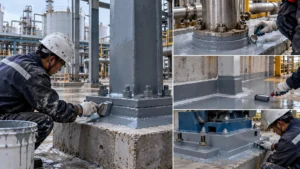
Surface preparation for chemical tank lining is less forgiving than external atmospheric coating because failures occur under continuous immersion. A common baseline is Sa 2.5 blasting, 50–75 µm surface profile, salt contamination control, weld grinding where required, and stripe coating at weld seams and edges.
Sa 2.5 surface preparation is often used for high-performance lining systems because it provides both cleanliness and mechanical anchor profile. ISO 8501-1 is commonly used to define visual cleanliness grades for prepared steel substrates before coating and lining application.
Surface preparation should also include:
- Degreasing before blasting where oil or grease is present.
- Removal of sharp edges, weld spatter, laminations, and undercut defects.
- Surface profile measurement against the lining TDS.
- Soluble salt testing where coastal exposure, chemical residue, or old tank service may leave contamination.
- Dust testing before primer or lining application.
For practical inspection alignment between EPC teams and contractors, surface preparation for industrial coatings can support the surface cleanliness and SSPC / ISO discussion.
Field mistake: allowing blasted steel to sit in humid conditions before lining application can cause flash rust or recontamination, then the chemical tank liner is blamed when blistering appears later.
Inspection and QC for Chemical Tank Liners
Inspection and QC for chemical tank liners should verify surface preparation, DFT, holidays, cure, and repair acceptance before the tank enters service. For aggressive chemical storage, inspection is not an optional final check; it is part of the lining design.
A practical QC plan should include:
- Surface preparation acceptance records and hold points.
- Surface profile and salt test reports before lining.
- DFT mapping by floor, shell, roof, nozzle, and weld area.
- Holiday test plan with specified voltage and acceptance criteria.
- Cure verification method before chemical filling.
- Repair and retest workflow for holidays, thin spots, or mechanical damage.
Holiday testing is especially important for immersion service coating because pinholes can expose steel directly to chemical attack. ASTM D5162 is commonly referenced for discontinuity testing of nonconductive protective coating films on metallic substrates.
Common Failures in Chemical Tank Lining Systems
Common failures in chemical tank lining systems usually come from chemical mismatch, contamination, incomplete cure, holidays, thin spots, or missed stripe coats. When failure is widespread, patching only the visible defect rarely solves the root cause.
Typical failure patterns include:
- Chemical tank liner blistering: Often linked to permeation, soluble salts, trapped moisture, or incomplete cure.
- Chemical attack failure: Usually caused by resin mismatch to chemical type, concentration, or temperature.
- Delamination in acid tank areas: Often starts at weld seams, edges, or profile peaks where stripe coats were missed.
- Localized underfilm corrosion: Commonly driven by holidays, pinholes, mechanical damage, or repair gaps.
- Softening or swelling: Frequently associated with solvent exposure, incomplete cure, or incorrect resin selection.
For broader root-cause training and maintenance planning, compare these patterns with industrial coating failure causes and prevention before finalizing a repair specification.
How to Select the Right Industrial Tank Lining System
The right industrial tank lining system is selected by translating operating data into resin chemistry, thickness range, surface preparation, and QC requirements. A useful specification should be executable by the applicator and verifiable by the inspector.
Step 1 – Identify Chemical Type
List all stored chemicals, cleaning agents, contamination risks, and possible future service changes. Chemical tank lining selection should not be based only on the main product name if cleaning chemicals or residues are present.
Step 2 – Determine Concentration Range
Define concentration as a range, not a single value. Chemical concentration can change during storage, evaporation, reaction, dilution, cleaning, or process upset.
Step 3 – Determine Operating Temperature
Define normal operating temperature, maximum temperature, cleaning temperature, and thermal cycling. Temperature can turn an acceptable chemical lining into a high-risk system if the resistance data was only checked at ambient conditions.
Step 4 – Define Immersion Type
Separate continuous immersion, intermittent immersion, splash, vapor, and condensation zones. Floors, lower shells, roofs, nozzles, vents, and weld transitions may require different stripe coat attention or DFT control.
Step 5 – Define Service Life and Inspection Interval
Define whether the tank requires 5–10 years, 10–15 years, or 15–20+ years of expected service with planned inspections. Longer service expectations require stronger resistance margin, stricter surface preparation, and more detailed QC documentation.
Practical requirement: request a chemical resistance chart or written media confirmation from the lining manufacturer during submittals. “Chemical resistant” is not a complete specification.
Choosing Reliable Industrial Chemical Resistant Coating Manufacturers
Industrial chemical resistant coating manufacturers should be evaluated by technical support capability, not only price or product list. Aggressive chemical storage is a high-consequence service, so suppliers should help define lining chemistry, thickness range, inspection plan, and repair method.
Before award, ask:
- Can the supplier recommend a complete industrial tank lining system for the chemical list and temperature range?
- Can they provide TDS documentation, resistance guidance, and application instructions for confined-space work?
- Can they support DFT range selection, recoat interval control, cure control, and repair procedures?
- Can they help align internal lining with external tank corrosion protection if both are included in the same procurement package?
- Can they respond to technical questions during execution, not only during sales quotation?
If the procurement scope includes internal lining and external tank protection, tank coatings can be reviewed as part of the broader system package.
FAQ
What is the best industrial tank lining for chemical storage?
The best industrial tank lining for chemical storage depends on chemical type, concentration range, operating temperature, immersion zone, and required inspection plan. For aggressive acids, solvents, or elevated temperatures, engineers often compare novolac epoxy, epoxy phenolic lining, glass flake systems, and vinyl ester lining before final selection.
A lining should be confirmed against chemical resistance data and the project TDS. A generic “chemical resistant” description is not enough for immersion service.
How thick should chemical tank lining be?
Chemical tank lining often starts around 400–600 µm DFT for many storage services, with 800 µm+ used in heavier-risk zones when the specification and application conditions justify it. The final thickness range should be set by chemical exposure, tank geometry, abrasion risk, and inspection requirements.
Thickness does not fix resin incompatibility. Select the correct chemistry first, then control DFT by zone.
Can epoxy resist strong acids in chemical tanks?
Some epoxy systems can resist certain acids under defined concentration and temperature ranges, but strong acids or elevated temperatures often require higher-resistance chemistries. Novolac epoxy tank lining, epoxy phenolic lining, glass flake reinforced systems, or vinyl ester may be evaluated depending on the service.
The final decision should be supported by chemical resistance charts or written media confirmation from the supplier.
What causes blistering in acid tank lining?
Blistering in acid tank lining is commonly caused by chemical permeation, soluble salt contamination, incomplete cure, holidays, pinholes, or thin spots at weld seams and edges. In many cases, the blister starts at the steel interface rather than in the visible top surface.
A QC plan should include surface preparation records, DFT mapping, holiday testing where specified, and cure verification before chemical immersion.
Is vinyl ester better than epoxy for chemical storage tanks?
Vinyl ester can be better than epoxy for certain aggressive chemicals and elevated temperature services, but it is not automatically better for every tank. The correct choice depends on chemical type, concentration range, temperature range, repair method, and application control.
Epoxy, novolac epoxy, epoxy phenolic, glass flake, and vinyl ester should be compared against the actual media list rather than selected by general product category.
RFQ Checklist for Chemical Tank Lining Projects
A complete RFQ for chemical tank lining should include tank data, chemical exposure, surface preparation requirements, DFT targets, inspection method, and site constraints. The more complete the RFQ, the more accurate the lining recommendation and quotation will be.
Send the following details:
- Tank size, substrate, and condition: new build, repair, pitted steel, or old lining removal.
- Full chemical list, concentration ranges, and possible contaminants.
- Operating temperature range and thermal cycling pattern.
- Immersion type by zone: continuous immersion, intermittent immersion, splash, vapor, roof, and nozzles.
- Requested chemical tank lining thickness ranges and DFT reporting requirements.
- Surface preparation standard, profile range, and salt contamination control approach.
- Inspection plan requirements, including holiday test and cure verification.
- Shutdown window, ventilation plan, access limits, and confined-space constraints.
- Required service life and planned maintenance interval.
Technical Note
Industrial tank lining performance depends on chemical compatibility, concentration, temperature, immersion zoning, substrate condition, surface preparation quality, cure control, DFT mapping, and inspection acceptance criteria. Final system selection should be confirmed against the applicable TDS, chemical resistance data, and project specification before procurement and application.
Request a Chemical Tank Lining Recommendation
Send your chemical list, concentration range, temperature range, tank size, substrate condition, and target service life so our manufacturer technical team can recommend a suitable lining system and provide TDS or RFQ support.
For project review, use the industrial coating technical support contact and include drawings, tank zones, service conditions, and inspection requirements.