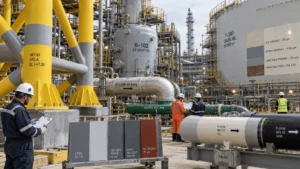
Industrial tanks fail quietly: corrosion often starts under deposits, at weld seams, and around nozzles, then shows up as leaks, contamination, or unplanned shutdowns. A properly engineered industrial tank coating scope separates internal tank lining decisions from external atmospheric protection, and then ties both to inspection and maintenance reality.
Quick Guide
- Define exposure first: immersion inside the tank needs tank lining, exterior weather needs tank coating.
- Select the tank liner by stored media and operating conditions, not by brand name alone.
- Specify thickness as ranges and verify DFT across floors, welds, and critical geometry.
- Control surface preparation and contamination, most failed tank liner cases start here.
- Send an RFQ with media, temperature, prep standard, access plan, and QA documents to your coating tank supplier.
What is industrial tank coating
Industrial tank coating usually refers to protective coatings applied to tank exteriors and associated steel, mainly to resist atmospheric corrosion, UV exposure, and general weathering. In the field, people also use “tank coating” as a broad term that includes internal protection, but internal immersion service is more accurately addressed by tank lining and tank liner systems.
A practical way to avoid specification errors is to separate the scope into two lines: tank lining for internal immersion protection and industrial tank coating for external atmospheric protection.
Tank lining vs tank coating: what’s the difference
This is the decision point that drives performance and cost.
- Tank lining is internal protection, typically in continuous or intermittent immersion, where permeation resistance and chemical resistance dominate.
- Tank coating is external protection, typically in atmospheric exposure, where UV durability and weathering resistance matter more than immersion resistance.
If your scope document mixes these two under one “tank coating” item, you will likely get mismatched products, unclear thickness targets, and disputes at handover.
Types of tank lining systems
A tank lining system is chosen by what the tank stores, how it operates, and how much downtime you can tolerate. Below are common tank liner approaches used across industrial tank coatings projects, written from a specification and execution standpoint.
Epoxy tank lining
Solvent-free epoxy is the most widely specified tank lining for general industrial
service. Total DFT typically runs 300–500 μm, applied in two to three coats.
It handles continuous immersion in water, diesel, crude oil, and many mild
chemicals up to around 60–80°C.
Where it fits: water storage tanks, fuel tanks, crude oil tanks, general
hydrocarbon service, fire water tanks.
Where it doesn’t fit: concentrated acids or solvents, operating temperatures
above 80°C, tanks with strong oxidizing chemicals. In these cases, move to
phenolic or vinyl ester systems.
Common mistake: specifying a general-purpose epoxy for a tank that sees
intermittent solvent or acidic condensate. It will pass ambient water immersion
testing but fail within 12–18 months at operating conditions.
Phenolic tank liner
Epoxy phenolic novolac linings (such as PLHF-4) are specified when the stored
media would degrade a standard epoxy — concentrated acids, aromatic solvents,
acidic crude with H₂S content, and chemical tanks where contamination risk is
unacceptable. Service temperature ceiling is typically 120°C in immersion.
Total DFT for phenolic systems is usually 400–600 μm, applied in three or more
coats with strict recoat window control — phenolic systems are less forgiving of
intercoat timing errors than epoxy.
Where it fits: chemical tank lining for acids and solvents, acidic crude oil
tanks, high-temperature process tanks, tanks where product contamination has
regulatory consequences.
Glass flake tank lining
Glass flake reinforced epoxy delivers a significantly longer barrier path for
corrosive media compared to conventional high-build epoxy — the overlapping glass
flake platelets force moisture and ions to travel a tortuous path through the
lining rather than diffusing straight through.
Typical DFT is 500–1000 μm. Abrasion resistance is substantially better than
standard epoxy, which matters in tanks with solids in suspension, frequent
mechanical cleaning, or high-velocity flow conditions.
Where it fits: slurry tanks, tanks with abrasive media, severe service zones,
tanks in C5 or CX atmospheric environments on the exterior, offshore tank
exteriors where coating life between maintenance windows must be maximized.
Decision rule: do not choose a tank liner only by “epoxy vs phenolic vs glass flake.” Choose by media, operating conditions, and the inspection and repair plan you can realistically execute.
Industrial tank coating for external protection
External industrial tank coating focuses on atmospheric corrosion control, including UV exposure and wet-dry cycling. For many tanks, a zinc primer plus epoxy build coat plus polyurethane topcoat is a common logic because each layer plays a different role: corrosion control at the steel interface, barrier build, and UV/weathering resistance.
What buyers forget: exterior failures are often caused by edges, roof details, and drainage traps, not “wrong paint.” Build stripe coat rules and geometry coverage into the scope.
For broader tank and pipeline system context, you can also reference: Storage tank and pipeline coating systems.
Applications of tank liners
Below are typical application scenarios where tank lining selection changes, even when the tank geometry is similar.
- Oil storage tank lining: prioritize barrier performance, resistance to stored product, and predictable repair procedures; define cleaning and shutdown constraints early.
- Water tank liner: focus on long-term barrier integrity, inspection access, and consistent film build at welds and floors; water tank coating terms are often used in procurement, but lining scope should be clearly internal.
- Chemical tank lining: prioritize chemical resistance margin, documentation, and stricter QA, because failure can mean contamination and safety risk.
- Wastewater tank lining: prioritize water resistance, under-deposit risk management, and inspection planning for difficult-to-access zones.
Field mistake: teams specify one “tank lining” for all tanks in a facility, then discover later that chemical tank lining and water tank liner needs were not equivalent.
How to choose the right tank liner
Use this step-by-step selection logic for tank liner selection and documentation control.
Step 1: Define service and operating envelope
Document stored media, concentration range, temperature range, and whether service is continuous immersion or intermittent splash and vapor zones.
Step 2: Define substrate and constraints
Identify steel condition, whether this is new build or industrial tank repair, and what access, ventilation, and shutdown window you actually have.
Step 3: Select tank lining system by risk, not only cost
- If chemical exposure risk is high, move toward a higher chemical resistance tank liner approach.
- If abrasion and cleaning cycles dominate, consider glass flake tank lining logic.
- If your main risk is general corrosion and you need predictable application, epoxy-based tank lining is commonly selected.
Step 4: Lock thickness ranges and inspection method
Specify tank lining thickness ranges, identify critical areas, and define what happens when readings are out of range.
Step 5: Pre-plan repair philosophy
If you cannot define repair procedures, you do not have a complete tank lining system.
Tank lining thickness requirements
Tank lining thickness should be defined as ranges and verified with DFT (dry film thickness) readings across floors, welds, and complex geometry. For immersion-oriented tank lining, a common engineering starting point is a total lining build in the 300–500 µm range, then adjusted by service severity and lining type.
As a starting reference by lining type:
- General epoxy tank lining (water, fuel, mild service): 300–500 μm total DFT
- High-build epoxy or glass flake (severe service, offshore): 500–1000 μm total DFT
- Epoxy phenolic novolac (chemical, acid service): 400–600 μm total DFT,
minimum 3 coats
These are engineering starting points. Final thickness must be confirmed against
the specific product TDS and the project specification, particularly for chemical
service where permeation resistance is critical.
Surface preparation for tank lining
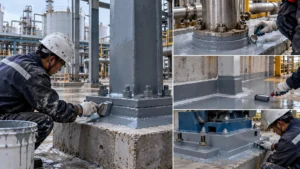
Surface preparation sets the adhesion foundation and is a leading root cause in tank lining blistering and coating delamination cases. Your tank lining scope should clearly define preparation standard, cleanliness verification, and contamination control before lining application.
Practical controls to include
- Standardize surface preparation acceptance criteria and hold points.
- Control contamination between blasting and lining, especially salts, dust, and moisture.
- Pay special attention to welds, edges, floors, and difficult-to-ventilate zones.
If your EPC team needs a surface preparation reference page to align workpacks and inspection language, use: Surface preparation for industrial coatings.
Common tank lining failures
Most failed tank liner problems are predictable and preventable if the system and execution controls are clear.
Common failure modes and typical causes
- Tank lining blistering: often linked to contamination, moisture control, or incorrect cure and recoat practice.
- Coating delamination: frequently starts at poor preparation or intercoat adhesion loss, then spreads under immersion.
- Rust under paint and corrosion under coating: commonly driven by thin spots, holiday defects, or repair gaps at weld seams and edges.
Troubleshooting decision rule: if failure is widespread or underfilm corrosion is active, local patching without full diagnosis usually repeats the same failure pattern.
Industrial tank coating supplier: what to look for
Many buyers search coating tank supplier or coating tanks supplier because they need more than a product, they need a system with documentation and execution support.
What to evaluate before awarding
- Ability to recommend a complete industrial tank coating and tank lining system, not just sell a single “tank coat.”
- Documentation readiness: TDS, application guidance, repair method, and QC acceptance checkpoints.
- Customization support: ability to adapt tank lining system choice to media, downtime, and site constraints.
- Project support workflow: pre-job submittals, sample panels if required, and technical responses during shutdown windows.
For readers who want to understand broader manufacturer capability and how to evaluate suppliers, you can also link internally to: How to choose the right industrial coating supplier.
Industrial tank coating price factors
Industrial tank coating price and tank liner cost are driven by execution realities more than paint price. Key cost drivers include:
- Surface preparation class, access method, and confined space requirements
- Total film build and number of coats
- Inspection and documentation requirements
- Repair risk, rework probability, and shutdown time cost
Buying rule for procurement: compare bids on the same surface prep scope, thickness ranges, QA plan, and repair method, otherwise “low price” often means “missing scope.”
FAQ
Q1: What is the difference between tank lining and tank coating?
Tank lining is internal immersion-focused protection, while tank coating often refers to external atmospheric protection.
Q2: How long does a tank liner last?
Tank liner life depends on stored media, operating conditions, thickness control, surface preparation quality, and maintenance access planning.
Q3: What is the best tank lining for oil storage?
Oil storage tank lining is typically selected by product type, temperature range, and cleaning regime, then matched to a proven tank lining system such as epoxy tank lining or other higher-resistance options if needed.
Q4: How thick should a tank liner be?
A common immersion lining starting range is 300–500 µm total, then adjusted by service severity and the selected tank lining system, with acceptance verified by DFT inspection.
Q5: How do I choose a reliable coating tank supplier?
Choose a coating tank supplier that can provide system recommendation, documentation, QC checkpoints, and repair guidance, not just material pricing.
RFQ checklist
To get a fast quotation, TDS pack, and tank lining system recommendation, send:
- Tank type and size, new build or industrial tank repair.
- Stored media and operating conditions, including temperature range and immersion description.
- Internal scope: tank lining required, areas included, and access constraints.
- External scope: tank coating required, exposure conditions, and appearance requirements.
- Surface preparation standard and quality plan, including hold points and contamination controls.
- Requested thickness ranges and DFT inspection plan.
- Schedule constraints, ventilation plan, and safety requirements for internal work.
- Documentation needs: TDS, application procedure, repair method, and inspection records.
Technical Note
Coating and lining performance depends on service media, operating conditions, substrate condition, surface preparation, application method, and inspection acceptance criteria. Confirm final system selection, thickness ranges, and QA requirements with the applicable TDS and your project specification before procurement and application.
CTA
If you are specifying industrial tank coating or tank lining for oil, water, chemical, or wastewater tanks in the Middle East, Southeast Asia, or Central Asia, send your service conditions and tank details. Our manufacturer technical team will recommend a tank lining system, provide a TDS pack, and support your RFQ process via Project inquiry & technical support.