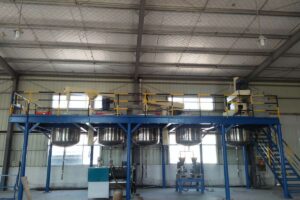
Manufacturer vs trading company: what’s the difference?
A manufacturer typically controls formulation, raw material qualification, batch production, in-house QC, and technical documentation, which directly affects repeatability and accountability. A trading company may be excellent at sourcing and logistics, but it usually depends on third parties for production control and technical root-cause support.
| What you need on projects | Manufacturer (best-fit when…) | Trader (best-fit when…) |
|---|---|---|
| Consistent batch performance | You need traceability + stable specs across deliveries | You’re buying small quantities or generic items |
| System responsibility | You want one party to own primer/midcoat/topcoat compatibility | You already have a locked spec and only need procurement |
| Technical support | You need submittals, troubleshooting, and site coordination | Your applicator/consultant provides the technical scope |
| Compliance documentation | You require structured TDS/SDS + QC deliverables | Documentation requirements are minimal |
Decision rule: If the project has approvals, inspection hold points, or long maintenance intervals, prioritize manufacturers (or traders who can prove factory-backed technical authority).
Key criteria for selecting an industrial coating supplier
1 Technical capability (not just “we sell epoxy”)
Ask whether the supplier can recommend a coating system that matches exposure, substrate condition, and application constraints—and explain why. If answers stay at marketing level (“high quality, strong adhesion”), you’re buying uncertainty.
2 Product system completeness (system > SKU list)
On industrial assets, coatings work as a stack: surface prep + primer + barrier coat + weathering/chemical-resistant topcoat, plus detail work (edges/welds). A practical benchmark is whether the supplier publishes system-style guidance for real assets, such as steel structure coating system selection and execution notes. (Example reference for system thinking: Steel Structure Coating System Guide.)
3 Project support (EPC reality)
A supplier that wins projects can support:
- Fast submittals (TDS/SDS, system recommendation, method statement)
- Compatibility clarifications (primer/topcoat, fireproof over primer, etc.)
- Inspection plan alignment (DFT, recoat window, surface prep acceptance)
- Troubleshooting turnaround (blistering, adhesion loss, contamination)
4 QC and documentation deliverables (what buyers forget)
Many RFQs fail because suppliers quote “paint,” but the project actually needs a handover package. Require, at minimum:
- TDS/SDS for each layer
- System recommendation sheet (with assumptions)
- Application procedure + repair procedure
- QC checklist + reporting templates
Questions you should ask before choosing a supplier
Use these questions to expose risk early—before purchase orders:
- Can you recommend at least two system options (performance-first vs cost-first) and explain tradeoffs?
- What minimum RFQ inputs do you need (exposure, prep method, durability target, site limits)?
- What is your standard QC release process and batch traceability method?
- How do you handle primer/topcoat compatibility and substitutions during procurement changes?
- Can you provide an inspection checklist and a repair/touch-up procedure template?
- Who provides technical support during application—how fast can you respond to site NCRs?
If your project includes passive fire protection on steel, treat it as a system-plus-documentation scope, not a single product line. (RFQ-style reference page: Fire-Resistant Coating Series: Manufacturer Guide & RFQ.)
Why long-term projects need a system-oriented supplier
Long-life assets don’t fail because one layer was “slightly cheaper”; they fail when system assumptions break (wrong prep, wrong compatibility, missing DFT records, uncontrolled recoat windows). A system-oriented supplier reduces lifecycle cost by preventing rework, reducing coating defects at details, and making future maintenance predictable through clear documentation and repair pathways.
Buyer mindset shift: Don’t buy “paint for steel”—buy a controllable process: specification → submittals → application controls → inspection records → handover.
Common failures and how to prevent them
- Early rust at edges/welds: often caused by missing stripe coats, insufficient film build at details, or poor prep acceptance criteria.
- Blistering and underfilm corrosion: commonly linked to contamination, trapped moisture, or uncontrolled recoat intervals.
- Intercoat delamination: frequently caused by compatibility issues, exceeded recoat windows, or surface chalking/condensation between coats.
Troubleshooting rule: If the supplier cannot provide a structured root-cause checklist (surface condition, climate logs, DFT records, batch traceability), you’ll lose time arguing instead of fixing.
Quality / inspection checklist
- Surface preparation standard + acceptance method stated clearly (with hold point before priming).
- DFT targets defined by layer as ranges (not a single total only), plus minimum readings per area and critical detail points.
- Recoat interval guidance and environmental limits clearly stated in documentation.
- Batch traceability: batch numbers linked to deliveries, application areas, and QC reports.
- Repair procedure: defined steps for damage, weld repairs, and local breakdown.
RFQ checklist
- Asset type and service environment (indoor/outdoor, coastal/industrial, chemical splash risk)
- Substrate condition (new build vs maintenance; existing coating info if any)
- Surface preparation method available and constraints
- Target durability / maintenance interval expectation
- Application method (shop/site; spray/roller) and schedule limits
- Documentation required: TDS/SDS, system recommendation, QC checklist, repair procedure, traceability format
Technical Note
Final coating system selection, layer build, and acceptance criteria must be confirmed against the applicable TDS and project specification, including surface preparation standard and inspection requirements.
CTA
Looking for a long-term industrial coating partner, not just a paint supplier? Share your environment, substrate condition, surface prep capability, and durability target—our technical team will respond with a system recommendation, RFQ document list, and TDS/SDS package via Contact.