Surface preparation for industrial coatings is the performance “multiplier”: the same coating system can last drastically longer—or fail early—depending on cleanliness, salts, and surface profile control. Soluble salts trapped under a coating can pull water through the film by osmosis, causing osmotic blistering, underfilm corrosion, and premature failure, even when the coating itself is high quality.
Why Surface Preparation Determines Coating System Performance
Mechanical bonding (profile/anchor pattern)
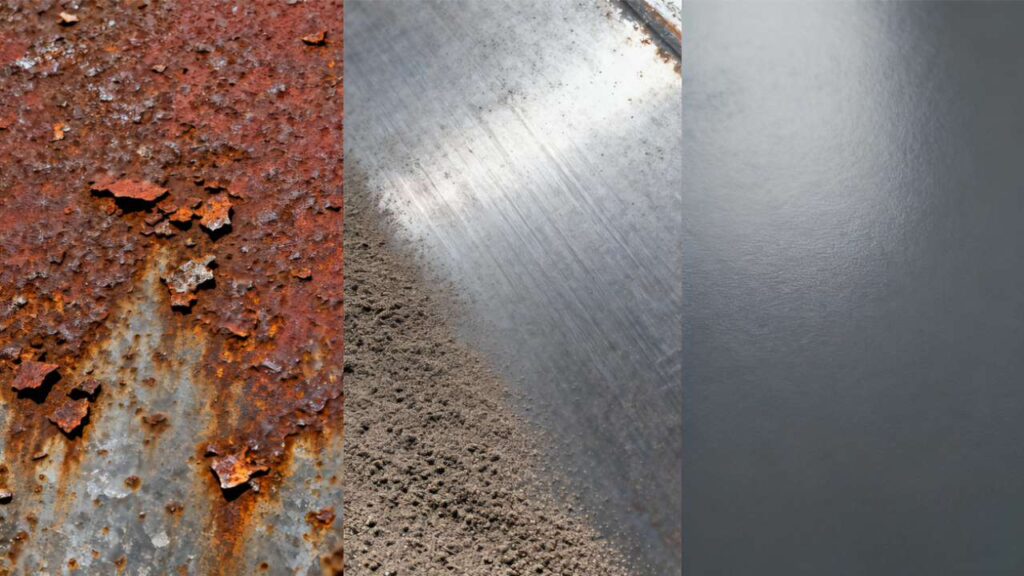
Surface preparation creates the surface condition and profile that coatings “key into,” improving mechanical bonding and adhesion reliability. Establishing the right surface profile is widely recognized as critical to coating adhesion and long-term performance.
The real impact of salts and oils (why failures happen under “good paint”)
Water-soluble contaminants trapped beneath the film can draw moisture through the coating and build pressure, leading to osmotic blistering and underfilm corrosion. This mechanism is a major reason coatings fail early in marine/coastal and immersion-prone assets.
Why high-performance coatings are more “surface-sensitive”
High-performance systems often rely on tight intercoat adhesion and defect-free barrier build; when salts, dust, or weakly-adhered mill scale remain, the system can become a moisture trap instead of protection. The SSPC-SP 10/NACE No. 2 joint standard explicitly frames blast cleaning as preparation “prior to the application of a protective coating or lining system,” underscoring that the coating performance is inseparable from the prep.
Overview of Industrial Surface Preparation Methods
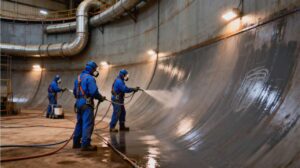
Abrasive blasting
Abrasive blasting is the workhorse method for achieving high cleanliness levels like Sa 2.5/SP10 and for creating a controlled surface profile for high-performance coatings. Joint standards also note that surface profile control can be significant to coating performance and should be addressed in procurement documents (project specifications).
Power tool cleaning (SP2 / SP3)
Power tool cleaning can be practical for maintenance and localized repairs where full blasting is impossible, but it has limitations versus blast cleaning levels in removing tightly-adhered residues and achieving uniform profile/cleanliness. Mappings and explanations of ISO/SSPC standards note that the standards are not perfectly “equivalent,” so you must specify the exact prep standard rather than assume interchangeability.
Chemical cleaning & degreasing (often skipped, but critical)
Degreasing and removal of oils/grease is a foundational step because contamination blocks adhesion even if blasting is performed afterward. General surface preparation guidance repeatedly highlights cleaning/contaminant removal as essential before coating.
ISO 8501 Surface Preparation Standards Explained (Sa 1 – Sa 3)
This section helps you translate “Sa level” into an RFQ that painters can execute and inspectors can accept.
Sa 1 / Sa 2 / Sa 2.5 / Sa 3 (what to call out)
A practical rule: the more aggressive the environment and the higher the coating performance target, the more you should push toward Sa 2.5 or Sa 3—but only if the project can actually execute it. The “Sa 2.5 vs SP10” nuance matters: one widely used explanation notes Sa 2.5 allows more staining than SP10, so avoid stating “Sa 2.5 / SP10 equivalent” without a project-specific decision.
Sa 2.5 blasting (why it’s commonly specified)
Sa 2.5 is commonly used for high-performance systems because it aims at very thorough blast cleaning while remaining achievable in many shop and site conditions. In practice, engineers choose it when they need high reliability but Sa 3 is unrealistic for schedule/cost or access (project-dependent).
Recommended coating system direction (by Sa level)
Lower cleanliness (maintenance constraints): specify compatible primers/systems designed for less-than-ideal prep (project-dependent), and tighten inspection hold points to reduce risk.
Higher cleanliness (Sa 2.5 / Sa 3): enables higher-performance barrier systems, but you still must control salts and profile and verify DFT over peaks (project-dependent).
SSPC Surface Preparation Standards (SP Series) Explained
SP2 / SP3 (hand/power tool cleaning)
These are commonly used where blasting is not feasible and are often seen in maintenance specs; they reduce loose rust and old coating but are not a substitute for near-white blast in severe environments. A key point from ISO/SSPC guidance is that standards are not always directly interchangeable, so the spec should state the exact SP level and acceptance criteria.
SP6 vs SP10 (commercial vs near-white blast)
The SSPC-SP 10/NACE No. 2 joint document defines near-white blast cleaning and gives clear allowable staining limits, and it contrasts this with commercial blast cleaning allowances. This is why EPC specs often select SP10 for severe service, especially where coating longevity is critical.
ISO vs SSPC crosswalk (use carefully)
A common crosswalk reference notes Sa 2.5 and SP10 are not strictly equal because their allowable staining differs (Sa 2.5 can permit more staining than SP10). For engineering specs, write one standard as the controlling requirement and avoid “either/or” language unless you also define acceptance limits and inspection method.
Step-by-step: How to Select the Correct Surface Preparation
Use this as your selection workflow when writing a coating specification.
Define exposure severity: offshore/marine, heavy industrial, indoor dry, immersion/condensation risk.
Confirm constraints: can you blast to Sa 2.5/SP10, or only power-tool clean due to access/shutdown?
Choose the prep level as the controlling requirement (ISO or SSPC), then lock in verification: cleanliness, profile, dust, and soluble salts where relevant. Soluble salts are a known driver of osmotic blistering and underfilm corrosion, so testing/mitigation is often justified in marine/immersion-risk assets.
Select coating system compatible with the achieved prep, not the “ideal” prep assumed in datasheets (project-dependent).
Scenario decision rules (engineering-style)
Heavy corrosion environment: favor higher blast levels and tighter verification, because failure risk from underfilm corrosion is high (project-dependent).
Offshore / marine: treat soluble salts as a primary risk; include testing/cleaning steps and do not rely on visual cleanliness alone.
Indoor industrial structures: you may accept lower prep in benign zones, but only if the coating system and inspection plan match that risk (project-dependent).
Common Surface Preparation Mistakes That Cause Coating Failure
Flash rusting / recontamination after blasting: delays and humidity can reintroduce corrosion; plan blast-to-coat windows and environmental control (project-dependent).
No soluble salt detection: salts can trigger osmotic blistering and underfilm corrosion even when surfaces look “clean.”
Profile/thickness mismatch: joint guidance notes that if coating thickness over peaks is inadequate, premature rust-through or failure can occur, so specify profile control and verify thickness appropriately (project-dependent).
Recommended Coating Systems Based on Surface Preparation Level
This is where engineers convert prep reality into a coating system that will actually perform.
If you can achieve Sa 2.5 / SP10 (high-performance baseline)
You can specify higher-performance barrier systems because the substrate cleanliness and profile support reliable bonding and defect control, but you still must manage salts and profile/thickness balance. The SP10/NACE No.2 document highlights profile control relevance and warns about premature failure if thickness over peaks is inadequate (project-dependent).
If you can only do SP2/SP3 power-tool cleaning (maintenance reality)
Select repair and maintenance systems designed for this preparation level and tighten inspection/hold points, because you cannot “inspect your way into” Sa 2.5 performance without Sa 2.5 prep. Crosswalk guidance emphasizes not treating standards as equivalent; system selection must follow the actual prep achieved.
[Anti-Rust & Primer Coatings Series] ->
[Epoxy Anti-Corrosion Coating Series] ->
[Marine & Offshore Coating Solutions] ->
Quality / Inspection Checklist (DFT, recoat interval, surface prep)
Use this as acceptance criteria guidance; final limits and methods are project-dependent.
Surface free of oil/grease; cleaning step documented.
Surface prep level verified against the specified ISO/SSPC standard (visual + documented acceptance).
Surface profile measured and recorded when significant to performance (per project spec).
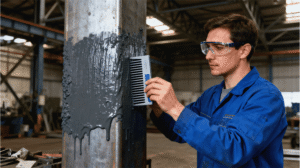
Soluble salt testing performed where marine/immersion/condensation risk exists; mitigation defined if above project limits.
Dust removal verified before coating (project-dependent).
DFT targets set as ranges and measured; ensure sufficient thickness over profile peaks to avoid premature rust-through (project-dependent).
Recoat intervals and environmental conditions logged (project-dependent).
RFQ Checklist (near the end)
To get a system recommendation aligned with your achievable surface preparation, send:
Substrate and condition: new steel vs maintenance, degree of rust/old coating
Target prep standard: ISO 8501 (Sa level) or SSPC (SP level)
Prep method available: abrasive blasting vs power tools; access constraints
Environment: offshore/marine, heavy industrial, indoor, immersion/condensation risk
Whether soluble salt testing is required by the spec (and any limits if known)
Application constraints: temperature/humidity windows, shift plan, blast-to-coat time
Documents requested: TDS/SDS, system recommendation, inspection checklist, repair procedure
CTA (engineering-grade)
Contact us with your target standard (ISO 8501 or SSPC SP), your achievable prep method, and the service environment. We will recommend a coating system matched to your surface preparation conditions and provide TDS plus an RFQ-ready specification checklist.
Contact Us
We would love to speak with you.
Feel free to reach out using the below details.