Steel protection life is often decided at the primer stage. Many projects default to an epoxy primer because it is versatile and easy to integrate, but higher-corrosivity environments and long-life specifications often push teams toward zinc-rich primers for their damage-tolerant corrosion control behavior.
Quick Guide
- Zinc-rich primers protect with sacrificial action; epoxy primers protect mainly by barrier isolation.
- If you expect mechanical damage and harsh atmospheres, zinc-rich is often the safer base layer.
- If the environment is low corrosivity or indoor, epoxy primer is often sufficient and more forgiving.
- In most long-life exterior systems, the best answer is not “either-or” but zinc or epoxy primer plus epoxy build plus a weatherable topcoat.
- Write QC into the scope: surface prep, DFT ranges, recoat control, and adhesion checks.
What a zinc rich primer is
A zinc-rich primer is designed to contain a high loading of metallic zinc so the coating can provide galvanic support to steel. In practical terms, zinc is more active than steel, so it preferentially corrodes and helps protect exposed steel at scratches, cut edges, and small coating defects when electrical continuity exists in the film.
Two subtypes matter for selection
- Organic zinc-rich primer, commonly epoxy zinc, which tends to be more application-friendly in the field
- Inorganic zinc-rich primer, commonly silicate-based, which is often chosen for maximum galvanic intent in controlled execution settings
What buyers forget: “zinc-containing” is not automatically “zinc-rich.” The mechanism depends on zinc loading and continuity, plus correct application and film build.
What an epoxy primer is
An epoxy primer is typically a two-component coating that cures into a dense, adherent film. Its primary protection mechanism is barrier isolation: it blocks water, oxygen, and ions from reaching steel when applied over correctly prepared substrate.
Why epoxy primers are so common
- Strong adhesion to properly prepared steel
- Good compatibility with many intermediate and topcoat systems
- Good tolerance to a wide range of industrial environments when specified correctly
Limitation to document clearly: epoxy primer does not provide sacrificial protection, so its damage tolerance depends heavily on film integrity and repair discipline.
Zinc rich primer vs epoxy primer: protection mechanism comparison
This is the core engineering difference, and it affects how your system performs after inevitable damage.
| Comparison point | Zinc-rich primer | Epoxy primer |
|---|---|---|
| Primary mechanism | Sacrificial, galvanic support to steel at defects | Barrier isolation by dense film |
| After coating damage | Can slow corrosion spread around scratches if continuity exists | Corrosion can spread underfilm if the defect is not repaired promptly |
| Best use case | Severe atmospheres, long-life targets, high damage risk | General industrial use, low to moderate corrosivity, controlled maintenance |
| Biggest execution risk | Sensitive to surface prep and film build discipline | Can fail from poor surface prep, contamination, or poor overcoating practice |
Decision rule: if your risk is “corrosion at defects and edges,” zinc-rich primers are often specified because they handle imperfection better. If your risk is “process simplicity and broad compatibility in moderate exposure,” epoxy primer often wins.
Organic zinc vs inorganic zinc primer
Both are zinc-rich, but execution and service fit differ.
Organic zinc, often epoxy zinc
- Typically more forgiving in field application
- Widely used in multi-coat systems for steel structures, infrastructure, and marine topside steel
Inorganic zinc, often silicate-based
- Often selected for maximum galvanic intent and demanding atmospheric service
- More sensitive to correct surface prep, environmental control, and overcoating discipline
If your contractors, schedule, or environment make strict control difficult, organic zinc may reduce application risk while still delivering zinc-rich behavior.
When to use zinc rich primer
Zinc-rich primer is often the right call when the environment and consequences justify it.
Typical scenarios
- Higher corrosivity categories and coastal or marine exposure
- Marine and offshore-related steel where damage and salt cycling are expected
- Bridges and infrastructure where long maintenance intervals are desired
- Power plants and heavy industrial areas with aggressive atmospheres and difficult access
If you are aligning selection to ISO thinking and want an internal reference for corrosivity and durability framing, use: ISO 12944 corrosion protection guide.
When epoxy primer is sufficient
Epoxy primer is often sufficient when galvanic damage tolerance is not the deciding factor.
Common scenarios
- Indoor steel with controlled environment
- Low corrosivity or short maintenance cycles
- Budget-limited projects where you can maintain access and repair discipline
Practical note: even in moderate environments, epoxy primer still requires correct surface prep and DFT control. Failures blamed on “paint quality” are often prep or recoat issues.
Zinc plus epoxy combined systems
For most long-life exterior steel, the optimal design is a combined system that uses each technology for its strength.
A common logic stack
- Zinc-rich primer to improve damage tolerance and early corrosion control at the steel interface
- High-build epoxy intermediate to provide the main barrier thickness and chemical resistance
- Weatherable topcoat such as polyurethane to protect the system from UV and weathering
To reinforce how epoxy and polyurethane complement each other in system design, reference: Epoxy vs polyurethane coating for steel structures.
For marine atmospheres and high-corrosivity selection logic, this hub is useful for internal linking and RFQ alignment: C5-M and CX marine corrosion protection systems.
Surface preparation requirements for zinc primers
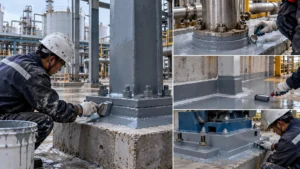
Zinc-rich primers are more sensitive to surface condition than many epoxy primers because contamination and insufficient profile can break continuity, reduce adhesion, and compromise the intended mechanism.
Minimum controls to write into the scope
- Sa 2.5 blasting as the baseline
- Defined surface profile range suitable for the primer system
- Soluble salt control in coastal and humid regions
- Dust removal and a pre-prime hold point
- Stripe coating at edges, welds, and bolts before full coats
If you need a reusable engineering reference for workpacks, use: Surface preparation for industrial coatings.
Cost comparison: zinc primer vs epoxy primer
Zinc-rich primers often increase upfront cost because they require higher surface prep discipline and tighter QC. In severe exposure, they can reduce maintenance frequency and lower the risk of early repair cycles, which is often the bigger cost driver for owners and EPCs.
Cost drivers to compare fairly
- Surface preparation class and access cost
- Rework risk and inspection intensity
- Maintenance access and downtime cost
- Required durability and repaint interval target
Common mistakes in primer selection
- Overdesigning low-corrosivity steel with zinc-rich systems where epoxy primer is sufficient
- Omitting zinc-rich primer in high-corrosivity exposure and then fighting edge rust and underfilm spread
- Treating “zinc-containing” as zinc-rich without mechanism clarity
- Poor surface preparation, especially salts and dust contamination
- Mismanaging film build, recoat windows, and overcoat compatibility
How to select the right primer for your steel structure
Step 1: Classify the environment and damage risk
Document whether the structure is indoor, outdoor, coastal, marine, or heavy industrial, and how likely coating damage is during service.
Step 2: Set durability and maintenance reality
If maintenance access is difficult or costly, prioritize systems that tolerate defects and reduce corrosion spread.
Step 3: Choose primer by mechanism, then lock the full system
Select zinc-rich or epoxy primer, then define the intermediate and topcoat roles and DFT ranges as a package.
Step 4: Align QC to the system
If the project cannot enforce surface prep and inspection discipline, adjust the system design before procurement rather than accepting hidden risk.
RFQ checklist
Send this to receive a fast recommendation and TDS pack for zinc-rich and epoxy primer options:
- Project location and environment description, including coastal or industrial exposure
- Asset type and access constraints, newbuild or maintenance
- Target corrosivity category or durability target if defined
- Surface preparation capability, including blast standard, profile range, and salt testing method
- Application plan: shop or field, temperature and humidity constraints
- Preferred system stack, including intermediate and topcoat needs
- Target DFT ranges per layer and stripe coat requirements
- QC documentation needs: hold points, DFT logs, adhesion checks, repair procedure
- Delivery and documentation requirements: TDS, SDS, batch traceability
Technical Note / Disclaimer
Primer selection and performance depend on exposure severity, surface preparation quality, film build control, and system compatibility. Confirm the final primer choice, DFT ranges, and inspection acceptance criteria with the applicable TDS and your project specification before approval.
CTA
If you share your environment description, durability target, surface preparation capability, and topcoat plan, our technical team will recommend the right primer strategy and provide a system build-up and documentation pack. Contact us here: Project inquiry & technical support.