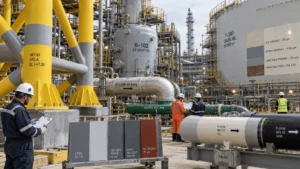
Marine corrosion is one of the most aggressive degradation mechanisms affecting steel structures worldwide. Offshore platforms, port facilities, coastal bridges, shipyards, marine storage tanks, and near-shore industrial plants are constantly exposed to salt-laden atmospheres, high humidity, UV radiation, and cyclic wet–dry conditions.
In such environments, coating failure is not merely cosmetic — it directly impacts structural integrity, operational safety, and lifecycle cost.
Under ISO 12944 corrosion protection standards, marine environments are classified primarily as C5-M (Very High – Marine) and CX (Extreme Offshore). Selecting the correct coating system under these categories determines whether a structure lasts 5 years or 25+ years. For ISO 12944 classification logic and design-life planning context, see ISO 12944 corrosion protection.
This article provides a complete engineering-level explanation of:
- Why marine corrosion is uniquely severe
- The difference between C5-M and CX
- Recommended coating systems for 15–25+ year service life
- Surface preparation requirements
- Common failure causes
- Cost and lifecycle considerations
- Practical system selection guidance
Why Marine Environments Cause Severe Corrosion
Marine corrosion is driven by electrochemical reactions accelerated by chloride ions (Cl⁻). Unlike typical industrial environments, marine atmospheres contain continuous airborne salt particles that deposit on steel surfaces.
The key accelerating factors include:
1. Chloride Contamination
Salt particles create conductive electrolyte films on steel surfaces, dramatically increasing corrosion rate.
2. High Humidity
Marine environments frequently exceed 80% relative humidity, allowing corrosion cells to remain active for long periods.
3. Wet–Dry Cycles
Tidal zones and splash zones create repeated wetting and drying, concentrating salts and intensifying corrosion.
4. UV Radiation
Intense sunlight degrades organic binders, especially in topcoats, reducing long-term protective performance.
5. Temperature Fluctuation
Thermal expansion and contraction stress coating films and may lead to cracking or delamination.
Because of these combined factors, marine corrosion is not linear — it accelerates rapidly once coating integrity is compromised.
ISO 12944 C5-M Corrosion Category Explained
Under ISO 12944, C5-M represents Very High Marine corrosivity.
Definition
C5-M environments include coastal and offshore areas with high salinity exposure and minimal pollution.
Typical Applications
- Port steel structures
- Coastal industrial facilities
- Offshore platforms (atmospheric zone)
- Shipyard equipment
- Coastal bridges
For marine and offshore application scoping and exposure zoning examples, see Marine & Offshore applications.
Corrosion Rate
Unprotected carbon steel in C5-M may experience corrosion rates exceeding 80–200 µm per year.
Design Life Classification
ISO 12944 categorizes coating durability as:
- High (H): 15–25 years
- Very High (VH): 25+ years
For marine projects, systems are typically designed for High or Very High durability classes.
ISO 12944 CX – Extreme Offshore Environment
CX is the highest atmospheric corrosivity category under ISO 12944.
Where CX Applies
- Offshore oil & gas platforms
- Splash zones
- Structures exposed to continuous salt spray
- Extreme coastal industrial facilities
CX Environments Involve
- Persistent salt saturation
- High UV exposure
- Severe wind-driven salt deposition
- Occasional direct seawater impact
Key Difference Between C5-M and CX
| Factor | C5-M | CX |
|---|---|---|
| Salt Exposure | High | Extremely high |
| Offshore Use | Yes | Primary |
| Design Complexity | High | Very high |
| Maintenance Difficulty | Moderate | Severe |
CX requires thicker systems, enhanced barrier properties, and often specialty intermediate coats such as glass flake epoxy.
C5-M vs C5-I – Industrial vs Marine Comparison
C5-M (Marine) and C5-I (Industrial) are often confused.
C5-I Characteristics
- High industrial pollution
- SO₂ exposure
- Chemical plant environments
C5-M Characteristics
- Chloride-driven corrosion
- Coastal salt atmosphere
- Offshore exposure
Key Differences
- Chloride content is significantly higher in C5-M.
- UV degradation is often more severe in marine locations.
- Marine coatings require stronger resistance to osmotic blistering.
Therefore, systems suitable for C5-I cannot automatically be applied in C5-M environments.
Recommended C5-M Coating Systems for 15–25 Year Design Life
The coating system — not a single product — determines durability.
15-Year (High Durability) C5-M System
Surface Preparation:
Sa 2.5 (Near White Metal Blast Cleaning)
Typical System:
- Zinc-Rich Epoxy Primer (60–80 µm)
- High-Build Epoxy Intermediate (120–160 µm)
- Polyurethane Topcoat (50–60 µm)
Total DFT: 230–300 µm
Why It Works
- Zinc provides cathodic protection.
- Epoxy provides barrier resistance.
- Polyurethane provides UV protection and color retention.
For primer selection options commonly used on offshore and heavy steel, see Anti-Rust & Primer Coatings.
25-Year (Very High Durability) C5-M System
Surface Preparation:
Sa 2.5 or Sa 3
Typical System:
- Zinc-Rich Epoxy (75 µm)
- High-Build Epoxy (150–200 µm)
- Additional Epoxy Layer (100–150 µm)
- Polyurethane or Fluorocarbon Finish (60 µm)
Total DFT: 350–450 µm
This thicker system significantly reduces oxygen and moisture permeability.
Typical Offshore CX Coating System Structure
CX requires maximum corrosion resistance.
Surface Preparation
- Sa 2.5 minimum
- Often Sa 3 for critical structures
- Salt contamination testing mandatory
Recommended System Example
- Zinc-Rich Epoxy Primer
- Glass Flake Reinforced Epoxy Intermediate
- High-Build Epoxy Barrier Layer
- Polyurethane or Fluorocarbon Topcoat
Total DFT: 400–600 µm depending on specification.
Why Glass Flake Epoxy?
Glass flake pigments create a lamellar structure that increases diffusion path length for water and oxygen, dramatically improving barrier performance.
For offshore system architecture discussions and zone-based protection logic, see Marine Anti Corrosion Coating: Offshore System Guide.
Surface Preparation Requirements for Marine Projects
Surface preparation accounts for approximately 60–70% of coating performance.
Required Standards
- Sa 2.5 (minimum)
- Salt level testing (Bresle method)
- Surface profile control (50–75 µm typical)
- Clean, dry, dust-free surface
Critical Considerations
- Residual salts can cause osmotic blistering.
- Insufficient profile reduces adhesion.
- Overly rough surfaces increase coating consumption and risk of pinholes.
- Without proper preparation, even premium coatings will fail prematurely.
Common Failures in Marine Coating Projects
Marine coating failures often stem from application errors rather than product defects.
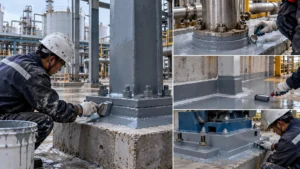
1. Insufficient Stripe Coating
Edges and welds are vulnerable areas requiring additional coating thickness.
2. Under-Thickness Application
Failing to meet specified DFT drastically reduces durability.
3. Poor Zinc Content
Low zinc loading compromises cathodic protection.
4. Inadequate UV Resistance
Using epoxy topcoats without UV-stable finishes leads to chalking and degradation.
5. Ignoring Maintenance Planning
Even 25-year systems require periodic inspection.
How to Select the Right Marine Coating System
Selecting a marine coating system involves structured decision-making.
Step 1: Define Corrosion Category
C5-M or CX based on exposure severity.
Step 2: Define Design Life
15–25 years or 25+ years.
Step 3: Determine Surface Preparation Capability
On-site blasting conditions matter.
Step 4: Select Primer Type
Zinc-rich for cathodic protection in high-risk areas.
Step 5: Determine Total Film Thickness
Balance performance and cost.
Step 6: Establish Inspection Standards
Include DFT measurement, adhesion testing, and salt testing.
Cost Consideration for C5-M and CX Projects
Higher performance systems increase upfront cost but reduce lifecycle expenses.
Cost Components
- Surface preparation (often 30–40% of total cost)
- Coating material cost
- Application labor
- Inspection and QA
- Maintenance cycle
Lifecycle Perspective
A 25-year system may cost 20–30% more initially but can reduce total lifecycle cost by eliminating repaint cycles.
Engineering Recommendations for Long-Term Offshore Protection
- Always perform salt contamination testing.
- Apply stripe coats on welds and edges.
- Avoid reducing DFT to cut costs.
- Use UV-resistant topcoats in exposed areas.
- Schedule inspection intervals every 2–5 years.
Marine corrosion cannot be eliminated — only controlled through systematic design.
Conclusion
C5-M and CX represent the highest atmospheric corrosion risks defined under ISO 12944.
Selecting the correct marine coating system requires:
- Proper corrosion classification
- Correct surface preparation
- Adequate film thickness
- High-performance barrier and cathodic protection layers
- Long-term inspection planning
In marine and offshore environments, coating system design directly determines structural longevity and total project cost.
Contact for Marine Coating System Design
If your project involves coastal, offshore, or extreme marine exposure, selecting the correct C5-M or CX-compliant coating system is critical.
Contact us for customized marine corrosion protection solutions based on:
- Project location
- Environmental severity
- Required design life
- Budget and maintenance expectations
A properly engineered marine coating system protects not just steel — but your entire investment lifecycle.
For system recommendation and TDS request, contact our technical team here: Contact Industrial Coating Manufacturer.