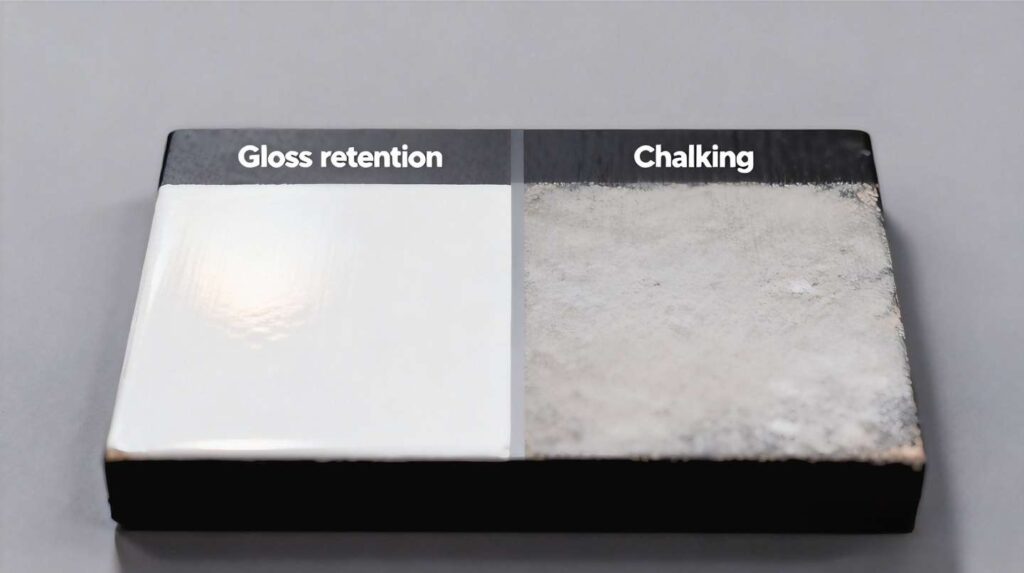
For marine decks and offshore topsides, the “best” topcoat depends on what is killing your coating first: UV weathering, abrasion/traffic, chemical splash, or maintenance access. ISO 12944-5 notes that most epoxy coatings chalk in sunlight and that if color or gloss retention is required, a suitable topcoat should be applied—this is why polyurethane and polysiloxane are common final-coat choices in marine exposure.
1) Define your deck exposure before choosing chemistry
“Marine deck” can mean a ship deck, jetty platform, offshore topsides walkway, or port equipment deck—each has different failure drivers. Define these RFQ inputs first:
Service zone: topsides/atmospheric marine exposure vs near-splash areas
UV exposure: full sun vs shaded
Mechanical duty: foot traffic, drag loads, dropped tools, abrasion
Chemical contact: fuels, oils, hydraulic fluid, cleaning chemicals (splash/spillage)
Aesthetic need: must hold color and gloss, or “functional only”
Unique value (what buyers forget): If the RFQ doesn’t state “walkway with heavy abrasion” vs “topsides with high UV,” suppliers may quote the wrong topcoat technology and DFT target, leading to early wear-through or chalking.
2) Where polyurethane topcoats typically win
Polyurethane (PU) topcoats are commonly selected where abrasion resistance and flexibility are key. Industry comparison guidance highlights polyurethane topcoats for excellent abrasion resistance and flexibility, which fits traffic areas on decks and platforms.
Typical use cases for PU on marine decks
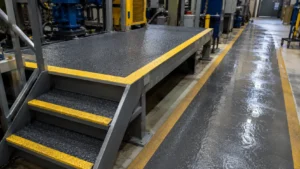
Walkways and working decks with frequent foot traffic
Areas prone to impact and scratching (tools, equipment)
Projects prioritizing simpler application routines (project-dependent)
Practical cautions (field reality)
PU topcoats still require good surface cleanliness and correct recoat timing over epoxy undercoats.
If the main failure mode is chalking/fade under strong UV, PU may require more frequent cosmetic maintenance than polysiloxane in some environments (project-dependent).
3) Where polysiloxane topcoats typically win
Polysiloxane topcoats are often chosen for outstanding durability and longer maintenance intervals in harsh exposure. A topcoat comparison resource notes polysiloxanes can offer extended durability and reduced maintenance needs, improving lifecycle cost even if initial cost is higher.
Typical use cases for polysiloxane on decks/topsides
Offshore topsides with intense UV and owner requirement for long-term appearance
Projects where access is difficult and repaint intervals must be extended
Specifications prioritizing lifecycle cost and reduced maintenance disruption
Practical cautions (field reality)
Polysiloxane systems may be less forgiving if surface prep or recoat windows are mishandled (project-dependent), so QC discipline matters.
Always confirm compatibility with the primer/intermediate system and the required DFT by TDS/project spec.
4) Decision table (PU vs polysiloxane for marine decks)
Use this decision matrix inside your project spec or procurement evaluation.
| Priority / Condition | Better choice | Why |
|---|---|---|
| Heavy traffic, abrasion, impact | Polyurethane | Known for abrasion resistance and flexibility. |
| Long-term color & gloss retention | Polysiloxane | Often selected for extended durability and reduced maintenance. |
| Lifecycle cost focus | Polysiloxane | Can reduce maintenance frequency over the asset life. |
| Faster, more familiar field execution | Polyurethane | Commonly used and often simpler to execute (project-dependent). |
| Spec requires high aesthetic durability | Polysiloxane (often) | Some system guides rate polysiloxane higher for aesthetic durability. |
Boundary condition: Topcoat selection is only valid when the full coating system is correct for the marine exposure category; ISO 12944-5 provides coating type guidance and notes epoxy chalking under sunlight, hence the need for suitable topcoats when aesthetics matter.
5) System configuration: don’t specify the topcoat alone
Marine deck performance is normally achieved via a system approach:
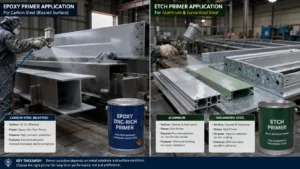
Anti-corrosion primer (often zinc-rich or epoxy, per spec)
Epoxy build/intermediate for barrier thickness
Final topcoat (PU or polysiloxane) for UV/weathering and cleanability
ISO 12944-5 explicitly states most epoxies chalk under sunlight and recommends a suitable topcoat if color or gloss retention is required; it also lists polyurethane and polysiloxane among coating types used in protective paint systems.
Steel Structure Coating Solutions
Unique value (what buyers forget):
Premium topcoats cannot compensate for insufficient epoxy barrier thickness or salt contamination.
Many disputes are caused by exceeding recoat windows and applying topcoat over a glossy/contaminated epoxy surface.
6) Typical DFT ranges (project-dependent; confirm by TDS/spec)
State DFT as ranges and finalize by product TDS and project specification.
Typical topcoat DFT ranges (guide only)
Polyurethane topcoat: ~40–80 μm DFT (common range; confirm by TDS)
Polysiloxane topcoat: ~50–100 μm DFT (common range; confirm by TDS)
Typical system total DFT (marine duty, guide only)
Often 200–350 μm total DFT depending on environment category, durability requirement, and system design (confirm by spec/TDS).
Field tip (acceptance): For decks, split acceptance zones: traffic lanes vs low-traffic areas, and record DFT readings by area with photo logs to reduce handover disputes.
7) Quality/inspection checklist (what to control on site)
Before topcoat
Confirm undercoat cleanliness (remove dust, salts, oils).
Verify the epoxy surface is within recoat window; if not, abrade/sweep per procedure (project-dependent).
Stripe-coat edges/welds if specified for consistent coverage.
During application
Control mixing ratio and pot life for 2K products (if applicable).
Maintain wet film control to hit DFT range after curing.
Avoid application under condensation risk.
After curing
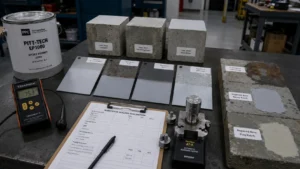
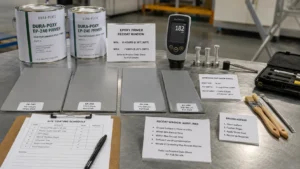
Verify DFT meets target range and uniformity.
Inspect for defects: pinholes, runs/sags, dry spray, poor gloss.
8) Common failures & troubleshooting
Failure: Chalking and fading
Driver: UV exposure; epoxy chalking is well-known and is why topcoats are used for aesthetics.
Fix: use an appropriate UV-stable topcoat technology; specify maintenance interval.
Failure: Poor adhesion between epoxy and topcoat
Driver: contamination, exceeded recoat window, glossy surface.
Fix: confirm recoat window; abrade/sweep and clean before topcoat (project-dependent).
Failure: Early wear-through on walkways
Driver: topcoat type not matched to abrasion duty or insufficient DFT.
Fix: choose abrasion-suitable topcoat, define traffic zones, and increase DFT within TDS limits.
9) RFQ Checklist (get a correct recommendation + quote)
To receive a fast, accurate proposal (PU vs polysiloxane), provide:
Asset type: ship deck / offshore topsides / jetty platform / port equipment deck
Location and climate: Middle East / SE Asia / Central Asia; UV intensity, humidity, coastal salt
Duty: foot traffic level, abrasion/impact risks
Chemical exposure: fuel/oil/cleaner splash frequency
Substrate condition: new steel vs maintenance repaint; existing coating type/age
Required durability: years to first major maintenance (or owner spec)
Application method: spray/roller, shutdown window constraints
Documents requested: TDS, SDS, system recommendation, QC procedure
Contact Us
We would love to speak with you.
Feel free to reach out using the below details.