In offshore projects, the splash zone is consistently the highest-risk location for coating failure — and the most frequently under-specified in RFQs. Offshore coating selection cannot be made at the asset level. It must be made zone by zone, because the splash and tidal interface combines wet/dry cycling, chloride concentration, UV exposure, and mechanical abrasion in a way that no other location on the same structure experiences simultaneously. Choosing the wrong epoxy technology for the splash zone — or failing to define the zone clearly in the RFQ — produces early coating breakdown and forces costly maintenance interventions that a correctly designed system would have deferred for a decade or more.
For project teams specifying offshore corrosion protection across full asset types — platforms, jackets, wind substructures, jetties — the marine and offshore coating solutions page covers the complete application scope.
Why the Splash Zone Is the Hardest Area to Protect
The splash and tidal interface is the most demanding offshore coating environment because no other zone simultaneously subjects the coating to the full combination of corrosion drivers. Understanding what the splash zone actually does to a coating system is the foundation for selecting the right offshore coating technology.
The coating experiences:
-
Frequent wet/dry cycling: the film alternately absorbs and releases moisture and salt, driving osmotic stress cycles that standard barrier films are not designed to sustain indefinitely
-
Chloride concentration on the surface: as seawater evaporates between wetting events, dissolved salts concentrate at the coating surface and drive ion penetration through any permeable film
-
Mechanical abrasion: wave action, floating debris, and maintenance traffic impose repeated impact and abrasive loading that damages films with insufficient mechanical toughness
-
UV and weathering above the waterline: the upper splash zone receives direct solar radiation and thermal cycling, adding photodegradation stress to an already demanding chemical environment
-
Higher failure risk at edges, welds, and bolted connections: geometric film thinning at sharp details reduces DFT at exactly the locations where stress concentration and corrosion risk are highest
Marine coating guidance consistently separates selection by zone — atmospheric, splash, tidal, and immersion — and references ISO 12944 C5-M or CX when specifying systems for splash and tidal interfaces.
Glass Flake Epoxy vs Standard Epoxy: What the Real Difference Is
The core technical distinction between glass flake epoxy and standard high-build epoxy is barrier morphology — how the cured film resists moisture and ion permeation at the microstructure level. Both are epoxy-based systems; the difference is what happens inside the film under sustained exposure.
Standard High-Build Epoxy
Standard epoxy systems provide strong adhesion to blast-cleaned steel and low film permeability compared with most other resin chemistries. In C3–C4 atmospheric marine environments and less severe tidal interfaces, high-build epoxy systems are an effective and cost-efficient barrier when surface preparation and application quality are controlled.
In splash zone service, standard epoxy can perform adequately when the specification is correct and maintenance cycles are planned and executed. The limitation is that standard epoxy films do not contain a structural barrier reinforcement — moisture and ions follow the shortest permeation path through the film matrix, and under sustained wet/dry cycling stress, this path shortens over time as micro-cracks develop.
Marine Epoxy Barrier Coat: Glass Flake Technology
Glass flake epoxy incorporates lamellar glass flake particles oriented parallel to the steel surface within the cured film. This microstructure creates a tortuous path: moisture and ions must navigate around each overlapping glass platelet rather than permeating directly through the film. The effective permeation path length through a glass flake film is significantly longer than through an equivalent DFT of standard epoxy.
Published technical data for glass flake systems note additional performance attributes relevant to splash zone service:
-
Reduced cathodic disbondment risk: the tortuous path barrier reduces the rate at which moisture and ions reach the primer/steel interface, which lowers the risk of cathodic disbondment in CP-protected structures
-
Improved impact and abrasion resistance: the lamellar glass flake reinforcement increases film toughness against mechanical loading from wave action and debris impact
-
Reduced coat count at equivalent or superior barrier performance: in some specifications, a glass flake barrier coat can deliver the required DFT and impermeability in fewer coats than a standard epoxy buildup — improving application productivity on offshore assets where working time and access are constrained
For the full glass flake epoxy and marine coating systems product range, see marine coating systems.
Selection Rules: When to Choose Each System
Use this decision table in your RFQ and specification to avoid over- or under-engineering the offshore coating system for each zone.
Critical buyer error: Many RFQs specify “offshore epoxy” without defining the zone. A supplier receiving an undifferentiated offshore RFQ will quote a standard system — which may be technically correct for the atmospheric zone but underperforms in the splash and tidal interface. Defining the zone explicitly in the RFQ is not a formality; it is the step that determines whether the quoted system is actually fit for the highest-risk location on the asset.
Marine Coating Systems: Typical Structures and DFT Ranges
DFT ranges below are indicative; final thickness must be confirmed against TDS and project specification. Both system architectures below are established approaches for offshore steel — the choice between them is driven by zone severity, maintenance strategy, and lifecycle cost target.
Option A: Standard Epoxy System
-
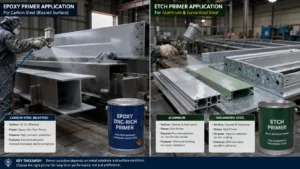
Epoxy zinc rich primer (sacrificial cathodic protection at the steel interface; Sa 2.5 minimum)
-
High-build epoxy intermediate coat (barrier buildup; typically 100–150 µm DFT per coat)
-
Aliphatic polyurethane topcoat above the waterline (UV stability and weathering resistance)
-
Typical total DFT: 200–320 µm depending on corrosivity category and design life
Option B: Glass Flake Epoxy Barrier System (Splash Zone Focused)
-
Epoxy zinc rich primer (cathodic protection foundation)
-
Glass flake epoxy barrier coat (high-build lamellar barrier; typically 250–500 µm DFT, project-dependent)
-
UV-resistant topcoat where above-waterline UV exposure applies (project-dependent)
-
Note: the lamellar diffusion morphology can reduce the number of coats required while improving lifecycle performance — a key reason glass flake systems are specified for high-risk environments where access for future maintenance is constrained
Both systems require Sa 2.5 blast preparation as the minimum for splash zone and immersion service. Surface profile and soluble salt levels must be confirmed against TDS requirements before primer application.
Surface Preparation and Application: What Matters Most Offshore
Surface preparation is the single variable with the highest impact on offshore coating performance — and the variable most frequently compromised in field execution. No offshore coating system, regardless of technology, compensates for inadequate surface preparation.
New build vs. maintenance repaint: new build conditions allow full blast preparation in controlled shop or yard environments. Maintenance repaint offshore is constrained by access, weather windows, surface contamination from in-service exposure, and the need to work around live plant. These constraints often drive system selection — surface-tolerant epoxy systems may be required where Sa 2.5 is not achievable in situ.
Field execution checklist for splash zone application:
-
Confirm whether this is new steel (shop or yard blast) or maintenance repaint (site constraints)
-
Salt contamination testing and removal before coating — soluble salt limits are typically ≤ 20 mg/m² for immersion and splash zone service
-
Stripe coat all edges, weld toes, bolt heads, and complex geometry by brush before each full-area spray coat
-
Measure and record DFT for every zone at the acceptance inspection stage — do not rely on wet film thickness alone
-
Consider holiday / pinhole testing for immersion service and critical splash zone sections (project-dependent)
-
Verify recoat windows from TDS — both minimum and maximum — before each subsequent coat application
Common Failures in Splash Zone Coatings and How to Prevent Them
Offshore coating failure analysis in splash zones consistently identifies three recurring failure modes — all of which are preventable at the design and specification stage.
Failure 1: Underfilm corrosion at edges and welds
Cause: insufficient stripe coating or geometric film thinning at sharp details produces DFT below the specified minimum at exactly the locations with highest stress concentration and corrosion risk.
Prevention: mandatory stripe coating by brush at all edges, weld toes, bolt heads, and connections before each full-area spray coat. DFT measurement at high-risk details must be part of the inspection hold-point record.
Failure 2: Premature barrier breakdown from permeability
Cause: a standard epoxy system specified for a splash zone environment that requires exceptional impermeability — typically because the zone was not explicitly defined in the RFQ or specification.
Prevention: specify glass flake epoxy barrier coat when sustained impermeability is required in C5-M or CX splash and tidal service. Define the zone in the RFQ. Confirm the system is matched to the ISO 12944 corrosivity category for the specific location, not the asset as a whole.
Failure 3: Adhesion loss at damaged areas
Cause: impact damage from wave debris or maintenance equipment creates a breach in the film; water ingress under the coating then progresses laterally through the primer/steel interface, particularly where cathodic disbondment resistance is low.
Prevention: select glass flake systems for high-impact zones where cathodic disbondment resistance is a specification requirement. Maintain an inspection and repair plan — early spot repair of damaged areas prevents lateral corrosion spread.
Offshore Protective Coatings Company: RFQ Checklist for System Recommendation
Copy the checklist below into your RFQ to receive a technically correct system proposal. The most common reason offshore RFQs produce inaccurate or non-comparable quotes is that zone definition and surface preparation scope are left unspecified — suppliers then make different assumptions and the quotes are not comparable.
Project basics:
-
Country/region (Middle East / Southeast Asia / Central Asia)
-
Asset type (offshore platform, jacket, wind substructure, jetty, pipe rack, etc.)
-
Required service life target and planned maintenance window intervals
Exposure definition (mandatory):
-
Zone: atmospheric / splash / tidal / immersion — specify each zone on the asset
-
ISO 12944 corrosivity category (C5-M / CX) if client or project standard specifies
-
Any NORSOK M-501 or project-specific coating standard requirements
Technical scope:
-
Substrate condition: new steel (shop/yard) or maintenance repaint (site constraints)
-
Surface preparation method available: blast / power tool / spot blast
-
Application method: airless spray / brush-roller for stripe coats
-
CP (cathodic protection) interface: confirm if CP system is present and cathodic disbondment resistance is a specification requirement
Performance expectations:
-
System preference: standard high-build epoxy / glass flake epoxy / request supplier recommendation based on zone and service life
-
DFT target range per coat and total — or request TDS-based recommendation
-
Coat count constraint (if any — relevant for offshore assets with application time pressure)
Documents requested from supplier:
-
TDS + SDS for each proposed product
-
Full system recommendation: primer + intermediate + barrier coat + topcoat, with DFT and recoat windows per layer
-
Inspection and acceptance plan (DFT hold points, repair procedure)
-
Reference projects in equivalent service environments (asset type and corrosivity category)
Next step options for qualified projects:
-
Request a coating system recommendation matched to your zone and service life
-
Request TDS/SDS package for shortlisted products
-
Request a sample or trial order for system qualification
FAQ
What is the difference between glass flake epoxy and standard epoxy for offshore use?
The core difference is barrier morphology. Glass flake epoxy contains lamellar glass platelets oriented parallel to the steel surface, creating a tortuous permeation path that significantly increases the effective path length for moisture and ions through the film. Standard high-build epoxy provides a barrier through film density and resin chemistry alone, without the structural reinforcement of lamellar particles. In C5-M and CX splash zone environments, this difference in permeation resistance translates to longer service intervals, reduced cathodic disbondment risk, and higher impact and abrasion resistance — which is why glass flake systems are specified for high-risk offshore zones where maintenance access is constrained and early failure is costly.
Which ISO standard defines offshore coating system requirements for splash zones?
ISO 12944 is the primary international reference for corrosion protection of steel structures by coating systems. ISO 12944-2 defines corrosivity categories — C5-M covers severe marine atmospheric exposure; CX covers offshore and very severe marine environments including splash and tidal zones. ISO 12944-5 provides system selection guidance linked to corrosivity category and design life (Low up to 7 years, Medium 7–15 years, High 15+ years). For offshore assets, NORSOK M-501 is also referenced on projects following Norwegian standards, and project-specific owner standards may apply.
What surface preparation is required for glass flake epoxy in splash zone service?
Sa 2.5 per ISO 8501-1 (equivalent to SSPC-SP10 Near-White Blast) is the minimum required surface preparation for glass flake epoxy in splash zone and immersion service. Soluble salt contamination must be controlled to ≤ 20 mg/m² (project-dependent — confirm against TDS and specification). Surface profile must match the primer TDS requirement, typically 50–85 µm Rz for high-build epoxy systems. Applying glass flake epoxy over inadequately prepared steel eliminates the cathodic protection mechanism of the zinc-rich primer and reduces adhesion performance to well below specification.
When should I specify glass flake epoxy instead of standard epoxy in an offshore RFQ?
Specify glass flake epoxy when any of the following conditions apply: the zone is splash or tidal interface in C5-M or CX; the service life target is 15+ years (ISO 12944-5 High durability); the structure is CP-protected and cathodic disbondment resistance is a specification requirement; maintenance access after installation is constrained or expensive; or mechanical abrasion and impact loading from wave action or operational activity are significant. If your RFQ only states “offshore epoxy” without zone definition, request a zone-by-zone system recommendation — a single system specification across the full asset is the most common source of mismatched performance in offshore coating projects.
Can glass flake epoxy reduce total coat count in offshore applications?
Yes, in some specifications. The lamellar glass flake structure achieves higher effective barrier performance per coat than standard epoxy at equivalent DFT, which means the required total DFT and barrier thickness can sometimes be reached in fewer coats. This is relevant on offshore assets where application time, weather windows, and access constraints drive cost — fewer coats with equivalent or superior lifecycle performance directly reduces application cost and schedule risk. Final coat count must always be confirmed against TDS and the project corrosivity category and design life requirements.