For structural engineers and project managers, “fireproofing” isn’t just about buying a can of paint—it’s about meeting a specific legal Fire Resistance Rating (FRR) of 60, 90, or 120 minutes. The thickness of the intumescent coating determines whether a steel beam holds up or collapses during a fire.
HUILI Coating provides certified thin-film intumescent coating systems designed to meet international fire safety codes while maintaining the aesthetic finish of exposed steel.
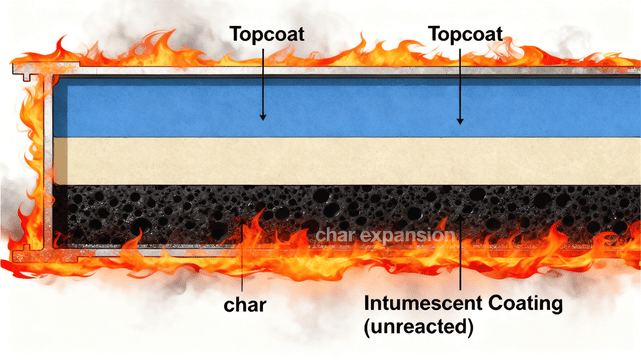
1) How Intumescent Coatings Work (The “Char” Effect)
Intumescent coatings are “reactive” paints. At normal temperatures, they look like a standard smooth finish (typically 0.5mm to 3mm thick). However, when exposed to heat (approx. 200°C+), they undergo a chemical reaction and swell up to 50 times their original thickness.
This expansion creates a thick, carbonaceous “char” layer that acts as a thermal insulator, slowing down the heat transfer to the steel core. This buys time—60, 90, or 120 minutes—for evacuation and emergency response before the steel reaches its critical failure temperature (usually 550°C).
2) Defining Your Requirement: 60 vs 90 vs 120 Minutes
The required Fire Resistance Rating (FRR) is dictated by your local building code and the building’s function.
- 60 Minutes (1 Hour): Common for low-rise commercial buildings, warehouses, and car parks.
- 90 Minutes (1.5 Hours): Often required for mid-rise offices, shopping malls, and industrial process structures.
- 120 Minutes (2 Hours): Mandatory for high-rise buildings, critical infrastructure (airports/hospitals), and heavy industrial petrochemical supports.
Go to Fire-Resistant Coating Series>>>
3) The Critical Formula: Hp/A (Section Factor)
You cannot simply ask “What is the thickness for 120 minutes?” The answer depends on the Section Factor (Hp/A) of the specific steel member.
- Hp (Heated Perimeter): The surface area of the steel exposed to fire.
- A (Cross-sectional Area): The mass of the steel that can absorb heat.
The Rule of Thumb:
- Heavy, thick steel (Low Hp/A): Heats up slowly -> Needs thinner coating.
- Light, thin steel (High Hp/A): Heats up quickly -> Needs thicker coating.
Example: A massive column might only need 1.0mm DFT for a 60-minute rating, while a thin roof truss might need 2.5mm DFT for the same rating.
4) Coating Thickness (DFT) Guide by Rating
Note: These are estimated ranges. Final specification must come from the manufacturer’s certified loading tables.
| Fire Rating | Typical DFT Range (mm) | Application Method |
|---|---|---|
| 30 Mins | 0.25mm – 0.70mm | Brush / Roller / Airless Spray |
| 60 Mins | 0.60mm – 1.50mm | Airless Spray (preferred) |
| 90 Mins | 1.20mm – 2.50mm | Airless Spray (multi-coat) |
| 120 Mins | 2.00mm – 4.50mm | Airless Spray (heavy duty) |
Warning: Applying too much thickness in one go can cause sagging or mud-cracking. High ratings usually require multiple passes.
5) The Complete System: Primer is Non-Negotiable
Intumescent coatings never go directly on bare steel. They are part of a 3-layer system:
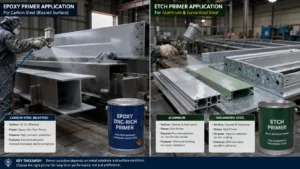
- Primer (Anti-Corrosion): Must be tested and compatible. A standard alkyd primer might fail under an intumescent layer. We recommend specific epoxy primers that ensure adhesion during the expansion phase.
- Intumescent Coat: The reactive layer (thickness defined by Hp/A).
- Topcoat (Sealer/Aesthetic): Essential for protection against humidity and wear. Without a topcoat, the intumescent layer can absorb moisture and degrade.
Go to Anti-Rust & Primer Coatings Series>>>
6) Common Application Mistakes
- Wrong Primer: Using a “universal” primer that softens when the intumescent paint solvents hit it.
- Ignoring Dew Point: Applying when steel is wet kills adhesion, causing the fireproofing to delaminate before the building is even finished.
- Missing Topcoat Outdoors: If the steel is semi-exposed (e.g., a canopy), a weather-resistant topcoat is mandatory to prevent the fireproofing from washing off.
7) RFQ Checklist for Fireproof Coatings
To get a valid loading table and price quote, engineers must provide:
- Steel Schedule: A list of beam/column sizes (e.g., W10x49, H-beams).
- Fire Rating: 60, 90, or 120 minutes?
- Exposure: Interior (dry), Semi-exposed, or Exterior?
- Standard Required: UL 1709 (Hydrocarbon fire) or BS 476 (Cellulosic fire)?
Go to steel structure coating industrial anti-corrosion solutions >>>
Next Step: Request a Project Loading Calculation
Don’t guess the thickness. Send us your steel schedule, and HUILI’s technical team will calculate the exact Dry Film Thickness (DFT) required for each beam to meet your 60/90/120-minute fire rating.