Pipelines represent some of the most critical and difficult-to-access infrastructure in industrial and energy projects. A pipeline coating failure can mean product contamination, accelerated corrosion, leakage risk, and costly excavation and repair — or, in subsea and offshore applications, intervention costs that dwarf the original coating budget many times over.
Pipeline coating encompasses two fundamentally different engineering challenges: external coatings that protect the pipe’s outer surface from soil, seawater, or atmospheric corrosion; and internal coatings (or linings) that protect the pipe bore from the corrosive, erosive, or contaminating effects of the transported product. Each requires a different selection approach, different application methods, and different inspection standards.
This guide covers both, with selection guidance by service condition, applicable standards, and the key specification decisions that determine system performance.
External Pipeline Coating: Protecting Against Soil and Environmental Corrosion
The external corrosion of buried and submerged pipelines is the primary cause of pipeline failure worldwide. Soil corrosion, microbially induced corrosion (MIC), and — in coastal or marine environments — seawater corrosion create a continuous attack on unprotected or inadequately protected pipe steel.
External pipeline coating systems work in combination with cathodic protection (CP) — the coating is the primary barrier, reducing the area of bare steel that the CP system must protect. An effective coating system dramatically reduces CP current demand and extends the service life of both the anode system and the pipe itself.
Fusion Bonded Epoxy (FBE)
FBE is the dominant external coating for new-build oil and gas transmission pipelines. Applied in a factory (mill) environment as a thermosetting powder, it is electrostatically sprayed onto preheated pipe and cured by the pipe’s residual heat. The result is a thin, dense, extremely well-adhered film — typically 300–500 µm DFT — with excellent cathodic disbondment resistance.
- Standards: CSA Z245.20, ISO 21809-1, AWWA C213
- Best for: onshore transmission pipelines (oil, gas, water) in soil or backfill environments
- Limitation: requires mill application — cannot be applied in the field; field joint coating required at weld joints
Three-Layer Polyethylene (3LPE) and Three-Layer Polypropylene (3LPP)
Three-layer systems add a mechanical protection outer layer to FBE. The structure is: FBE base layer (adhesion) + adhesive copolymer layer (bonding) + high-density polyethylene or polypropylene outer jacket (mechanical protection, moisture barrier). 3LPE is standard for most onshore and shallow-water pipelines; 3LPP is used for high-temperature service (up to 140°C) and deepwater pipelines where water pressure could disbond PE systems.
- Total thickness: 2.5–4.5 mm (3LPE); 3–5 mm (3LPP)
- Standards: ISO 21809-1 (3LPE), ISO 21809-2 (3LPP), DIN 30670
- Best for: onshore buried pipelines; offshore pipelines to moderate depth; high-temperature pipeline service
Coal Tar Enamel (CTE) and Coal Tar Epoxy
Historically the dominant pipeline coating, coal tar enamel has largely been replaced by FBE and 3LPE in new-build projects due to health and regulatory concerns (coal tar is a carcinogen). Coal tar epoxy (a two-component epoxy modified with coal tar) remains in use for rehabilitation, water pipeline service, and some industrial buried pipeline applications.
- Typical DFT: 400–1,000 µm (epoxy); 3–6 mm (enamel with glass wrap reinforcement)
- Best for: rehabilitation of existing CTE-coated pipelines; gravity sewer and stormwater pipelines; low-cost buried pipeline protection
- Limitation: coal tar content restricts use in many jurisdictions; not suitable for potable water pipelines
Epoxy and Polyurethane Field Applied Systems
For above-ground pipelines, field joint coating, and pipeline infrastructure in atmospheric or industrial environments, two-component epoxy and polyurethane systems are standard. These are the ISO 12944-type systems used for structural steel — applied by airless spray to blast-cleaned pipe exterior.
- Typical system: zinc-rich epoxy primer (60–80 µm) + high-build epoxy intermediate (120–200 µm) + polyurethane topcoat (50–80 µm) = 230–360 µm total
- Standards: ISO 12944-5 (C3 to CX), NACE SP0169 (buried pipeline external coating)
- Best for: above-ground pipework, process pipework, pipeline facilities and stations; field joints
For anti-corrosion external coating for steel pipe in buried and industrial applications, see our dedicated specification guide.
Comparison: External Pipeline Coating Systems
| System | Applied DFT / Thickness | Best Application | Key Standard | Service Life |
| Fusion Bonded Epoxy (FBE) | 300–500 µm | Onshore transmission pipeline — mill applied | ISO 21809-1 | 25–40 years |
| 3-Layer Polyethylene (3LPE) | 2.5–4.5 mm | Buried pipelines; moderate temperature | ISO 21809-1 | 30–50 years |
| 3-Layer Polypropylene (3LPP) | 3–5 mm | High temp (>80°C); deepwater | ISO 21809-2 | 30–50 years |
| Coal Tar Epoxy | 400–1,000 µm | Rehabilitation; gravity sewer; water pipe | AWWA C210 | 15–25 years |
| Epoxy + PU (field applied) | 230–400 µm | Above-ground pipework; field joints; industrial | ISO 12944 | 10–25 years |
| Bituminous coating | 300–600 µm | Buried low-pressure pipelines; rehabilitation | BS 4164 | 10–20 years |
Internal Pipeline Coating: Protecting the Pipe Bore
Internal pipeline coating serves two purposes that are distinct from external corrosion protection: corrosion protection of the pipe bore from the transported product; and flow efficiency improvement by reducing the pipe bore surface roughness, increasing throughput, and reducing pumping energy.
Epoxy Lining for Internal Pipe Corrosion Protection
Two-component solvent-free or low-solvent epoxy is the standard internal coating for steel pipelines carrying corrosive products — water, dilute chemicals, and petroleum products with water content. Applied by centrifugal spinning (small diameter pipe) or airless spray (large diameter pipe, field applied).
- Typical DFT: 200–500 µm
- Standards: AWWA C210 (water pipelines), API 5L2 (flow efficiency coating), ISO 15741 (internal coating for flow improvement)
- Best for: water transmission and distribution pipelines; crude oil and gas gathering lines with water content; industrial process pipework
- Potable water: must use WRAS-approved or NSF 61-listed epoxy for drinking water service
Fusion Bonded Epoxy (FBE) Internal Lining
The same FBE technology used for external coating is also applied to pipe interiors in mill environments — particularly for natural gas transmission pipelines where the smooth FBE surface improves flow efficiency (reduced roughness coefficient). Applied at 50–100 µm for flow efficiency; 200–400 µm for corrosion protection.
Glass Flake Epoxy Internal Lining
For pipelines carrying aggressive media — produced water with high chloride content, chemical process streams, sour gas with H₂S — glass flake epoxy provides the enhanced barrier performance required. Applied at 500–1,500 µm by airless spray in-situ (large diameter pipelines and risers) or in a mill.
- Best for: produced water pipelines; brine injection lines; chemical process pipelines; offshore risers and flowlines
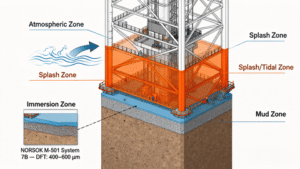
- Standards: NACE SP0169, NORSOK M-501
Cement Mortar Lining
For large-diameter water distribution pipelines, cement mortar lining provides a cost-effective, durable internal coating that is compatible with potable water and provides a degree of self-healing (minor cracks re-seal through ongoing cement hydration). Applied by centrifugal spinning.
- Thickness: 6–19 mm depending on pipe diameter
- Standards: AWWA C205, ISO 4179
- Best for: municipal water distribution; ductile iron and steel water mains
Field Joint Coating: The Critical Weak Point
Field joint coating is one of the most important — and most frequently underspecified — elements of a pipeline coating system. When mill-applied coatings (FBE, 3LPE) are cut back at weld joints, the bare steel at the joint must be coated in the field after welding. Field joints represent only 1–3% of the total pipe surface area but account for a disproportionate share of pipeline corrosion failures.
Field joint coating options range from heat-shrink sleeves (the most common, quickest to apply) to liquid epoxy systems, mastic tape wraps, and infill-moulded systems for high-performance applications. The field joint coating must be compatible with the mainline coating and provide equivalent corrosion and cathodic disbondment resistance.
- Heat shrink sleeves: fast to apply; good adhesion to FBE; performance depends on preheat and application quality — the most common cause of premature field joint failure
- Liquid epoxy (two-component): higher reliability when correctly applied; allows DFT verification and holiday testing; preferred for critical or high-temperature applications
- Infill-moulded polypropylene: for 3LPP mainline systems — maintains thermal insulation continuity at joints; specialist equipment required
💡 Field joint coating quality depends heavily on the skill and experience of the application team. Insist on documented application procedures, qualified applicators, and 100% holiday detection on all field joints — not just visual inspection.
Cathodic Protection and Coating Compatibility
External pipeline coatings and cathodic protection (CP) systems are designed to work together. The coating provides the primary barrier; CP provides residual protection where holidays (coating defects) expose the steel. For this combined protection to work, the coating must be resistant to cathodic disbondment — the tendency of a coating to lose adhesion under the alkaline conditions created by CP current at holidays.
FBE and high-build epoxy systems have excellent cathodic disbondment resistance and are CP-compatible. Polyethylene and polypropylene jacket systems are inherently CP-compatible. Coal tar systems vary — test data to ISO 15711 or ASTM G8 should be requested.
The coating system must be compatible with the CP system design voltage. Coatings exposed to excessive CP current (overprotection) can blister or disbond. Confirm the maximum CP voltage at the design stage with both the coating manufacturer and the CP engineer.
Key Standards for Pipeline Coating
| Standard | Coverage |
| ISO 21809-1 | External coating for buried or submerged pipelines — polyolefin coatings (3LPE, 3LPP) |
| ISO 21809-2 | External coating — fusion bonded epoxy |
| ISO 21809-3 | Field joint coating for external pipeline systems |
| AWWA C210 | Liquid epoxy coating for steel water pipelines (internal and external) |
| AWWA C205 | Cement mortar lining for water pipelines |
| API 5L2 | Internal coating of line pipe for improved flow efficiency |
| NACE SP0169 | Control of external corrosion on underground or submerged metallic piping systems |
| ISO 15741 | Paints and varnishes — friction reduction coatings for internal bore of pipelines for non-compressible fluids |
| ISO 15711 | Paints and varnishes — cathodic disbondment test for coatings in seawater |
Frequently Asked Questions
What is the most common cause of buried pipeline coating failure?
The three most common causes, in order of frequency, are: (1) field joint coating failure — poor application quality, inadequate surface preparation, or incompatible field joint system; (2) mechanical damage during backfill or soil movement — particularly for thin FBE systems without an outer protection layer; and (3) cathodic disbondment at holidays — where coating adhesion loss under CP current allows corrosion to spread laterally beneath the film. Selecting the correct system and insisting on rigorous inspection of field joints are the most effective preventive measures.
Does internal pipeline coating affect flow rate?
Yes — positively. Smooth epoxy or FBE internal coatings significantly reduce the pipe bore surface roughness coefficient compared to bare steel. A smooth internal coating can reduce pumping energy requirements by 15–30% for a given flow rate, or increase throughput at constant pump pressure. This flow efficiency improvement is often the primary justification for internal coating of gas transmission pipelines, where even small reductions in line resistance translate to significant energy savings over a 30–40 year design life.
Can pipeline coating be inspected without excavation?
External coating condition on buried pipelines can be assessed non-destructively using several techniques: DCVG (Direct Current Voltage Gradient) survey identifies holidays and coating defects by mapping current discharge from the pipeline; CIPS (Close Interval Potential Survey) assesses CP effectiveness; and electromagnetic inspection techniques can detect coating thickness variations. For internal coating, video inspection using CCTV or pig-mounted cameras identifies damage, delamination, and coating condition. Full integrity assessment typically combines multiple techniques.
Pipeline Coating Systems from Huili Coating
Huili Coating manufactures field-applied pipeline coating systems for above-ground, industrial, and offshore pipeline applications — including anti-corrosion epoxy systems, glass flake epoxy for aggressive internal service, and high-temperature systems for process pipework.
- External pipeline coating: zinc-rich + epoxy + PU systems per ISO 12944 C3–CX
- Internal pipeline coating: solvent-free epoxy and glass flake epoxy for water, hydrocarbon, and chemical service
- Bituminous coating for buried pipelines — low-pressure and rehabilitation service.
- External anti-corrosion coating for steel pipe — specification guide for buried and industrial applications.
- Pipeline coating and lining systems overview — full system coverage for industrial pipeline projects.
- Storage tank and pipeline coating — corrosion challenges and coating solutions for tanks and pipelines.
Provide your pipeline service conditions (product, temperature, burial depth, operating environment) for a system recommendation. Contact us via the project inquiry form.