Steel remains a core material in industrial construction, infrastructure, energy, and manufacturing because it combines strength with cost efficiency, but it is highly vulnerable to corrosion when moisture, oxygen, salts, or chemicals reach the surface.
That is why choosing the right corrosion resistant coating for steel is not just a paint decision; it is a lifecycle, maintenance, and risk-control decision for owners, EPC contractors, and fabricators.
Modern steel protection usually relies on system design rather than a single product, combining primers, build coats, topcoats, and preparation standards to match the real service environment.
Quick Guide
- Match the coating system to corrosivity, service life, and maintenance access first.
- Use zinc-rich, epoxy, and polyurethane layers together when long-life atmospheric protection is needed.
- Treat surface preparation, DFT, and recoat control as part of the system, not as site afterthoughts.
- Use higher-duty systems for marine, offshore, and heavy industrial exposure.
- Send environment, steel condition, and durability target before requesting TDS or pricing.
What Is Corrosion Resistant Coating for Steel
A corrosion resistant coating for steel is a protective coating or coating system applied to steel to prevent or slow corrosion caused by environmental exposure.
These systems work by creating a barrier against water and oxygen, resisting chemicals, or providing sacrificial protection when zinc-based primers are used.
In practice, steel coating for corrosion resistance is rarely a single-layer solution on industrial assets.
Most long-life specifications use a multi-layer system in which each coat performs a different function, such as adhesion, barrier build, UV resistance, or cathodic protection.
Why It Is Important for Industrial Steel Protection
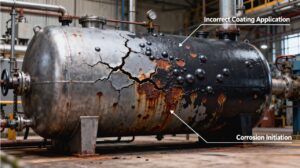
Steel corrosion is an electrochemical reaction involving iron, oxygen, and water, and it becomes more aggressive in coastal zones, industrial atmospheres, buried service, and conditions with high humidity or cycling temperatures.
If the surface is not protected, corrosion can spread quickly across exposed areas, edges, welds, and damaged film zones.
For industrial assets, corrosion can lead to:
- Structural deterioration and higher safety risk.
- More shutdowns and repair work.
- Higher lifecycle cost and earlier replacement.
- Lower reliability in aggressive operating environments.
For owners and EPC teams, the correct corrosion coating for steel directly affects service life, maintenance planning, and total project cost.
Compare Corrosion Resistant Coating Systems for Steel
Different systems are used depending on whether the main protection mechanism is barrier performance, sacrificial action, or a combined multi-layer approach.
For most atmospheric steelwork, multi-layer systems give the best balance of corrosion resistance, durability, and maintainability.
If you need a broader project view, HUILI’s steel structure coating solutions page shows how system logic changes by asset type and environment.
Choose Key Coating Materials Used
Epoxy coatings
Epoxy coatings are among the most common materials in corrosion resistant coating for steel because they provide strong adhesion, water resistance, chemical resistance, and barrier build.
They are widely used on pipelines, tanks, structural steel, and machinery, especially as primers or intermediate coats.
Polyurethane coatings
Polyurethane coatings are commonly used as topcoats because they offer strong UV resistance, color retention, and good exterior durability.
In most long-life steel systems, polyurethane complements epoxy rather than replacing it, with epoxy providing the main barrier build and polyurethane protecting the system from sunlight and weather.
Zinc-rich coatings
Zinc-rich primers are critical in many heavy-duty systems because they provide sacrificial protection, meaning zinc corrodes preferentially and helps protect exposed steel.
They are often specified for bridges, offshore steel, coastal assets, and other severe atmospheric environments.
Fluorocarbon coatings
Fluorocarbon coatings are premium topcoat options used where long-term weather resistance, color stability, and exterior durability are priorities.
They are more common on exposed architectural or coastal steel than on general low-cost industrial steel.
Other advanced materials
Depending on service conditions, engineers may also consider high-temperature resistant coatings, chemical-resistant linings, water-based anti-corrosion systems, or specialty protective coatings.
These materials are usually selected when standard zinc-epoxy-polyurethane systems do not fully address the operating environment.
Design Coating Systems for Long-Term Protection
A typical high-performance corrosion resistant coating for steel uses a zinc-rich primer, an epoxy intermediate coat, and a polyurethane or fluorocarbon topcoat.
This design combines active corrosion control, total film build, and weather resistance in a way that is easier to optimize for industrial steelwork.
Typical layer roles:
- Primer: adhesion to steel and early corrosion protection.
- Intermediate coat: build thickness, reduce permeability, and improve chemical resistance.
- Topcoat: improve UV resistance, color retention, and exterior durability.
DFT planning and total system build should be linked to environment and durability target, not copied from unrelated projects.
ISO 12944 is widely used to connect corrosivity category and durability range to the protective paint system used on steel structures.
For teams comparing topcoat roles in more detail, HUILI’s epoxy vs polyurethane coating guide is a helpful reference during specification review.
Check Surface Preparation and Inspection Requirements
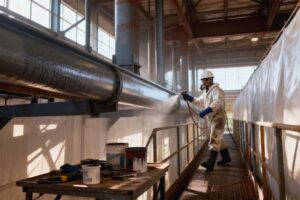
Surface preparation has a major effect on whether a corrosion coating for steel performs as designed.
If the steel is contaminated, poorly profiled, or inadequately cleaned, even a strong coating system can fail early.
Common preparation routes include:
- Abrasive blasting for higher-performance systems.
- Mechanical cleaning where blasting is restricted.
- Chemical or solvent cleaning where contaminants must be removed before coating.
For heavy-duty systems, Sa 2.5 and SSPC-SP 10 / NACE No. 2 are widely referenced preparation levels for steel prior to protective coating application.
A practical inspection checklist should cover:
- Surface cleanliness and profile before priming.
- Dust, oil, grease, and soluble salt control where relevant.
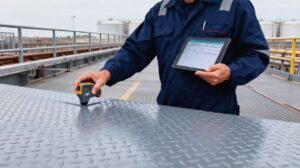
- DFT readings across flats, welds, edges, and repairs.
- Minimum and maximum recoat interval control between coats.
- Final defect inspection for misses, runs, pinholes, and edge coverage.
Review Industrial Applications
Corrosion resistant coating for steel is used across a wide range of assets, but system choice changes with exposure type and maintenance constraints.
- Structural steel: buildings, bridges, and industrial plants need long-term atmospheric protection.
- Storage tanks: external and internal coatings differ because atmospheric and immersion conditions are not the same.
- Pipelines: systems must address soil exposure, moisture, and service conditions.
- Offshore and marine structures: high salt, humidity, and severe corrosivity demand more robust systems.
- Industrial equipment: coating design must balance corrosion resistance, maintainability, and operating conditions.
Understand the Advantages of Modern Industrial Coating Systems
Modern systems give steel assets longer service life, lower maintenance frequency, and better reliability when they are matched correctly to the environment.
They also allow engineers to tune performance by combining different primers, build coats, and topcoats rather than relying on one generic material.
Key benefits include:
- Better lifecycle performance for steel structures.
- Lower risk of premature corrosion in aggressive exposure.
- Improved flexibility across industrial, coastal, and marine environments.
- Easier system customization for durability target and maintenance planning.
Choose the Right System for Engineers and Project Owners
System selection should start with environment, durability target, substrate condition, and application constraints rather than with product brand or low unit price.
That is especially important because ISO 12944 durability classes are tied to time to first major maintenance, which helps connect coating choice to lifecycle planning.
Key selection factors:
- Corrosivity level, such as C3, C4, C5, marine, or buried exposure.
- Expected service life and maintenance strategy.
- Steel condition, such as new fabrication, aged substrate, or maintenance repaint.
- Application method and site restrictions.
- Need for UV resistance, chemical resistance, or premium appearance.
Typical matching logic:
- Marine or coastal steel: zinc-rich primer + epoxy build + polyurethane or other weather-resistant topcoat.
- Heavy industrial atmospheres: epoxy-heavy systems with appropriate topcoat and DFT build.
- Buried or specialty exposure: system choice should be based on actual service condition rather than atmospheric coating logic.
If your team is building a specification package, HUILI’s ISO 12944 corrosion protection guide is useful for aligning environment and durability with system direction.
Prepare the RFQ Checklist
A good RFQ gives enough information for a real system recommendation, while a weak RFQ usually produces only a generic quote.
Include these items:
- Service environment, such as indoor, outdoor, coastal, marine, industrial, or buried.
- Asset type, such as structural steel, tank, pipeline, or fabricated equipment.
- Target service life or maintenance interval.
- Steel condition and achievable surface preparation standard.
- Application method, access limits, and shutdown window.
- Special requirements, such as chemical splash, UV retention, or high-temperature exposure.
What buyers often forget:
- Edge and weld geometry that makes coating control harder.
- Whether the project is shop-applied, site-applied, or maintenance repaint.
- Whether inspection resources are available for DFT, profile, and environmental checks.
Prevent Common Specification Mistakes
Some coating failures start on paper, not on the steel.
A common mistake is specifying a coating family without defining environment, durability, or preparation level.
Avoid these errors:
- Choosing only by initial material price.
- Using outdoor steel systems without checking UV and weathering needs.
- Increasing thickness while neglecting preparation quality.
- Treating all aggressive environments as identical.
- Ignoring recoat windows and inspection controls during application.
Conclusion
There is no single best corrosion resistant coating for steel for every project.
The best result comes from matching coating materials, system build, preparation standard, and inspection control to the actual service environment and durability target.
For most industrial atmospheric steel, multi-layer systems built around zinc-rich, epoxy, and weather-resistant topcoats remain the most practical route to long-term steel corrosion protection.
FAQ
What is the best corrosion resistant coating for steel?
There is no universal best option because the right system depends on environment, service life, preparation standard, and maintenance strategy.
For many industrial atmospheric structures, multi-layer systems are more effective than single-coat approaches.
Why are zinc-rich coatings important for steel protection?
Zinc-rich coatings provide sacrificial protection, so zinc corrodes preferentially and helps protect the steel substrate.
That makes them especially useful in heavy-duty and marine-oriented systems.
Can epoxy coatings be used alone for corrosion protection?
Epoxy coatings provide strong barrier protection and are widely used, but outdoor systems often need a UV-resistant topcoat because epoxy alone has weaker UV performance.
How long does a corrosion resistant coating system last?
Service life depends on corrosivity, system design, preparation quality, and inspection control.
In ISO 12944-based planning, durability is linked to time to first major maintenance rather than to one fixed life for every project.
What factors affect coating performance?
The biggest factors include surface preparation, total DFT, environment, material selection, recoat control, and application quality.
What is the difference between barrier and cathodic protection coatings?
Barrier coatings mainly block water, oxygen, and contaminants from reaching steel, while cathodic protection coatings use zinc or similar metallic content to protect the substrate sacrificially.
Technical Note
Coating selection, DFT range, and surface preparation level should be confirmed against the latest TDS, project specification, and actual exposure conditions before procurement or application.
Where ISO 12944 or related preparation standards are referenced, confirm the corrosivity category, durability target, and preparation level before finalizing the system.
Request a System Recommendation
Send your project environment, steel type, asset type, surface preparation condition, drawings, and target durability through our contact page so our technical team can recommend a suitable corrosion resistant coating for steel, provide TDS, and help you prepare a clearer RFQ.