When a structural steel project fails ahead of schedule, the root cause is almost always the same: the coating system was specified for the wrong environment. A C3-grade system applied in a coastal Saudi industrial zone will start blistering within two to three years. A C5-M over-spec applied to a sheltered urban warehouse in Malaysia wastes budget and delays the project timeline.
This guide is written for procurement engineers, EPC project managers, and technical buyers in the Middle East and Southeast Asia who need to match the right anti-corrosion coating system to the right environment — and source it reliably.
We cover ISO 12944 corrosivity categories from C3 to C5-M, the recommended primer-to-topcoat systems for each, what to look for in a coating manufacturer, and how Huili’s 30-year supply chain delivers these systems to projects in Saudi Arabia, the UAE, Indonesia, Malaysia, Vietnam, and beyond.
1. Why the corrosivity category determines everything
ISO 12944 classifies atmospheric environments into six corrosivity categories — C1 (very low) through CX (extreme) — based on annual steel corrosion loss and the level of chloride or sulphur dioxide pollution in the air. For heavy industrial projects in the Middle East and Southeast Asia, the relevant range is C3 to C5-M.
Getting the category wrong is expensive in both directions. Under-specifying means premature rust, structural risk, and costly re-coating during plant operation. Over-specifying inflates material and application costs without delivering meaningful extra protection.
The table below summarises the three categories most relevant to projects in your region.
| Category | Typical environment | Common project types | Min. service life target |
|---|---|---|---|
| C3 | Urban or light industrial; moderate humidity and sulphur dioxide | Warehouses, commercial steel frames, bridges in dry inland areas | 15 – 25 years |
| C4 | Heavy industrial; chemical plants, coastal infrastructure, high humidity | Petrochemical plants, coastal bridges, power station structures | 20 – 25 years |
| C5-I / C5-M | Very high industrial or marine; permanent condensation, salt spray, high pollution | Offshore platforms, desalination plants, coastal steel structures in the Gulf | 25+ years |
Source: ISO 12944-2:2018. Service life targets assume correct surface preparation, application, and DFT.
2. How to classify your project environment in the Middle East and Southeast Asia
Many buyers in these regions underestimate their corrosivity category because they are thinking about climate rather than industrial exposure. The Gulf’s dry desert air feels benign, but coastal proximity, salt-laden wind, and the concentrated chloride pollution found around refineries and desalination plants typically push projects to C4 or C5-M.
Southeast Asia adds high annual humidity and frequent condensation cycles on top of coastal chloride exposure, making C4 the practical minimum for most open industrial structures in Malaysia, Indonesia, Vietnam, and the Philippines.
A practical classification checklist for site engineers:
- Is the site within 1 km of the sea or a tidal estuary? → C4 minimum, likely C5-M
- Is the structure inside or adjacent to a petrochemical, chemical, or fertiliser plant? → C4 minimum
- Is the site in an inland desert location with no industrial sources nearby? → C3 may apply
- Is the structure permanently submerged, splash-zone, or exposed to high condensation? → C5-M or CX
- Is the annual relative humidity above 75% for more than half the year? → Step up one category
When in doubt, specify one category higher and document the rationale. The cost delta between a C3 and a C4 system is typically 15–20% of material cost — far lower than the cost of early re-coating during plant operation.
3. Recommended coating systems for C3, C4, and C5 environments
A steel structure coating system always consists of three functional layers: a primer (sacrificial or barrier protection), an intermediate coat (barrier thickness and adhesion bridging), and a topcoat (UV resistance, colour retention, final weather barrier). What changes between categories is the primer technology, the zinc content, the number of coats, and the total dry film thickness (DFT).
C3 system — commercial and light industrial
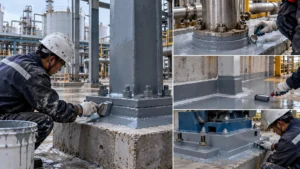
Surface preparation to Sa 2.0 or St 2 (manual cleaning is acceptable for this category). The primer is typically a two-component epoxy anti-corrosion primer applied in two coats to achieve 120 µm DFT. The topcoat is a chlorinated rubber or aliphatic acrylic polyurethane for UV stability and colour retention, applied in two coats to 80 µm DFT. Total nominal DFT: 200 µm.
This system suits warehouses, steel frames for commercial buildings, and inland bridges in dry regions such as central Saudi Arabia or highland areas of Indonesia where coastal exposure is minimal.
C4 system — heavy industrial and coastal
Surface preparation must reach Sa 2.5 (abrasive blast cleaning). The primer is a two-component epoxy zinc-rich primer with 60–70% zinc content, applied in two coats to 140 µm DFT, providing cathodic protection to the steel. The intermediate coat is an epoxy micaceous iron oxide (MIO) layer at 70 µm DFT, which dramatically extends the diffusion path for corrosive species. The topcoat is an aliphatic acrylic polyurethane at 80 µm DFT. Total nominal DFT: 290 µm.
This is the standard specification for petrochemical plant structures across the Gulf, coastal power plants in Southeast Asia, and port infrastructure throughout the region. It is also the most common system specified by major EPC contractors operating in Saudi Aramco and ADNOC supply chains.
C5-M system — marine and extreme industrial
Surface preparation to Sa 2.5 or Sa 3 where specified. The primer is an inorganic zinc silicate or high-zinc epoxy zinc-rich primer (70–80% zinc content), applied in two coats to 140 µm DFT. The intermediate coat is an epoxy MIO at 70 µm DFT. The topcoat is a long-lasting fluorocarbon or high-performance aliphatic polyurethane finish at 80 µm DFT. Total nominal DFT: 290–320 µm, with some offshore specifications requiring up to 380 µm.
This system is mandatory for offshore platforms, coastal desalination and LNG plant structures, jetties, and any steel that will be exposed to permanent salt spray. Projects in the Arabian Gulf, the Strait of Malacca, and coastal Vietnam typically require C5-M as a minimum for external structural steelwork.
| Layer | C3 system | C4 system | C5-M system |
|---|---|---|---|
| Surface prep | Sa 2.0 / St 2 | Sa 2.5 | Sa 2.5 – Sa 3 |
| Primer | Epoxy anti-corrosion primer × 2, 120 µm | Epoxy zinc-rich (60–70% Zn) × 2, 140 µm | Inorganic zinc or high-zinc epoxy (70–80% Zn) × 2, 140 µm |
| Intermediate | — | Epoxy MIO × 1, 70 µm | Epoxy MIO × 1, 70 µm |
| Topcoat | Chlorinated rubber / acrylic PU × 2, 80 µm | Aliphatic acrylic PU × 2, 80 µm | Fluorocarbon or aliphatic PU × 2, 80 µm |
| Total DFT | 200 µm | 290 µm | 290 – 320 µm |
4. Special application considerations for the Gulf and Southeast Asian climates
Standard ISO 12944 testing is conducted at European baseline conditions. Projects in the Gulf and Southeast Asia frequently encounter conditions that require additional specification attention.
High ambient temperature during application. When steel surface temperature exceeds 40°C — common on unshaded structural members in Saudi Arabia, the UAE, and the Gulf Coast of Oman — solvent-borne coatings can skin over before the lower layers have properly outgassed. This traps solvent and causes pinhole blistering. Specify coatings with an extended pot life under high-temperature conditions, or schedule application during early morning hours. Huili’s technical team provides application window guidance for specific Gulf latitude conditions as part of every project specification.
High humidity during application in Southeast Asia. Epoxy coatings applied above 85% relative humidity can suffer from amine blushing, a surface phenomenon that reduces inter-coat adhesion. This is a documented risk for steel erection in Malaysia, Indonesia, and coastal Vietnam during monsoon season. Moisture-tolerant epoxy primers and careful monitoring of dew point versus steel temperature are essential for maintaining specification compliance.
UV intensity. The Middle East and equatorial Southeast Asia both have UV index levels significantly higher than European testing baselines. Standard epoxy topcoats chalk and fade within 18–24 months under these conditions. Aliphatic polyurethane or fluorocarbon topcoats are the correct choice for external surfaces — not just aesthetically, but because chalking degrades the barrier function of the topcoat over time.
5. What to verify when sourcing a coating system from China
China is the world’s largest manufacturer of industrial protective coatings, and Chinese-manufactured systems have been specified on major EPC projects across the Gulf, Africa, and Southeast Asia for over two decades. However, quality varies significantly between manufacturers, and procurement teams unfamiliar with the market can make costly specification errors.
Here are the five checks that matter most:
1. Salt spray test certificates. A genuine C4 or C5-M system should carry third-party salt spray test data to ASTM B117 or ISO 9227. Request the actual test report, not just a product data sheet that references the standard. The test duration should be at minimum 1000 hours for C4 and 1440 hours for C5-M. Huili’s epoxy zinc-rich primer systems are independently tested by SGS to 1440 hours.
2. Zinc content verification in zinc-rich primers. The protective performance of a zinc-rich primer depends almost entirely on the metallic zinc content in the dry film. ISO 12944 defines the minimum at 80% by weight for cathodic protection primers. Ask for the product data sheet and cross-reference the zinc dust loading — this is where budget-tier manufacturers cut costs invisibly.
3. ISO 9001 manufacturing certification. A certified quality management system means batch-to-batch consistency in zinc content, viscosity, and resin ratios. Huili holds ISO 9001 certification and is a qualified supplier to SINOPEC, CNOOC, and CNNC — state-owned enterprises with some of the strictest incoming material QC in China’s industrial sector.
4. Technical support and documentation. A coating manufacturer that cannot provide a full system specification document — including surface preparation standard, DFT range per coat, recoat windows, and application method guidance — is not ready to support an international project. Expect a written coating system proposal within 24–48 hours of submitting project parameters.
5. Supply chain stability and lead time. For projects in the Gulf and Southeast Asia with fixed handover dates, coating delivery failures cause significant programme risk. Verify that the manufacturer has production capacity in excess of your order volume, maintains raw material stock, and can provide a confirmed delivery schedule. Huili’s 65,000 m² manufacturing base in Anhui Province produces over 30,000 tonnes per year, with standard export lead times of 20–30 days to Gulf and Southeast Asian ports.
6. How Huili supports Middle East and Southeast Asia project teams
Huili has supplied anti-corrosion coating systems to steel structure projects across Saudi Arabia, the UAE, Qatar, Indonesia, Malaysia, Vietnam, and the Philippines. Our project support model is designed for EPC contractors and procurement teams who need technical confidence, not just a price list.
For every project inquiry, our process is:
- Environment classification review. We review the site location, ISO 12944 category, and any client or owner-operator specification requirements (Saudi Aramco SAES, ADNOC standards, etc.).
- Written coating system proposal. A full system document including primer, intermediate, and topcoat product references, surface preparation standard, DFT per coat, recoat windows, and application guidance — delivered within 24 hours.
- Third-party test data. Relevant SGS salt spray, adhesion, and chemical resistance test certificates provided with the proposal.
- Competitive pricing with confirmed lead time. FOB or CIF pricing with a production and shipping schedule tied to your project programme.
- On-site technical support. For large projects, Huili can arrange NACE/FROSIO-aligned technical support for application quality inspection.
Selecting the right system protects both the structure and the budget
Specifying a steel structure coating system correctly for a C3, C4, or C5-M environment is not a complex process once the environment is properly classified. The technical frameworks exist — ISO 12944 provides the classification logic, and proven primer-to-topcoat systems exist for every category. What matters is applying the right system with verified materials, proper surface preparation, and correct application conditions for the Gulf or Southeast Asian climate.
If you are currently specifying or procuring a coating system for a steel structure project in the Middle East or Southeast Asia, Huili’s engineering team can provide a full system proposal within 24 hours of receiving your project parameters.
Get a free ISO 12944-compliant coating specification for your project
Tell us your corrosivity category, steel tonnage, and project location. Our engineers will return a complete system proposal — product references, DFT schedule, test data, and pricing — within 24 hours.
Request a free specification & quote →Frequently asked questions
What is the difference between C4 and C5-M in ISO 12944?
C4 covers high industrial and coastal environments with aggressive pollution but without permanent salt spray exposure. C5-M is specifically for marine environments where the steel is exposed to direct salt spray or seawater aerosol on a near-permanent basis — such as offshore platforms, jetties, and structures within the splash zone. In practice, C5-M requires a higher zinc content in the primer and a more durable topcoat chemistry such as fluorocarbon, as well as a higher total DFT.
Can I use a C5-M coating system in a C3 environment?
Technically yes, but it is unnecessary and expensive. A C5-M system applied in a C3 environment will outlast the design life of the structure without providing any practical benefit over a correctly specified C3 system. The correct approach is to match the system to the actual classification, then re-evaluate if the environment changes over the structure’s life.
How do I verify the zinc content of a zinc-rich primer from a Chinese manufacturer?
Request the product data sheet and check the zinc content in the dry film, stated as a percentage by weight. The figure should be clearly stated — if it is absent or vague, treat this as a red flag. For critical projects, specify that the coating must be accompanied by a third-party analytical test certificate confirming zinc content from a recognised laboratory such as SGS or Bureau Veritas.
Does Huili supply coating systems to Saudi Aramco-approved projects?
Huili’s coating systems are specified to meet the performance requirements of major owner-operator standards including Saudi Aramco SAES-H-002 series and ADNOC AGES specifications. We can provide relevant test data and technical documentation to support your approval submission. Contact our technical team to discuss your specific project requirements.
What is the typical lead time for a coating order from China to the Gulf or Southeast Asia?
Standard production lead time for most coating systems is 10–15 working days from order confirmation, with sea freight transit times of 18–25 days to Gulf ports (Jeddah, Dammam, Dubai, Abu Dhabi) and 12–18 days to major Southeast Asian ports (Singapore, Port Klang, Tanjung Priok, Ho Chi Minh City). Total door-to-port lead time is typically 30–40 days. Huili maintains buffer stock of high-volume product lines to support urgent requirements.