Global buyers for EPC projects in corrosive environments—from Middle East oil/gas to Southeast Asia infrastructure—need suppliers whose coatings perform without surprises. Sales presentations sound impressive, but only a site visit reveals if production matches the claims.
Use this 10-point factory audit checklist to assess infrastructure, processes, and systems firsthand. You will gain the tools to spot reliable partners capable of delivering consistent anti-corrosion coatings for your steel assets.
Why Physical Audits Trump Brochures in Coating Procurement
In anti-corrosion coatings, where a single batch failure can idle a project, PPT slides about “world-class automation” mean little without workshop proof. Traders hide behind suppliers with poor traceability, leading to mismatched viscosities or adhesion issues during application.
A boots-on-ground factory audit validates scale for your volumes, contamination controls, and QC rigor. It separates capable manufacturers from those risking your schedule and budget.
Infrastructure Essentials: Workshops and Warehousing Audit
Begin with layout and capacity: can the site handle industrial paint production without quality compromises?
- Workshops (aim for 48,000 m2+): Verify zoned areas for epoxy, polyurethane, and specialty lines. Check floor cleanliness, ventilation to prevent solvent buildup, and logical workflow from raw intake to filling.
- Warehousing (target 8,590 m2): Assess temperature/humidity controls (15–25°C, <70% RH), flammable segregation, and spill containment. Inspect FIFO labeling and inventory systems for raw resins and finished goods.
Poor infrastructure signals inability to scale or maintain stability, as seen in many failed industrial coating projects.
Production Core: Verifying Automation and Sealed Operations
Examine the lines where coatings are born: focus on controls that ensure repeatability.
| Inspection Item | Verification Steps | Pass Criteria |
|---|---|---|
| Automated dosing | Review digital scales (±0.1% accuracy) and batch input logs | PLC-controlled, no manual overrides |
| Sealed mixing | Inspect vessels for inert gas blanketing and agitator seals | No open exposure, validated cleaning records |
| Inline QC | Check viscosity/density sensors pre-filling | Alarms and auto-reject for out-of-spec |
| Line changeover | Observe or review protocols between systems/colors | Swab tests, documented rinse cycles |
These confirm batches stay uniform, vital for steel structure coating systems.
Lab and R&D: Probing Technical Capability
The lab proves performance claims—audit it thoroughly.
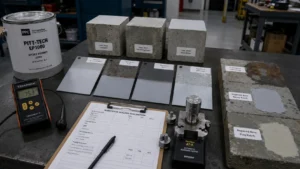
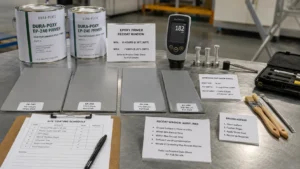
- Equipment check: Confirm salt spray/Q-FOG chambers, cross-cut testers (ISO 2409), and viscometers. Request calibration logs (monthly/quarterly).
- Expert team (30+ members): Review recent test reports for adhesion (0–1 rating), impact, and chemical resistance on production batches.
- Sample retention: Verify 2-year storage in controlled warehouse for re-testing traceability.
Without strong R&D, factory output lacks validated durability for C5 environments.
Systems and Compliance: QMS, Traceability, HSE
Documentary proof seals the audit.
- QMS/ISO 9001: Examine non-conformance trends, customer feedback loops, and internal audits. Trace a batch from raw COAs to dispatch records.
- Raw traceability: Match supplier certificates for pigments/resins to incoming inspections.
- HSE: Evaluate fire suppression, PPE enforcement, emergency drills, and hazmat storage.
These underpin reliable delivery and risk mitigation.
Passing Audit Signals a Strategic Partner
A factory that aces these 10 points has the scale, controls, and maturity for global supply. It positions you to partner confidently with a reliable coating manufacturer like Huili, whose 65,000 m2 base exemplifies audit-ready operations.
FAQ: Factory Audit Logistics
How long does a factory audit typically take?
Expect 4–8 hours on-site: 1–2 hours infrastructure/production, 1–2 hours lab/documents, 1 hour HSE/QMS review, plus closing discussion. Add prep time for records review.
Can a remote video audit replace an in-person visit?
Video works for initial screening (layout, equipment overview) but misses tactile checks like surface cleanliness, logbook details, or seal integrity. Reserve physical audits for shortlisted suppliers on volume contracts.