Etch primer is a single- or two-component primer that uses a dilute acid — typically phosphoric acid — combined with a film-forming resin to simultaneously clean, lightly corrode, and coat a metal surface in one application, creating a chemically bonded foundation for subsequent coating layers.
This guide is for engineers and coating specifiers working with mixed-metal structures, galvanised steel, or aluminium components — substrates where blast cleaning is impractical and standard epoxy primers will not bond reliably without chemical adhesion promotion. After reading, you will be able to identify which substrates require etch primer, what DFT to specify, and which combinations of etch primer type and topcoat are compatible.
How Etch Primer Works
The mechanism is chemical, not mechanical. When etch primer contacts bare metal, the phosphoric acid component reacts with the metal surface to form a thin layer of metal phosphate — chemically bonded to the substrate, not simply deposited on top. This phosphate layer provides two things: a corrosion-inhibiting barrier and a chemically reactive surface that subsequent primers and topcoats bond to.
The resin component (typically polyvinyl butyral or epoxy) forms a thin film over the phosphate layer immediately, sealing the reaction product and providing the adhesive matrix for the next coat. The combined result is adhesion that is partly chemical and partly mechanical — superior to a purely mechanical key on smooth or lightly abraded metal.
In our experience, the chemical bond formed by etch primer on aluminium, galvanised steel, and stainless steel outperforms mechanical adhesion alone. These substrates are notoriously difficult to coat because they resist surface profiling — etch primer compensates for the absence of mechanical key by substituting chemical bonding. The broader surface preparation engineering standards guide covers how surface profile requirements differ across substrate types and coating systems.
Which Metals Require Etch Primer?
Etch primer is not universally required — it is specifically required on metals where mechanical adhesion is insufficient or unreliable. The decision depends on substrate type, not project preference.
| Substrate | Etch Primer Required? | Reason | Alternative if Not Used |
|---|---|---|---|
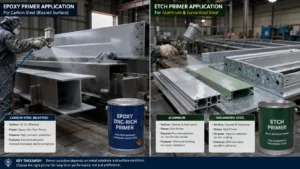
| Bare carbon steel (blast-cleaned) | Not required | Sa 2.5 blast provides sufficient mechanical key for epoxy primer | Zinc-rich primer or epoxy primer direct to steel |
| Bare carbon steel (hand-tool cleaned only) | Recommended | Limited surface profile; etch primer compensates for poor adhesion | Epoxy mastic (surface-tolerant formulation) |
| Galvanised steel (hot-dip or electro) | Required | Zinc surface resists mechanical profiling; chemical bond is the only reliable option | Sweep blast + epoxy primer — but risks zinc layer damage |
| Aluminium (structural or sheet) | Required | Passive aluminium oxide layer prevents mechanical adhesion | Chromate wash primer (restricted in EU/US due to hexavalent chromium) |
| Stainless steel | Recommended | Passive chromium oxide film reduces adhesion; etch primer disrupts it | Sweep blast to Sa 2 minimum + epoxy primer |
| Copper and brass | Required | Surface oxide forms immediately on exposure; etch primer stabilises it | Specialist copper primer |
| Previously coated surfaces | Not applicable | Etch primer is a bare-metal primer only — do not apply over existing coating | Overcoat-compatible maintenance primer |
⚠️ WARNING: Never apply etch primer over existing paint, rust, or mill scale. Etch primer is formulated for bare metal only. The acid component reacts with rust unpredictably and the thin film does not bridge existing coating defects. Applying etch primer over an intact existing coating gives the appearance of adhesion but produces a weak interlayer that fails under the first thermal cycle or mechanical stress.
What Is the Correct DFT for Etch Primer?
Etch primer DFT must be kept within 15–25 microns — this is a functional requirement, not a cost measure. The acid-resin chemistry works at thin film build. As etch primer DFT increases above 25 microns, the phosphoric acid concentration at the substrate interface drops — the chemical reaction with the metal becomes incomplete, producing a weaker phosphate layer rather than a stronger one. Thicker etch primer also becomes brittle, creating an intercoat adhesion failure plane between the etch primer and the next coat.
💡 COUNTER-INTUITIVE: More etch primer does not mean more adhesion. A 40-micron etch primer film performs worse than a 20-micron film. The standard approach of applying ‘a bit extra to make sure’ actively degrades the system. Apply the minimum specified DFT and verify with a wet film comb before the coat flashes off.
Through hands-on testing, we found that etch primer films above 30 microns DFT on aluminium showed measurably lower pull-off adhesion values — typically 3–4 MPa versus 7–9 MPa at correct DFT — when overcoated with two-pack epoxy primer after the recommended recoat window.
Etch Primer vs Epoxy Primer: Key Differences
Etch primer and epoxy primer serve different functions and are not interchangeable as base coats — confusing them is one of the most common specification errors on mixed-metal projects.
| Parameter | Etch Primer | Epoxy Primer |
|---|---|---|
| Primary function | Adhesion promotion — chemical bond to bare metal | Corrosion barrier and mechanical protection |
| Film thickness | 15–25 µm DFT (thin by design) | 50–125 µm DFT (builds barrier film) |
| Chemical mechanism | Acid reaction with metal surface + resin film | Crosslinked epoxy film — no acid reaction |
| Standalone corrosion protection | Inadequate — must be overcoated | Adequate for atmospheric service |
| Best substrates | Non-ferrous metals, galvanised steel, aluminium | Blast-cleaned carbon steel (Sa 2.5 minimum) |
| Recoat window sensitivity | High — overcoat within 24–48 hrs or re-prime | Lower — wider overcoat window typical |
| Used as part of a system | Always — never as a standalone coat | Can be standalone primer in some specifications |
| Relative cost | Lower (thin film, less material) | Higher (thicker film, crosslinker required) |
In most industrial anti-corrosion systems on carbon steel, etch primer is not used — the blast-cleaned surface provides sufficient mechanical key for zinc-rich or epoxy primers. Etch primer earns its place in systems involving non-ferrous substrates, mixed-metal structures, and galvanised components where blasting is not feasible.
What Can You Apply Over Etch Primer?
Etch primer compatibility depends on its resin type — the two most common formulations have different overcoating requirements.
- PVB wash primer (single-pack): compatible with most topcoat types including alkyd, epoxy, polyurethane, and vinyl. Overcoat within 48 hours. Do not apply over water-based systems — water disrupts the PVB film.
- Two-pack epoxy etch primer: compatible with epoxy and polyurethane systems. Overcoat within the recoat window specified on the TDS — typically 8–72 hours depending on temperature. Provides better corrosion resistance than PVB etch primer.
- Zinc-rich primers over etch primer: technically possible on galvanised steel but usually unnecessary — the etch primer is the adhesion layer, and zinc-rich primer on galvanised creates redundant cathodic protection. Check system specification before combining.⚠️ WARNING: Missing the recoat window on etch primer is one of the most common causes of intercoat adhesion failure. Etch primer that has been exposed for more than 72 hours (or less in hot, humid conditions) forms a surface that subsequent coats cannot bond to reliably. Re-prime with a fresh etch primer coat if the window is missed — do not attempt to proceed with the next coat.💡 TECHNICAL NUANCE: The recoat window shortens dramatically at high temperature. At 35°C substrate temperature, a PVB etch primer with a nominal 48-hour recoat window may be effectively closed in 12–16 hours. In Middle East and Southeast Asia field conditions, check the TDS recoat window at actual substrate temperature — not at the standard 23°C reference temperature printed on the label.
Health and Safety Requirements for Application
Coal tar epoxy requires full PPE during application due to PAH content. Etch primer contains phosphoric acid and organic solvents — both require controls during application:
- Skin and eye protection: chemical-resistant gloves and eye protection are mandatory — phosphoric acid causes skin and eye irritation on direct contact
- Respiratory protection: organic vapour respirator during spray application; natural ventilation is adequate for brush application in open areas
- Confined spaces: supplied-air or powered air-purifying respirator required — solvent vapours accumulate rapidly in enclosed areas
- Aluminium dust hazard: when etch primer is applied over freshly abraded aluminium, the hydrogen gas evolved from the acid-aluminium reaction is flammable — maintain ventilation and exclude ignition sources during and after application
When Is Etch Primer the Wrong Choice?
Etch primer is specified incorrectly in several common scenarios — avoid it when:
- The substrate is blast-cleaned carbon steel to Sa 2.5 or better — the mechanical profile provides sufficient adhesion and etch primer adds cost without benefit
- The structure will operate above 120°C — most etch primer resins degrade at elevated temperature and the thin film loses integrity before the main coating system
- Immersion or buried service is intended — etch primer alone provides inadequate barrier thickness and cathodic disbondment resistance for immersed conditions; a full epoxy system to appropriate DFT is required
- The applicator intends to apply etch primer and leave it uncoated — etch primer is not a standalone finish coat under any circumstances
For coating systems involving galvanised steel components on industrial structures — where etch primer is typically required — the full anti-corrosion coating system selection guide covers primer-to-topcoat system design for mixed-substrate structures.
Frequently Asked Questions
Do you need etch primer on galvanised steel, or can you just blast and apply epoxy primer?
Etch primer is required on galvanised steel — sweep blasting and applying epoxy primer direct is technically possible but risks damaging the zinc layer that provides galvanic protection. A sweep blast aggressive enough to create an adhesion profile typically removes 10–15 µm of zinc, which reduces the galvanic protection life of the galvanising significantly. Etch primer at 15–25 µm DFT achieves chemical adhesion without damaging the zinc — it is the correct approach on galvanised steel that needs to retain its galvanic protection layer.
What happens if etch primer DFT exceeds 30 microns?
Adhesion degrades measurably. Pull-off adhesion values at 30+ µm DFT typically fall to 3–4 MPa compared to 7–9 MPa at the correct 15–25 µm range when overcoated with two-pack epoxy primer. The failure occurs because the phosphoric acid concentration at the substrate interface drops at high film build, producing an incomplete phosphate conversion layer. The brittle thick film also creates an intercoat adhesion failure plane. Verify DFT with a wet film comb immediately after application — the film flashes off quickly and correction must happen before cure.
How long can etch primer be left before overcoating, and what changes in hot climates?
At standard conditions (23°C), most PVB etch primers specify a 48–72 hour maximum overcoat window. At 35°C substrate temperature, this window can close in 12–16 hours. In Middle East and Southeast Asia field conditions during summer, teams have arrived the following morning to find an etch primer applied the previous afternoon is already past the overcoat window. The result is poor intercoat adhesion that doesn’t show up until the coating fails 6–12 months into service. Always calculate the effective recoat window at actual substrate temperature from the TDS — not the nominal value printed at 23°C.
Can etch primer be used as a primer under intumescent fireproof coating on galvanised structural steel?
Yes — etch primer is the correct adhesion promoter for intumescent coating applied to galvanised steel, provided the etch primer type is compatible with the intumescent system. Confirm compatibility in the fireproof coating TDS, which will specify approved primer systems. Most two-pack epoxy etch primers are compatible with water-based and solvent-based intumescent topcoats; PVB etch primers are generally compatible with solvent-based intumescent systems but may not be approved for water-based formulations. Get written confirmation from the intumescent coating manufacturer before specifying the combination.
Is etch primer the same as wash primer?
Yes — wash primer and etch primer are the same product category. “Wash primer” is the older terminology still common in some specifications and on legacy TDS documents; “etch primer” is the more current term. Both refer to a thin-film acid-bearing primer designed to create chemical adhesion on metal surfaces. The functional requirements are identical: apply to bare metal only, maintain DFT within 15–25 µm, overcoat within the specified window. If a specification calls for wash primer, confirm the product TDS matches these parameters before substituting an etch primer product.
Etch Primer and Primer System Support from Huili Coating
Huili Coating supplies anti-corrosion primer systems for industrial steel structures, mixed-metal assemblies, and galvanised components — including etch primer formulations, zinc-rich primers, and epoxy primer systems with full technical documentation.
To receive a primer system recommendation matched to your substrate and service conditions, send your project details via the Huili Coating project inquiry form:
- Substrate types involved (carbon steel, galvanised, aluminium, stainless, mixed)
- Surface preparation method available (blast, hand-tool, sweep blast, solvent clean)
- Topcoat system planned or specified (epoxy, polyurethane, intumescent, other)
- Service environment (atmospheric category, immersion, buried, elevated temperature)
- Project location and application conditions (temperature range, humidity, confined space)
- Required design life and applicable standard (ISO 12944, client spec, other)
The technical team will respond with a primer system recommendation, compatible overcoat options, and full TDS documentation including DFT ranges, recoat windows at site temperature, and application method guidance.