A 2K epoxy primer is a two-component primer that uses a separate resin (Part A) and hardener (Part B) to form a chemically cured, highly durable primer layer that outperforms many single-component primers in adhesion, corrosion resistance, and chemical resistance.
Buyers usually search for 2k epoxy primer when they are trying to decide whether a two-pack system is really necessary for their metal, steel structure, machinery, floor, or special substrate project, and what type they should choose. This guide explains what a 2K epoxy primer is, how it differs from 1K primer, the main types and uses, and how to select the right system and ask the right questions before buying.
What Is a 2K Epoxy Primer?
A 2k epoxy primer is a two-component (2K = “two-pack”, “2 part”, or 2 component epoxy primer) primer where the base component (epoxy resin) and the curing agent (hardener) are supplied separately and must be mixed together in a defined ratio before application.
Once mixed, a 2 part epoxy primer starts a chemical reaction between the resin and hardener that builds a crosslinked network — the primer cures chemically, rather than simply drying by solvent evaporation like many single-pack primers. This chemically cured network is what gives a 2k primer epoxy its high adhesion, chemical resistance, and durability compared with air-dry systems.
Because the reaction starts as soon as the two components are mixed, a 2k epoxy primer has a limited pot life — a finite working time after mixing before the material becomes too thick to apply or gels in the pot. This is one of the key practical differences buyers must understand compared with single-pack products.
How Is 2K Epoxy Primer Different from 1K Primer?
The core difference between 1K and 2K primers is how they form a solid film and the performance that film can deliver.
Single-pack (1K) primers:
- Usually air-dry by solvent evaporation or simple oxidation.
- Are easy to use — open the can and apply, no mixing ratio to control.
- Provide basic adhesion and limited corrosion protection for less demanding conditions.
- Are more forgiving in small DIY or light-duty applications but reach a performance ceiling quickly.
2k epoxy primer systems:
- Cure by chemical reaction between epoxy resin and hardener.
- Require accurate mixing by volume or weight and have a defined pot life.
- Develop much higher adhesion to properly prepared metal, better corrosion resistance, and superior resistance to moisture, chemicals, and mechanical stress.
- Are the standard choice for demanding industrial, marine, and infrastructure projects where long service life is required.
In practical terms, buyers should move from a simple single-pack primer to a 2k epoxy primer when:
- The structure is expected to see outdoor exposure, industrial atmospheres, or marine environments.
- There is a requirement for a multi-coat system with polyurethane, polysiloxane, or other high-performance topcoats.
- The project needs 5–15+ years of service life rather than short-term cosmetic protection.
- The cost of failure (corrosion, coating breakdown, downtime) is significantly higher than the cost of using a 2K system.
Why 2K Epoxy Primer Is Used in Industrial Coating Systems
In industrial coating systems, a 2k epoxy primer has three main roles:
- Adhesion promotion
It creates a strong bond between the prepared substrate and the rest of the coating system, especially on carbon steel and many non-ferrous metals when the correct surface preparation is used. - Corrosion barrier
The crosslinked epoxy film provides low water vapour permeability and good resistance to many salts and chemicals, forming the primary barrier against corrosion in many epoxy coating for steel systems. - System compatibility
A well-formulated primer epoxy is designed to be compatible with epoxy intermediates and polyurethane or polysiloxane topcoats, allowing the system to meet ISO 12944 or project-specific durability requirements.
For this reason, 2k epoxy primer is common in:
- Structural steel for industrial plants, warehouses, and infrastructure.
- Process equipment, machinery, and support steel.
- Tanks, pipelines, and pipe racks (as the first coat in a multi-layer system).
- Maintenance painting where old systems are repaired and upgraded.
Buyers who choose 2k epoxy primer are not only “preparing the surface” — they are building the foundation of the whole protection system.
Common Types of 2K Epoxy Primer
Not all 2k epoxy primers are the same. Within the broad category of 2 component epoxy primer, several specialised types exist, each tuned for different conditions.
Standard anti-corrosion 2K epoxy primer
This is the “workhorse” 2k epoxy primer used on blast-cleaned steel and many industrial steel structures. Typical features:
- DFT range around 50–100 µm per coat.
- Requires Sa 2.5 or similar abrasive blast profile for full performance.
- Provides a balance between adhesion, barrier protection, and overcoat flexibility.
It is often the first layer in standard C3–C4 (medium to high) atmospheric environments when combined with epoxy intermediate and polyurethane topcoat systems.
High-build 2K epoxy primer
High-build 2k epoxy primer is formulated to achieve higher DFT — often 120–200 µm in a single coat — to reduce the number of coats needed and improve barrier performance.
- Used where fast build-up of protective thickness is important.
- Useful in maintenance and new-build projects with tight schedules.
- Requires careful control of film thickness to avoid runs, sags, or solvent entrapment.
High-build primers are often used as both primer and intermediate coat in heavy-duty coating systems.
Zinc-rich epoxy primer (2K zinc epoxy)
Zinc-rich epoxy primers are still chemically cured two-pack systems, but they contain a very high loading of zinc metal dust to provide cathodic protection to the steel.
- Typical zinc content above 80% by weight in the dry film.
- Provides sacrificial protection in addition to barrier properties.
- Used as the first coat in very high durability (C5/CX) systems and for critical infrastructure.
Zinc-rich 2k epoxy primer often requires an additional 2k epoxy primer or intermediate coat on top before the final topcoat is applied.
Surface-tolerant / maintenance 2K epoxy primer
Surface-tolerant 2k epoxy primer is designed to adhere to less-than-ideal surfaces — such as power tool cleaned steel (St 2/St 3) and tight, sound existing coatings.
- Used extensively in maintenance and repair projects where full blasting is not possible.
- Has modified resin and solvent systems to wet and bond to marginal surfaces.
- Often specified with lower surface prep grades but clear limits written into the TDS.
These formulations are attractive for plant shutdowns and offshore maintenance where access and blasting options are limited.
Aerosol options such as 2k epoxy primer spraymax
There are also aerosol-packaged 2k epoxy primer products, such as 2k epoxy primer spraymax, where the hardener is released into the can before use.
- Convenient for small repairs, automotive bodywork, and spot priming.
- Limited pot life once activated, just like other 2K products.
- Typically not designed as the primary primer for large industrial structures, but can be useful for small-scale repair work and edges.
Typical Uses of 2K Epoxy Primer
Because of its versatile performance, epoxy primer for metal is used in a wide range of applications.
Primer for steel and industrial metal
On carbon steel and low alloy steel, 2k epoxy primer is the default choice when a project needs serious corrosion protection:
- New fabrication for industrial buildings, process plants, tank farms, and pipe racks.
- Structural steel in C3–C5 environments when used as part of a full system.
- Machinery and equipment where mechanical damage and chemical exposure are expected.
Primer for epoxy and floor systems
2k epoxy primer is often used as a primer for epoxy floor coatings and other epoxy systems:
- It binds dust and provides adhesion to concrete or metal substrates.
- It reduces pinholes and outgassing in epoxy floor topcoats.
- It improves the long-term bond between the substrate and high-build epoxy floor layers.
However, not all industrial 2k epoxy primers are designed for floors; floor-specific primers have different rheology and penetration properties.
Maintenance and industrial steel protection
In maintenance painting, 2k epoxy primer — especially surface-tolerant types — is used to:
- Tie in spot-blasted areas to surrounding sound coatings.
- Build a sound, chemically resistant base layer before polyurethane or polysiloxane topcoat.
- Extend service life of existing assets without full strip-and-recoat.
Limited use on wood and special substrates
In some systems, a specialised epoxy resin primer for wood or multi-purpose 2k epoxy primer can be used on wood or composite surfaces, but only when specifically allowed by the TDS. For these substrates, flexibility, movement, and moisture vapour transmission must be considered — generic metal primers are not always suitable.
The key is to check that the chosen 2k epoxy primer is approved for the exact substrate and end-use, rather than assuming one product covers steel, concrete, wood, and plastics equally well.
What Surfaces Can 2K Epoxy Primer Be Used On?
The suitability of a 2k epoxy primer depends heavily on both the substrate and the surface preparation quality.
Steel and carbon steel
- Ideal match for blast-cleaned steel (Sa 2.5 or equivalent) in industrial environments.
- Can also be used on power tool cleaned steel in maintenance-grade formulations.
- Often paired with zinc-rich primers in multi-coat systems.
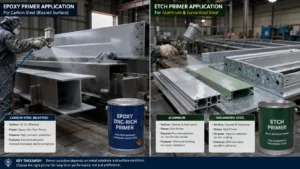
Galvanised or smooth surfaces
On galvanised steel and other smooth zinc-coated surfaces, a 2k epoxy primer can be used only if surface preparation is done correctly:
- Sweep blasting or appropriate chemical pretreatment is usually required.
- Some special adhesion-promoting primers may be specified before the epoxy primer.
Aluminium, chrome, and other special substrates
For aluminium and epoxy primer for chrome or other hard, smooth metals:
- Adhesion is more challenging and may require special pretreatment, etch primers, or wash primers.
- Only certain 2k epoxy primer products are formulated and tested for these substrates.
- Always confirm substrate compatibility on the TDS or with the manufacturer’s technical service before specification.
Wood and porous substrates
Some multi-purpose systems use an epoxy resin primer for wood, which is still a 2K epoxy but designed for porous substrates and dimensional movement:
- Standard industrial 2k epoxy primer for metal is not automatically suitable for wood.
- Timber, plywood, and engineered wood products often require primers designed to handle moisture movement and swelling/shrinkage.
In all cases, the label “2k epoxy primer” is not enough — substrate compatibility must be checked specifically.
Key Advantages of 2K Epoxy Primer
From a buyer’s perspective, a 2k epoxy primer offers several clear advantages:
- Strong adhesion: Chemical cure and epoxy chemistry deliver excellent adhesion to properly prepared metal.
- Good corrosion resistance: Provides a dense barrier against water and many corrosive agents; often the main protective layer in the system.
- Chemical and moisture resistance: More resistant to many oils, fuels, and chemicals than typical single-pack primers.
- System versatility: Compatible with a wide range of intermediate and topcoat systems, including polyurethane and polysiloxane.
- Suitability for demanding conditions: Appropriate for industrial, marine, and infrastructure projects where long design life is required.
This combination makes 2k epoxy primer a default ‘serious’ primer choice in many industrial specifications.
Limitations and Common Mistakes
Despite its advantages, 2k epoxy primer is not a universal solution and is easy to misuse if its limitations are ignored.
Limited pot life after mixing
Once resin and hardener are mixed, the pot life is often in the range of 30–90 minutes depending on temperature. Attempting to extend pot life by adding solvent or using material after it has thickened will lead to poor film formation and reduced performance.
More demanding mixing and application control
Mix ratio errors (for example 3:1 when the product requires 4:1), poor mixing, or failing to allow an induction time when required all reduce the degree of cure. This can cause soft films, poor adhesion, or intercoat delamination.
Surface preparation still matters
Even the best 2K epoxy primer cannot compensate for poor surface prep. Applying over rust, mill scale, oil, or old, poorly adhering coatings will lead to early failure. The surface preparation requirements in the TDS must be treated as mandatory, not optional.
Not every 2K epoxy primer suits every substrate
A product optimised as an epoxy primer for metal might not be the right choice for wood, chrome, or galvanised steel without the right pretreatment. Assuming that “2K epoxy” automatically bonds to everything is a specification error.
Incorrect thinner or overcoating practice
Using the wrong thinner, exceeding the maximum overcoat interval, or applying heavy coats in one pass can all produce defects like solvent entrapment, wrinkling, and intercoat adhesion failure.
How to Choose the Right 2K Epoxy Primer
Choosing the right 2k epoxy primer is a specification decision, not just a catalogue pick. Work through the following questions:
- What substrate are you coating?
- Carbon steel, galvanised steel, aluminium, chrome, wood, concrete, or a mix?
- Do you need a specific adhesion-promoting primer for any of these?
- Is it new fabrication or maintenance?
- New steel can usually be blast-cleaned and coated with a standard or high-build 2k epoxy primer.
- Maintenance work may need a surface-tolerant 2K primer to adhere to power tool cleaned steel and existing coatings.
- What environment will it face?
- Indoor, outdoor, marine, chemical, high-humidity, or high-temperature service?
- The more severe the environment, the more important the correct 2K primer and full system selection become.
- What topcoat or full system will go over the primer?
- Is the system epoxy–epoxy–polyurethane, or something else?
- Check that the 2k epoxy primer is part of a tested system with the intended topcoat, using resources like your supplier’s anti-corrosion primer range.
- How will it be applied?
- Spray (airless or conventional), brush, roller, or aerosol?
- Some 2k epoxy primers are optimised for spray, while smaller repair jobs may benefit from products similar in use to a 2k epoxy primer spraymax, but sized and designed for industrial work rather than DIY only.
- Do you need faster drying, higher build, or better surface tolerance?
- Fast-drying formulations help in tight schedules and multi-coat systems.
- High-build versions reduce the number of coats.
- Surface-tolerant versions are vital for repairs where you cannot blast.
If you answer these questions clearly before talking to a supplier, you will get a much more precise recommendation.
Questions to Ask Before Buying
When you speak with a supplier or manufacturer, use this checklist to clarify whether a particular 2k epoxy primer is suitable for your project:
- What is the recommended substrate and surface preparation level?
(Sa 2.5 blast, St 3 power tool, specific treatments for galvanised or aluminium, etc.) - What is the mix ratio and pot life at my expected application temperature?
(Ask for pot life at both 23°C and your actual site temperature.) - What is the recommended DFT per coat and total system DFT?
(And how many coats are typically needed to reach it?) - Which topcoats are compatible?
(Epoxy, polyurethane, polysiloxane, intumescent — and whether any intermediate coat is required.) - Is it suitable for industrial steel, maintenance work, or special substrates like chrome or wood?
(Ask whether the product is approved as an epoxy primer for chrome or primer epoxy for specific non-metal surfaces.) - What technical documents are available?
(Technical Data Sheet (TDS), Safety Data Sheet (SDS), and an application guide showing surface preparation, mixing, and overcoating windows.)
A professional supplier should be able to answer these clearly and provide documentation, not only marketing claims.
2K Epoxy Primer FAQ
What does 2K epoxy primer mean?
“2K” means “two-component” or “two-pack” — a 2k epoxy primer is supplied as two parts (resin and hardener) that must be mixed in a specified ratio before application. Once mixed, the material cures by chemical reaction, forming a crosslinked film that is stronger and more chemically resistant than most single-component primers.
Is 2K epoxy primer better than 1K primer?
For demanding industrial and outdoor uses, yes. A properly applied 2k epoxy primer delivers higher adhesion to prepared metal, better corrosion resistance, and stronger resistance to moisture and many chemicals compared with typical 1K air-dry primers. However, it requires better surface preparation, accurate mixing, and control of pot life, so it is more complex to use than a simple 1K primer.
Can 2K epoxy primer be used on metal?
Yes — epoxy primer for metal is one of the main uses of 2K epoxy systems. On blast-cleaned steel, it is often the standard primer in industrial coating systems. On galvanised, aluminium, or chrome, only certain 2k epoxy primer products are suitable and surface preparation requirements are stricter; always check the TDS for substrate-specific instructions.
Can 2K epoxy primer be used on wood or chrome?
Some specialised 2k epoxy primer products can be used as epoxy resin primer for wood or epoxy primer for chrome, but only when the product is formulated and tested for those substrates. Wood moves and absorbs moisture differently from steel, and chrome is very smooth and difficult to bond to. Never assume a general-purpose metal primer is suitable for wood or chrome — only use it when the TDS explicitly lists these substrates and describes the preparation required.
How long does 2K epoxy primer last after mixing?
The pot life of a 2k epoxy primer is typically between 30 and 90 minutes at 23°C, depending on the formulation. Pot life shortens significantly at higher temperatures; at 30–35°C, it may be reduced to 15–30 minutes. After pot life is exceeded the material should be discarded — continuing to use thickening or gelling material leads to poor film formation and weak performance.
Is aerosol 2K epoxy primer suitable for industrial use?
Aerosol-type 2K primers (such as small-can “2k epoxy primer spraymax” style products) are convenient for small repairs, automotive bodywork, and touch-up. For large industrial projects and structural steel, they are usually not practical due to limited volume, less control over film thickness, and higher per-area cost. Industrial work typically uses standard multi-litre 2k epoxy primer kits applied by spray, brush, or roller as part of a tested coating system.
2K Epoxy Primer Support from Huili Coating
Huili Coating supplies 2k epoxy primer systems for structural steel, machinery, and industrial equipment, including standard anti-corrosion primers, high-build variants, and surface-tolerant maintenance formulations as part of complete epoxy and polyurethane coating systems.
To receive a 2k epoxy primer recommendation and technical data package tailored to your project, send your details via the Huili Coating project inquiry form:
- Substrate types (carbon steel, galvanised, aluminium, chrome, wood, mixed)
- Surface preparation method available (blast, power tool, hand tool, existing coating condition)
- Environment (indoor, outdoor, marine, chemical, high-humidity, or high-temperature service)
- Planned topcoat system (epoxy, polyurethane, polysiloxane, floor system, etc.)
- Application method (spray, brush, roller, or aerosol-style repair)
- Target design life and any applicable standards (ISO 12944, client specifications)
Our technical team will respond with a suitable 2k epoxy primer system, recommended DFT ranges, compatible topcoats, and TDS/SDS documentation to support your specification and procurement process.