Choosing the wrong industrial coating supplier can cost far more than the difference in unit price. A supplier that cannot provide consistent batch quality, adequate technical documentation, or responsive engineering support creates hidden costs: rework, project delays, specification non-conformances, and in the worst cases, coating failure in service.
For procurement managers and project engineers sourcing industrial coatings — particularly for export projects in the Middle East, Southeast Asia, or Europe — supplier evaluation needs to go well beyond price and lead time. This checklist covers the eight dimensions that distinguish a reliable, professional industrial coating manufacturer from a low-cost, high-risk alternative.
1. Manufacturing Capability and Quality System
The foundation of supplier reliability is a documented, auditable quality management system at the manufacturing facility.
- ISO 9001 certification: the international standard for quality management systems. Certification by an accredited third-party body such as Bureau Veritas, SGS, or TÜV confirms that the manufacturer has documented processes for batch control, incoming raw material inspection, in-process quality checks, and finished product release testing. Request the current certificate and verify it is in scope for coating manufacturing.
- In-house testing laboratory: a credible manufacturer conducts batch-level QC testing before product release — viscosity, density, non-volatile content (NVC), and colour. Request sample QC test records (Certificate of Analysis / COA) from recent production batches.
- Manufacturing scale and capacity: confirm production capacity is adequate for your project volume and timeline. For large projects, ask for the manufacturer’s current order book status to assess lead time risk.
- Raw material sourcing: high-performance coatings depend on consistent raw material quality. Ask whether the manufacturer uses consistent raw material suppliers and whether they conduct incoming material testing.💡 Huili Coating operates a 65,000 m² manufacturing facility with in-house QC laboratory, ISO 9001 certified quality system, and full batch-level COA documentation for all products. See our manufacturing capability overview.
2. Product Range and Technical Depth
A single-product supplier is a procurement risk — project specifications change, and you need a supplier who can adapt. Evaluate the breadth and depth of the product range:
- Anti-corrosion systems: zinc-rich primers, epoxy intermediates, polyurethane topcoats — covering ISO 12944 categories C3 through CX. For full system coverage, see anti-corrosion coating systems for steel.
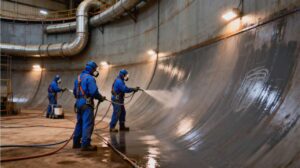
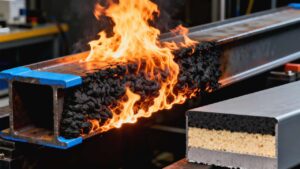
- Specialised systems: intumescent fireproof coatings (UL 1709 / BS 476), high temperature coatings (200°C–650°C), tank lining systems (epoxy, glass flake, novolac), marine and offshore coatings.
- System compatibility: primer, intermediate, and topcoat supplied by the same manufacturer ensures compatibility and maintains certified system performance. A supplier who manufactures only primers or only topcoats requires you to manage inter-supplier compatibility.
3. Technical Documentation Package
Professional suppliers publish complete, accurate technical documentation as standard. For export projects, documentation in English is non-negotiable. Request and review:
A supplier who cannot provide all five documents — or who provides incomplete, generic, or poorly translated versions — is not ready for professional project supply. The quality of documentation reflects the quality of the product.
4. Independent Performance Test Data
Manufacturer-stated performance claims are marketing. Independent third-party test data is evidence. For industrial coating procurement, always request:
- ISO 9227 salt spray test: 3,000 hours minimum for C5 systems; 4,200 hours for CX systems. Check pass criteria: no blistering, scribe creep within the specification limit, adhesion retention at or above 3 MPa.
- ISO 4624 pull-off adhesion: minimum 5 MPa for epoxy primers on blast-cleaned steel. Confirm testing was conducted on the actual substrate — carbon steel, not aluminium or concrete test panels.
- Cathodic disbondment (ISO 15711): required for seawater immersion and buried pipeline applications. Confirms resistance to undercutting from cathodic protection current.
- Fire test certificates (UL 1709 / BS 476): for intumescent coatings, these must be from an accredited fire testing laboratory. Check that the tested system matches the proposed specification — same primer, same intumescent, same topcoat, same DFT range.
- ASTM C581 immersion test: for tank lining and chemical service products — 30-day immersion at service conditions. Confirm the test fluid matches your stored medium.💡 Huili Coating provides third-party test reports from accredited laboratories for all major product lines. Test data packages are available on request alongside the product TDS.
5. Export Experience and Compliance Capability
For international procurement, a supplier’s export track record and compliance capability matter as much as their product quality. Verify:
- Export documentation: Bill of Lading, Packing List, Certificate of Origin, Commercial Invoice — confirm the supplier has experience with export documentation requirements for your destination market.
- Customs and trade compliance: confirm HS codes are correctly classified for your product category. Mis-classification causes delays and potential duty issues.
- Dangerous goods compliance: solvent-borne coatings are classified as dangerous goods under IMDG and IATA. Confirm the supplier can ship DG-compliant and provide the required DG declaration.
- Destination market regulatory compliance: EU (REACH, VOC directives), UAE (GSO standards), Singapore (NEA chemical regulations), Australia (AICIS). A professional supplier has worked with these requirements before.
For a detailed guide to sourcing industrial coatings from China for international projects, see the industrial coating China sourcing guide.
6. Technical Support and Application Engineering
The supplier relationship does not end at shipment. For industrial coating projects, ongoing technical support is essential. Evaluate:
- Pre-project system selection support: does the supplier’s technical team review your service conditions and propose a validated system — or just send a product list?
- Project-specific application procedures: will they produce a written application procedure document tailored to your project’s surface preparation standard, application method, inspection requirements, and environmental conditions?
- Troubleshooting response: if a coating defect is identified during application or in early service, can the technical team respond within 24–48 hours with a written root cause analysis and remediation procedure?
- English-language capability: for international projects, technical communication in clear, professional English is essential — not just for documentation, but for real-time troubleshooting.
7. Factory Audit and On-Site Assessment
For high-value or long-term supply relationships, a factory audit provides direct evidence of manufacturing capability that no document can replicate. Key audit checklist items:
- Quality management system documentation — review ISO 9001 records, non-conformance reports, and corrective action logs.
- Production batch records — trace a recent batch from raw material intake through production, QC testing, and product release.
- In-house laboratory — verify calibration records for test equipment including viscometers, density cups, NVC ovens, and adhesion testers.
- Raw material warehouse — check storage conditions, labelling, and FIFO inventory management.
- Finished goods warehouse — check storage conditions, product segregation, and batch traceability.
- Packaging line — verify correct labelling, DG classification marking, and batch number traceability.
For buyers who cannot conduct in-person audits, a 10-point remote audit framework is available for coating supplier QMS and ISO 9001 verification.
8. Commercial Terms and Supply Reliability
Technical capability means nothing if the commercial relationship does not work for your project. Confirm:
- MOQ (minimum order quantity): confirm MOQ per product per colour aligns with your project volume. Some manufacturers have high MOQs that are impractical for smaller projects or trial orders.
- Lead time: standard production lead time from order confirmation to ex-works. For project supply, confirm the lead time is locked at order placement.
- Shelf life and storage: standard shelf life is 12 months from date of manufacture for most epoxy and PU systems. Confirm storage conditions — temperature range and away from direct sunlight — to avoid on-site product degradation.
- Payment terms: standard for export supply is 30% deposit and 70% against copy of Bill of Lading, or Letter of Credit for large orders. Confirm the supplier can work with your preferred payment structure.
- After-sales: what happens if a quality issue is identified after receipt? Confirm the supplier’s claims process and whether they carry product liability insurance for export markets.
Frequently Asked Questions
How do I verify an ISO 9001 certificate is genuine?
All legitimate ISO 9001 certificates issued by accredited certification bodies are traceable in a public registry. For certificates issued by Bureau Veritas, SGS, TÜV, DNV, or Lloyd’s Register, you can verify the certificate number and expiry date on the certification body’s website. If the supplier provides a certificate from an unknown body, verify the certification body’s accreditation status with the International Accreditation Forum member list. Unaccredited “ISO 9001” certificates are not equivalent and should not be accepted as evidence of quality management system compliance.
Is a Chinese coating manufacturer able to meet European or Middle East project standards?
Yes — provided the manufacturer has invested in product development and testing to the relevant standards. ISO 12944, NORSOK M-501, and UL 1709 are product performance standards, not country-of-origin standards. A Chinese manufacturer whose products have been independently tested and certified to these standards is, by definition, compliant — regardless of where they are manufactured. The key is verifying the test data, not the country of origin. For projects requiring specific approvals such as ADNOC, Saudi Aramco, or Shell, confirm the specific approved products list requirements with the operator before supplier selection.
What is the difference between a product approval and a system approval?
A product approval certifies that a specific coating product meets a defined performance standard, such as ISO 9227 salt spray or UL 1709 fire rating. A system approval certifies that a complete coating system — primer plus intermediate plus topcoat, applied at defined DFT on a defined substrate — meets the standard. For most industrial project specifications, a system approval is required, not just individual product approvals. Always confirm that the test certificate covers the complete system in the configuration you intend to use — not just one component of it.
Evaluate Huili Coating for Your Next Project
Huili Coating is an ISO 9001 certified industrial coating manufacturer supplying anti-corrosion, fireproof, high temperature, and tank lining systems to projects across Europe, the Middle East, and Southeast Asia.
- Complete technical documentation package provided as standard: TDS, SDS, COA, chemical resistance guide, and third-party test reports.
- In-house QC laboratory with batch-level testing and COA for every shipment.
- Export experience across 30+ countries — full DG documentation and customs compliance capability.
- English-language technical team for system selection, application procedures, and troubleshooting support.
Request our supplier qualification package — including ISO 9001 certificate, product test reports, and sample COA — via the supplier inquiry page.