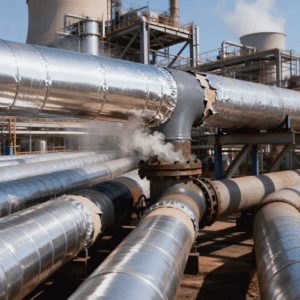
Not all coatings can take the heat. Standard epoxy and polyurethane systems begin to soften, discolour, and degrade at temperatures above 120°C — yet many industrial assets operate far beyond that. Boilers, exhaust systems, furnace shells, heat exchangers, and process pipework routinely reach 300°C to 650°C in continuous service.
Specifying a standard industrial coating in high-temperature service is one of the most common — and costly — mistakes in plant maintenance. The coating blisters, chalks, and debonds, leaving the substrate unprotected within months.
This guide breaks down the main types of high temperature coating, the correct system for each temperature band, applicable standards, and what to check when qualifying a supplier.
What Makes a Coating ‘High Temperature’?
A high temperature (HT) coating is a protective system engineered to maintain adhesion, cohesion, and corrosion protection at elevated service temperatures — conditions that would cause conventional coatings to fail.
The key performance parameters that define a true HT coating are:
- Thermal stability: the resin binder does not soften, decompose, or lose cross-link density at rated temperature
- Oxidation resistance: the film resists oxidative degradation from prolonged heat exposure
- Thermal cycling resistance: the coating survives repeated heat-up and cool-down cycles without cracking or delamination
- Adhesion retention: bond strength to the substrate remains adequate at operating temperature
Standard epoxy systems begin to degrade above 120°C. Standard polyurethane above 80°C. Only specialised silicone, modified silicone, and inorganic binder systems retain performance at the temperatures common in industrial plant.
High Temperature Coating Types by Temperature Band
The correct coating system is determined first by the maximum continuous service temperature, then by the environment (atmospheric, immersion, chemical exposure) and the substrate. The following bands align with how the industry segments these products.
Band 1 — Up to 200°C: Modified Epoxy and Epoxy-Silicone
At the lower end of the high-temperature spectrum, modified epoxy systems (sometimes called heat-resistant epoxy) and epoxy-silicone hybrids provide corrosion protection up to 200°C in continuous dry-heat service.
- Typical applications: heat exchangers, warm pipework, process vessels, steam lines (exterior)
- Finish: available in a range of colours; generally suitable for brush, roller, or spray
- Limitation: not suitable for open-flame exposure or direct radiant heat; continuous temperature must not exceed rated limit
Band 2 — 200°C to 400°C: Silicone-Based Coatings
Pure silicone resin systems are the workhorse of the 200–400°C range. The silicone binder is inherently stable at these temperatures, forming a tightly cross-linked inorganic-organic network on curing. They are typically pigmented with metallic aluminium or micaceous iron oxide (MIO) for corrosion protection.
- Typical applications: boiler casings, furnace exteriors, exhaust manifolds, process pipework, stack liners
- Colour options: silver (aluminium pigment) is standard; heat-stable colours (black, grey, red) available at additional cost
- Curing: most silicone systems cure on first heat-up (thermal cure at 200°C+); some offer air-dry versions for ambient application
- DFT: typically 25–50 µm per coat, 50–75 µm total — thinner than standard systems
�� Silicone coatings cure by driving off solvent and then cross-linking at temperature. Do not test for curing with MEK rub immediately after application — the system is not fully cross-linked until first heat-up.
Band 3 — 400°C to 600°C: High-Build Silicone and Aluminium-Silicone
Above 400°C, standard silicone systems lose pigment binder integrity. High-ratio aluminium-silicone systems — with a higher proportion of metallic aluminium pigment and a heat-stable silicone resin — maintain protection up to 600°C. These coatings function partly as a sacrificial aluminium barrier: the aluminium oxidises and forms a hard, adherent aluminium oxide layer that protects the underlying steel.
- Typical applications: furnace shells, kiln exteriors, incinerators, flare stacks, high-temperature process equipment
- Colour: silver only (aluminium pigment dictates appearance)
- DFT: 25–40 µm per coat; over-application leads to mud-cracking on thermal cycling
- Critical note: apply at minimum DFT — HT silicone systems crack if applied too thick
Band 4 — Above 600°C: Inorganic Zinc Silicate and Ceramic Coatings
Above 600°C, organic binders — including silicone — cannot survive. Protection in this range requires inorganic binder systems: typically ethyl or potassium silicate-based coatings carrying metallic or ceramic pigments.
- Inorganic zinc silicate: provides galvanic (sacrificial) protection to steel up to 400°C; above this, used as a heat-stable primer under aluminised topcoats
- Ceramic coatings: specialist systems using inorganic ceramic pigments in a silicate binder — suitable to 650°C+ in atmospheric service
- Typical applications: exhaust stacks, petrochemical fired heaters, incinerator interiors, kiln shells
�� True 650°C+ service requires specialist engineering assessment. Standard surface preparation, application methods, and inspection criteria do not apply — work with the coating manufacturer’s technical team from specification stage.
High Temperature Coating Systems: At-a-Glance Comparison
| System Type | Temp. Range | Typical Use | DFT Range | Key Advantage |
| Modified epoxy / epoxy-silicone | Up to 200°C | Heat exchangers, warm vessels | 75–150 µm | Good corrosion resistance + colour retention |
| Silicone (standard) | 200–400°C | Boilers, exhaust, stacks | 50–75 µm | Proven thermal stability; wide availability |
| Aluminium-silicone (high-ratio) | 400–600°C | Furnace shells, incinerators | 25–50 µm | Sacrificial Al barrier; stable to 600°C |
| Inorganic zinc silicate | To 400°C (as primer) | Primer under HT topcoats | 50–75 µm | Galvanic protection; fire-stable |
| Ceramic / inorganic silicate | 600–650°C+ | Fired heaters, kiln shells | 25–75 µm | Only viable option above 600°C |
Critical Selection Factors
Temperature rating alone is not sufficient for specification. Four additional factors determine whether a high temperature coating will perform in service.
1. Continuous vs. Intermittent Temperature
Most manufacturer temperature ratings are given for continuous service. Intermittent exposure (equipment that cycles between ambient and peak temperature) is typically more damaging than continuous high-temperature exposure, because thermal cycling causes repeated expansion and contraction stress.
Always specify both the continuous operating temperature and the maximum excursion temperature (peak) when requesting a recommendation. A system rated to 400°C continuous may handle 450°C intermittent — or may not.
2. Heat-Up Rate
Rapid heat-up can cause steam entrapment in the coating film, leading to blistering. Many HT systems require a controlled first heat-up procedure — typically ramping at 25–50°C per hour to the operating temperature. This is especially critical for silicone systems that rely on thermal curing.
3. Environmental Exposure
High temperature does not eliminate the need for corrosion protection — it often intensifies it. Equipment operating outdoors or in coastal/industrial atmospheres faces combined thermal and corrosive attack. For these applications, select systems with both high-temperature rating and demonstrated atmospheric corrosion resistance referencing ISO 12944 corrosion categories.
- Inland industrial (C3–C4): standard silicone aluminium systems are generally adequate
- Marine/coastal (C5-M): select systems with specific marine atmospheric test data; consider aluminium-silicone over inorganic zinc primer
- Offshore/CX: engineering specification required; coordinate with coating engineer
4. Surface to Be Coated
High temperature coatings are formulated primarily for carbon steel. Different substrates — stainless steel, cast iron, refractory concrete — require specific adhesion primers or surface treatments. Always confirm substrate suitability with the manufacturer before specifying.
Surface Preparation for High Temperature Coatings
The surface preparation requirements for HT coatings are, if anything, more stringent than for standard systems. Contamination, mill scale, and poor anchor profile cause premature adhesion failure that accelerates exponentially at temperature.
Standard requirements for carbon steel:
- Cleanliness: abrasive blast to ISO 8501-1 Sa 2½ (SSPC-SP 10) as a minimum
- Surface profile: 40–70 µm Rz — coarser profiles suitable for silicone systems than for standard industrial coatings
- Chloride: ≤ 20 mg/m² (Bresle patch method, ISO 8502-9)
- Oil/grease: solvent clean to SSPC-SP 1 before blasting if contamination present
- Application window: apply within 4 hours of blasting; at 3°C above dew point minimum
For equipment that has been in service (maintenance recoating), complete removal of all degraded or blistered existing coating is mandatory before reapplication. Spot repairs over failed coatings in high-temperature service are ineffective — the failure mechanism (typically thermal degradation of adhesion) continues beneath the repair.
�� Huili Coating recommends SSPC-SP 10 as the standard for all HT coating projects. For applications above 400°C, our technical team specifies a specific blast profile and contamination level requirement in the project application procedure document.
Application Guidelines
High temperature coatings differ from standard industrial coatings in several important application aspects:
Film Build Control
HT silicone systems are among the few coating types where over-application is as damaging as under-application. Applying silicone systems thicker than the specified DFT range leads to mud-cracking on the first thermal cycle — the outer surface cures and contracts faster than the inner film, creating a pattern of cracks that compromises the coating barrier.
Always apply HT coatings to the lower end of the specified DFT range. If additional protection is needed, apply a second coat within the inter-coat interval window after the first coat has tacked off.
Thinning
Many HT silicone systems require thinning for spray application, using a specified solvent (typically xylene or a manufacturer-supplied thinner). Over-thinning reduces film build and pigment concentration, compromising both performance and colour stability. Never thin beyond the manufacturer’s stated maximum — typically 10–15% by volume.
First Heat-Up Procedure
For silicone systems, the first heat-up is part of the curing process and must be controlled:
- Allow 24 hours minimum ambient dry time after application before heat-up
- Ramp temperature slowly: 25–50°C per hour recommended
- Hold at 200°C for 30–60 minutes to drive off residual solvent and begin cross-linking
- Continue ramp to operating temperature
- Do not subject coating to water or moisture during the heat-up process
Failure to follow the first heat-up procedure is a leading cause of premature HT coating failure — particularly blistering in the first weeks of service.
Common Failure Modes in High Temperature Coating
| Failure Mode | Root Cause | How to Prevent |
| Blistering on heat-up | Rapid temperature ramp; moisture trapped in film | Controlled first heat-up; 24hr ambient dry before firing |
| Mud-cracking | DFT applied too thick; over-thinning | Apply to lower DFT limit; check wet film thickness during application |
| Adhesion failure at temperature | Inadequate surface prep; contamination | Sa 2½ blast; chloride ≤20 mg/m²; apply within 4hr of blasting |
| Colour change / chalking | Wrong system for temperature band | Match system to continuous service temperature, not peak only |
| Edge corrosion | Insufficient film build on edges and welds | Stripe coat edges before full coat; verify DFT at edges |
| Delamination on thermal cycling | System not rated for cycling; DFT too high | Specify system for thermal cycling duty; maintain DFT lower limit |
Applicable Standards and Specifications
While there is no single international standard that covers the full range of high temperature coatings (unlike ISO 12944 for atmospheric corrosion protection), several standards and test methods are widely referenced:
- ISO 12944-5: Paint systems for corrosion protection of steel structures — covers upper-temperature limits for standard systems and provides context for HT selection
- ASTM D2485: Standard test methods for evaluating coatings for high-temperature service — heat resistance test (Method A to 260°C; Method B to 316°C)
- BS EN ISO 3248: Determination of the effect of heat on films of paints and varnishes — used to validate HT performance claims
- NORSOK M-501 Rev. 6: References specific HT system requirements for offshore applications — System 7 (heat-resistant surfaces)
- API RP 583: Corrosion under insulation and fireproofing — covers coatings for insulated HT pipework and vessels
- SSPC-PS 12.00: Guide to topcoat selection for high-temperature service — practical selection reference
When specifying for a project, always confirm which standard the client or EPC contractor requires. Offshore projects commonly mandate NORSOK M-501; refinery projects often reference API standards; general industry may accept manufacturer test data to ASTM D2485.
Evaluating a High Temperature Coating Supplier
Performance claims for HT coatings are easy to make and difficult to verify without the right documentation. When qualifying a supplier, request the following:
- Temperature rating evidence: independent test reports to ASTM D2485 or BS EN ISO 3248 — not just manufacturer-stated limits
- Thermal cycling data: test data showing coating performance after repeated heat-cool cycles (minimum 10 cycles to rated temperature)
- Technical Data Sheet: must state continuous and intermittent temperature limits separately; pot life at application temperature; minimum and maximum DFT
- First heat-up procedure: a credible supplier provides a written, project-specific heat-up procedure — not just a generic instruction on the TDS
- Application track record: request references from comparable temperature applications; ask for inspection records including DFT measurements and holiday test results
- Quality certification: ISO 9001 certification confirms a documented manufacturing quality system
�� Huili Coating supplies high temperature coating systems rated from 200°C to 650°C, with full technical documentation including ASTM D2485 test reports, thermal cycling data, and project-specific application procedures. Our technical team provides system selection support for new projects — contact us with your operating temperature, substrate, and environment details.
Frequently Asked Questions
Can I use a standard epoxy coating on surfaces up to 150°C?
Standard bisphenol-A epoxy systems are typically rated to 120°C continuous in dry atmospheric service. At 150°C, most standard epoxy systems will begin to soften and lose adhesion, particularly under cyclic conditions. For service at or above 150°C, a modified epoxy or silicone-based system is recommended. If in doubt, request the manufacturer’s documented heat resistance data (ASTM D2485 or equivalent) — not just a stated temperature figure.
What is the difference between heat-resistant paint and high temperature coating?
‘Heat-resistant paint’ is a general consumer or light-industrial term, often applied to products rated to 200–300°C and sold in aerosol or small-quantity formats. ‘High temperature coating’ is the professional/industrial designation and typically implies a two-component or specialist single-component system with documented performance data, available in project quantities, and supported by technical data sheets and application procedures. For industrial plant and process equipment, always specify a professional HT coating system backed by test data.
Do high temperature coatings provide corrosion protection?
Yes, but the mechanism differs by system type. Silicone aluminium coatings provide barrier protection (the aluminium pigment creates a dense, low-permeability film) and some galvanic protection. Inorganic zinc systems provide galvanic (sacrificial anode) protection. However, at the highest temperature bands (above 500°C), the primary function of the coating shifts from active corrosion protection to oxidation resistance — the steel surface itself develops a natural oxide layer at these temperatures that provides some protection.
How often should high temperature coatings be inspected?
Inspection frequency depends on the operating environment and criticality of the asset. For outdoor industrial equipment in C3–C4 environments, annual visual inspection is a minimum. For offshore or coastal assets, more frequent inspection is appropriate. During inspection, look for: colour change (chalking or darkening indicates thermal degradation of the binder), cracking or mud-crack patterns, edge lifting or delamination, and pinhole corrosion. Early intervention on small areas is far more cost-effective than full strip-and-reline.
Can high temperature coatings be applied under insulation (CUI protection)?
Yes, but the selection criteria are different. Coatings under insulation (CUI — Corrosion Under Insulation) must resist water ingress during outages and thermal shock during maintenance, as well as the operating temperature. Systems specified for CUI protection are referenced in API RP 583. Not all HT coatings are suitable for CUI service — specifically, thin-film silicone systems that require thermal curing may be compromised if the equipment is frequently insulated and then uncovered. Always confirm CUI suitability with the manufacturer.
Need a High Temperature Coating for Your Project?
Huili Coating manufactures a complete range of high temperature coating systems for industrial plant, process equipment, and offshore structures — covering 200°C through 650°C continuous service.
- Silicone aluminium systems: 200°C – 600°C
- High-ratio aluminium-silicone: 400°C – 600°C
- Inorganic / ceramic systems: up to 650°C+
- Full technical documentation in English: TDS, SDS, ASTM D2485 test reports, heat-up procedures
- Export supply to Europe, Middle East, and Southeast Asia
- ISO 9001 certified manufacturing
Send your operating temperature, substrate, asset type, service environment, and project drawings so the technical team can recommend the correct system. For quotation support and system selection, use the technical support contact page.