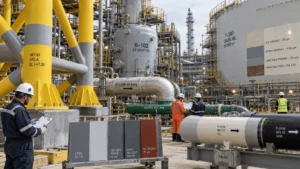
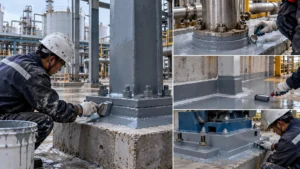
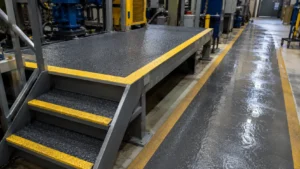
‘Heavy duty’ is one of those terms that appears on a lot of coating product labels and specifications without a precise meaning. Every manufacturer seems to have a ‘heavy duty’ epoxy. Not all of them perform the same way in genuinely aggressive industrial environments.
In the ISO 12944 framework, the term maps reasonably well to category C5 (very high corrosivity) — environments that include aggressive coastal locations, high-humidity industrial sites, and process plant with regular chemical exposure. A C5 coating system is substantively different from a C3 or C4 system — not just in DFT, but in the type of products used. This guide explains what a C5 heavy-duty system actually consists of, and why the specific components matter.
What Makes C5 Different from C4
The jump from C4 to C5 isn’t just ‘apply more coating’. The intermediate coat changes — from standard high-build epoxy to glass flake epoxy — and this is the most significant technical difference in the system.
In C5 environments, the dominant failure mode for standard epoxy coatings is osmotic blistering: chloride ions diffuse through the coating film, accumulate at the steel interface, and create osmotic pressure that separates the film. Standard epoxy films are sufficiently permeable to chlorides that this happens within 5–10 years in aggressive C5 environments. Glass flake epoxy dramatically reduces this permeability. The overlapping borosilicate glass platelets create a tortuous diffusion path that extends the chloride transit time by a factor of 10–50.
| System Component | C4 Specification | C5 Specification | Why Different |
|---|---|---|---|
| Primer | Zinc-rich epoxy, 60–75 µm | Zinc-rich epoxy, 60–75 µm | Same — zinc galvanic protection required for both |
| Intermediate | High-build epoxy, 100–150 µm | Glass flake epoxy, 150–250 µm | GFE needed for chloride barrier in C5 |
| Topcoat | Aliphatic PU, 50–75 µm | Aliphatic PU, 60–75 µm | Same product type; slightly higher DFT in C5 |
| Total DFT | 260–340 µm | 340–440 µm | Higher build in C5 |
| Service life (H) | 15+ years | 15+ years | Same target; GFE makes it achievable in C5 |
The full classification logic that separates C4 from C5 — and from CX for offshore service — is covered in the ISO 12944 C5 corrosion protection guide.
The Glass Flake Epoxy Intermediate: What to Specify
Not all glass flake epoxy products are equivalent. When specifying, confirm:
- Glass flake type: borosilicate glass flakes (not standard E-glass) provide better chemical and moisture resistance
- Flake size: 200–2000 µm is typical; smaller flakes are easier to apply but provide less barrier effect per unit thickness
- Zinc-free formulation: glass flake epoxy is not a zinc-containing primer — it’s a barrier coat. Don’t confuse it with zinc-rich systems.
- DFT range: confirm the specified DFT is within the manufacturer’s validated range for the product. Glass flake systems have a maximum DFT per coat — exceeding it causes mudcracking.
- Application equipment: glass flake systems require airless spray with larger tip sizes (0.023–0.027 inch) and higher pressure (250+ bar) than standard epoxy to maintain flake suspension. Confirm the applicator has appropriate equipment.
When Standard Epoxy Is Not Adequate — The Signs
How do you know if a site genuinely warrants C5 specification rather than C4? A few indicators:
- Site is within 1–2km of the open coast with prevailing onshore winds — salt deposition is elevated regardless of whether the structure looks ‘coastal’
- Adjacent to process plant with significant SO₂, chloride, or HCl emissions from stacks or process vents
- High time-of-wetness: structures that are frequently condensation-wet — near cooling towers, process steam venting areas, or in high-rainfall climates — corrode faster even without high atmospheric contamination
- Previous coating history shows early failure: if existing steel on the same site has shown premature coating failure (say, within 5–8 years of a standard epoxy system), the environment is more aggressive than a C4 specification can handle
Surface Preparation for Heavy-Duty C5 Service
Sa 2½ (ISO 8501-1) is the minimum — this is not negotiable for C5. The surface profile should be at the coarser end of the specification for glass flake intermediate coats: Rz 60–100 µm provides better mechanical adhesion for the high-viscosity glass flake material.
Chloride contamination control is particularly important in C5 service. The acceptance criterion is ≤ 20 mg/m² chloride (Bresle patch, ISO 8502-9). On coastal sites, test immediately before coating — not just after blasting. A blasted surface in a coastal environment can reach unacceptable chloride levels within 1–2 hours in windy conditions. The zinc-rich primer for steel structures guide covers primer-specific surface preparation requirements in detail.
Heavy-Duty Coating for Specific Industrial Environments
Chemical and Petrochemical Plants
Add chemical splash resistance consideration alongside the atmospheric corrosion system. For steel subject to occasional acid or solvent splash, specify an epoxy topcoat rather than polyurethane — epoxy has better chemical resistance, though it chalks under UV. For areas of regular chemical exposure, specify a novolac epoxy topcoat or consult the manufacturer’s chemical resistance data.
Coastal Industrial Facilities (Ports, Refineries, Fertiliser Plants)
These sites often combine C5 atmospheric conditions with specific process chemicals (chlorine, ammonia, acids). The C5 glass flake system handles the atmospheric component. For areas of direct chemical splash or condensation of process chemicals, additional protection specific to the chemical is required — which may involve a specialist topcoat or modified intermediate coat. The system selection logic for coastal and marine environments is covered in the anti-corrosion coating guide for coastal and marine steel.
High-Humidity Indoor Industrial Environments
Warehouses and processing buildings in tropical climates, or indoor environments with significant moisture generation (food processing, paper mills, laundries), can be C4 or C5 conditions internally even if the external environment is milder. Specify the internal coating system based on internal conditions, not external classification.
Frequently Asked Questions
Can I use a C5 system in a C4 environment?
Yes, and it won’t cause any harm to the coating performance. A C5 system will simply last longer than necessary in a C4 environment — the service life will extend well beyond the typical 15-year high-durability target. The economic question is whether the additional material cost of the C5 system (typically 30–50% more than C4 in materials) is justified by the specific project’s maintenance access cost and lifecycle requirements. For structures where access is easy and cheap, specifying to the actual category is economically correct. For structures where access is difficult and maintenance is expensive, over-specifying by one category is often justified.
Is ‘heavy duty epoxy’ the same as glass flake epoxy?
Not necessarily. ‘Heavy duty epoxy’ is a marketing term that describes high-build, solvent-free, or chemical-resistant epoxy systems — but it doesn’t imply glass flake reinforcement. Glass flake epoxy is a specific product type where borosilicate glass flakes are incorporated into the epoxy matrix. When specifying for C5 service, confirm whether the proposed product actually contains glass flake reinforcement — ask for the product composition and TDS, not just the product description.
What’s the maximum DFT per coat for glass flake epoxy, and what happens if it’s exceeded?
Maximum DFT per coat is typically 300–400 µm, depending on the specific product — always confirm in the manufacturer’s TDS. Exceeding the maximum causes mudcracking: the film dries and contracts but the internal stress exceeds the film’s flexibility, producing a cracked surface pattern that compromises both aesthetics and barrier performance. Monitoring wet film thickness with a comb gauge during application is the most practical way to prevent this, particularly on large-area application where it’s easy to over-apply in one pass.
Does a C5 system require a different topcoat from a C4 system?
The topcoat product type is typically the same — aliphatic polyurethane — but the DFT is slightly higher in C5 (60–75 µm vs 50–75 µm). The topcoat’s role in the system is UV and weathering resistance, not the primary corrosion barrier — that function is performed by the zinc primer and glass flake intermediate. For C5 environments with chemical exposure (petrochemical, fertiliser), an epoxy topcoat may replace polyurethane in areas of direct chemical contact, at the cost of some UV performance.
How do I confirm a manufacturer’s C5 system has adequate test data?
Request the ISO 9227 neutral salt spray test duration and the specific system (primer + intermediate + topcoat, with DFT per coat) that was tested. For a C5 High durability claim, ISO 12944-6 requires 1,440 hours salt spray as a minimum; many credible C5 systems are tested to 3,000 hours or more. Also request ISO 4628 blister, rust, and delamination ratings from the test — passing 1,440 hours with significant blistering is not equivalent to passing with no defects. The system TDS alone is insufficient; ask for the actual test report.
Get a C5 Heavy-Duty System Recommendation
Huili Coating manufactures zinc-rich epoxy primers, glass flake epoxy intermediates, and aliphatic polyurethane topcoats for C5 industrial steel applications — with ISO 9227 salt spray test data (3,000+ hours) and full system documentation including TDS, SDS, and application procedures.
To recommend the right C5 system and provide TDS or RFQ support, send your project details via the Huili Coating project inquiry form:
- Site environment and ISO 12944 category (or site description for assessment)
- Structure type and industrial process context (petrochemical, coastal port, process plant, etc.)
- Any chemical exposure zones requiring enhanced topcoat specification
- Surface preparation method available (shop blast or site blast)
- Required durability range and design life
- Any applicable project standards (ISO 12944, NORSOK, client specification)
- Surface area and project timeline
The technical team will respond with a coat-by-coat C5 system recommendation, DFT per coat, ISO test data, and full product documentation — specific to your industrial environment and project requirements.