Choosing the wrong epoxy tank lining can lead to lining failure within months — resulting in costly downtime, contamination, and tank replacement. Yet with dozens of epoxy formulations on the market, many engineers struggle to identify which system actually meets their service conditions.
This guide covers everything procurement engineers and project managers need to know about epoxy tank linings: how they work, the main types available, selection criteria by service medium, applicable standards, and what to look for when evaluating a supplier.
What Is Epoxy Tank Lining?
Epoxy tank lining is a protective coating system applied to the interior surface of industrial storage tanks. It creates a chemically resistant barrier between the tank substrate (typically carbon steel or concrete) and the stored medium — whether petroleum products, water, chemicals, or food-grade liquids.
Epoxy linings consist of two components: a resin (Part A) and a hardener (Part B). When mixed, they undergo a cross-linking chemical reaction that produces a dense, hard film with exceptional adhesion, low permeability, and resistance to a broad range of chemicals.
Unlike paints or single-component coatings, properly applied epoxy tank linings bond chemically to the substrate and form a continuous film that resists blistering, undercutting, and cathodic disbondment — the three most common failure modes in tank interior protection.
Main Types of Epoxy Tank Lining
Not all epoxy systems are equal. The type of epoxy resin and pigment used significantly affects performance. Here are the five most common types used in industrial tank lining applications:
1. Solvent-Free Epoxy Lining
Solvent-free (100% solids) epoxy systems are the industry standard for most storage tank linings. With zero VOC content and high build (typically 250–500 µm DFT per coat), they provide maximum chemical resistance and film integrity.
- Best for: crude oil tanks, fuel storage, potable water tanks
- Standards: approved to AWWA C210, AS/NZS 3862 for water service
- Typical DFT: 300–500 µm in 1–2 coats
2. Glass Flake Epoxy Lining
Glass flake epoxy reinforces the standard epoxy matrix with platelet-shaped glass flakes (typical flake size: 200–2000 µm). The overlapping flakes create a tortuous path that dramatically reduces moisture and ion permeability.
- Best for: chemical tanks, seawater ballast tanks, desalination plants
- Outstanding resistance to: sulfuric acid (up to 70%), caustic soda, brine
- Typical DFT: 500–2000 µm
- Standards: NORSOK M-501, DNV-RP-F106
3. Novolac Epoxy Lining
Epoxy novolac systems use a higher-functionality resin that produces a denser cross-link network. This gives them superior chemical resistance compared to standard bisphenol-A epoxy, particularly at elevated temperatures.
- Best for: high-concentration acid/solvent tanks, petrochemical service
- Temperature resistance: typically up to 120°C continuous in immersion
- Typical DFT: 300–600 µm
4. Amine-Cured vs. Polyamide-Cured Epoxy
The hardener chemistry affects the performance balance. Amine-cured systems offer higher chemical resistance; polyamide-cured systems provide better flexibility and moisture tolerance during application.
5. Epoxy Phenolic Lining
Epoxy phenolic linings are used in the most demanding service conditions — crude oil with high H₂S content, high-temperature chemical service, and jet fuel storage. They require elevated temperature curing (typically 60–80°C) for full cross-linking.
- Best for: refinery tanks, crude oil with H₂S, JP-8/Jet A fuel
- Temperature resistance: up to 150°C in immersion
Epoxy Tank Lining Types: Quick Comparison
| Type | Chemical Resistance | Temp. Limit | Best Application | Typical DFT |
| Solvent-Free Epoxy | Good — broad range | 60°C | Fuel / water tanks | 300–500 µm |
| Glass Flake Epoxy | Excellent — acids, salts | 80°C | Chemical / marine tanks | 500–2000 µm |
| Novolac Epoxy | Excellent — solvents, acids | 120°C | Petrochemical tanks | 300–600 µm |
| Epoxy Phenolic | Outstanding | 150°C | Crude oil / refinery | 200–400 µm |
| Polyamide-Cured Epoxy | Good | 55°C | General industrial | 200–400 µm |
Selection Guide: Choosing the Right Epoxy Tank Lining
The correct epoxy system depends on four key parameters. Specifying the wrong system — even a high-quality product — will result in premature failure.
Step 1: Define the Stored Medium
Chemical compatibility is non-negotiable. Always consult the manufacturer’s Chemical Resistance Guide (CRG) and cross-reference with the specific concentration, temperature, and immersion/splash conditions.
| Stored Medium | Recommended System | Key Concern |
| Potable water | Solvent-free epoxy (WRAS/NSF 61 approved) | Taste/odor compliance |
| Crude oil / fuel | Solvent-free or epoxy phenolic | Aromatic solvents, H₂S |
| Sulfuric acid (≤70%) | Glass flake epoxy or novolac | Acid permeation |
| Caustic soda (NaOH) | Glass flake epoxy | Saponification risk with amine-cure |
| Brine / seawater | Glass flake or solvent-free epoxy | Osmotic blistering |
| Solvents / aromatics | Novolac or epoxy phenolic | Solvent swelling / softening |
| Food grade liquids | FDA-compliant solvent-free epoxy | Regulatory compliance |
Step 2: Assess Operating Temperature
Epoxy linings are thermoplastic-hardened systems — elevated temperature softens the film and reduces chemical resistance. Always specify based on the maximum service temperature, not the ambient temperature.
- Below 60°C: standard solvent-free epoxy is suitable
- 60–100°C: novolac epoxy recommended
- 100–150°C: epoxy phenolic (post-cured) required
- Above 150°C: consider phenolic lining or inorganic zinc alternative
Step 3: Consider Tank Geometry and Application Method
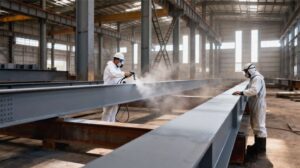
Large field-erected tanks with complex internals are typically spray-applied. Smaller shop-fabricated tanks may use brush/roller. Glass flake systems require airless spray with a high-pressure pump (minimum 250 bar) and specific tip sizing — not all contractors have this capability.
Step 4: Check Applicable Standards
Specifying to recognized standards protects procurement engineers and ensures coating systems are independently validated. Key standards for tank lining include:
- SSPC-SP 10 / ISO 8501-1 Sa 2½:
Near-white blast cleaning — the minimum required surface preparation for epoxy tank lining.
- ASTM C581:
Standard practice for determining chemical resistance of thermosetting resins.
- API 652:
Lining of aboveground petroleum storage tank bottoms — the reference standard for the petroleum industry.
- AWWA C210 / AWWA C222:
NSF 61-certified epoxy lining systems for water service tanks.
- NORSOK M-501:
Surface preparation and protective coating — widely specified for offshore and subsea tanks.
Surface Preparation: The Most Critical Factor
Surface preparation accounts for more than 80% of epoxy lining performance. No epoxy system — regardless of quality — will perform to specification on an improperly prepared substrate.
For carbon steel tank interiors, the minimum requirement is:
- Abrasive blast cleaning to ISO 8501-1 Sa 2½ (SSPC-SP 10)
- Surface profile: 50–100 µm Rz (medium to coarse blast profile for glass flake systems)
- Surface salinity: ≤ 20 mg/m² chloride (Bresle patch method, ISO 8502-9)
- Application within 4 hours of blasting (or before visible oxidation)
For concrete tank substrates, the standard is typically ICRI 310.2 CSP 3–5 (mechanical abrasion or shot blasting), with moisture content below 4% (CM method) before application.
�� Huili Coating’s technical team provides pre-project surface assessment reports on request. Surface profile and cleanliness measurements are included in our standard quality control documentation.
Application Process Overview
A typical epoxy tank lining application follows this sequence:
- Surface preparation: blasting, solvent cleaning, anchor profile verification
- Prime coat (where specified): zinc-rich primer or epoxy primer, 50–75 µm DFT
- First intermediate coat: epoxy base system, 150–300 µm DFT
- Second coat (full-build coat): same system or glass flake finish, 200–500 µm DFT
- Stripe coating: manual brush application on welds, edges, nozzles, and pitting areas
- Holiday detection: 100% pinhole testing using wet sponge (low voltage) or spark test (high voltage) per NACE SP0188
- DFT verification: per SSPC-PA 2, minimum 5 readings per 10 m²
- Cure validation: solvent rub test (MEK, 50 double rubs minimum) before service
Common Failure Modes and How to Avoid Them
| Failure Mode | Root Cause | Prevention |
| Blistering / osmotic blistering | Chloride contamination, inadequate DFT | ≤20 mg/m² chlorides; min. DFT per spec |
| Cracking / delamination | Insufficient surface profile; thermal shock | Maintain anchor profile Rz 50–100 µm; follow cure schedule |
| Pinhole / holidays | Spray technique, solvent entrapment | 100% holiday test after each coat; control pot life |
| Chemical attack / softening | Wrong system for service medium or temperature | Full chemical resistance validation before specification |
| Edge corrosion | Insufficient stripe coat coverage | Manual stripe coat all edges, welds, and nozzles before full coat |
How to Evaluate an Epoxy Tank Lining Supplier
For B2B procurement, supplier qualification is as important as product selection. When evaluating suppliers, request the following documentation:
- Technical Data Sheet (TDS):
Confirms DFT range, chemical resistance, temperature limits, mixing ratio, and pot life. A credible supplier publishes this data openly.
- Safety Data Sheet (SDS / MSDS):
Required for shipment, storage, and worker safety compliance.
- Independent test reports:
Look for third-party chemical resistance testing per ASTM C581 or ISO 2812. In-house data is insufficient for critical applications.
- Quality certifications:
ISO 9001 confirms a documented quality management system. Product-specific approvals (WRAS, NSF 61, Lloyd’s, DNV) confirm suitability for regulated services.
- Application guidelines:
A professional supplier provides detailed application procedures covering surface prep, mixing, thinning limits, inter-coat intervals, curing schedules, and inspection requirements.
�� Huili Coating provides complete technical packages including TDS, SDS, chemical resistance guides, third-party test reports, and application procedures — in English — for all export markets. ISO 9001 certified. Contact our technical team for project-specific recommendations.
Frequently Asked Questions
How long does an epoxy tank lining last?
A properly specified and applied epoxy tank lining typically lasts 10–20 years in service, depending on the service medium, operating temperature, maintenance practices, and inspection frequency. Glass flake systems in marine or chemical service typically achieve 15+ years with proper maintenance. The single greatest factor in service life is surface preparation quality at the time of application.
Can epoxy lining be applied over existing lining?
In most cases, no. The existing lining must be removed and the substrate returned to bare metal (Sa 2½) before reapplication. Applying over failed or aged lining traps contamination and adhesion failure points. The only exception is when the existing lining is fully intact, well-adhered, compatible with the new system, and the engineer has conducted adhesion testing per ASTM D4541.
What is the minimum tank temperature for epoxy application?
Most solvent-free epoxy systems require a minimum substrate temperature of 10°C, with the substrate at least 3°C above the dew point. At lower temperatures, curing is dramatically slowed and adhesion is compromised. For cold-weather applications, winter-grade hardeners or heated enclosures are required. Always follow the manufacturer’s application window specifications.
What is the difference between tank lining and tank coating?
The terms are often used interchangeably, but technically: a ‘coating’ refers to any applied film, while a ‘lining’ implies a thicker, higher-build system specifically designed for full immersion service in the tank interior. Linings are typically applied at 300–2000 µm DFT, are designed for immersion resistance (not just atmospheric protection), and are subject to holiday detection testing. External tank coatings serve a different function and are subject to different specifications.
Do epoxy tank linings require maintenance?
Yes. Even the best epoxy lining requires periodic inspection and maintenance. Typical inspection intervals for petroleum service tanks follow API 653 (internal inspection every 5–20 years, depending on corrosion rate and bottom condition). During inspection, look for: blistering, edge lifting, pinhole corrosion, mechanical damage, and settlement staining. Early intervention on small damage areas (spot repair) is far more cost-effective than full strip-and-reline.
Need Expert Guidance on Epoxy Tank Lining?
Huili Coating manufactures a full range of epoxy tank lining systems — including solvent-free epoxy, glass flake epoxy, novolac epoxy, and epoxy phenolic — for industrial, marine, and chemical service applications worldwide.
Our systems are manufactured to ISO 9001 quality standards and comply with international specifications including API 652, NORSOK M-501, AWWA C210, and NSF 61.
- Export supply to Europe, Middle East, and Southeast Asia
- Full technical documentation in English: TDS, SDS, chemical resistance guides
- Engineering support for project-specific system selection
- Competitive pricing with MOQ flexibility for project quantities
Contact our technical team at huilicoating.com for project specifications, samples, and pricing.