Steel structure coating failure is rarely a pure product-quality issue; it’s usually a mismatch between surface condition, environment severity, and the coating system design and controls used during application. The fastest way to prevent repeat failures is to treat each symptom (peeling, blistering, underfilm corrosion, early rust) as an inspection problem: verify surface cleanliness (including salts), verify prep standard, then verify system build and application controls.
Quick Guide: Stop failures before they start
Confirm failure location: edges/welds/bolts vs flat areas (details fail first).
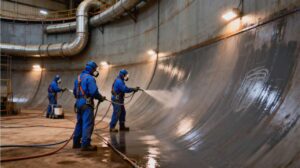
Verify surface prep: confirm Sa 2.5 (near-white) is actually achieved, not just written in the RFQ.
Check salts: test and control soluble salts to reduce blistering and underfilm corrosion risk.
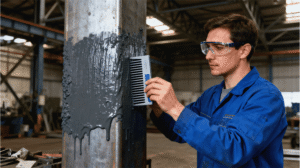
Validate system build: confirm primer + epoxy build + topcoat compatibility and target DFT by layer.
Control application: monitor humidity/temperature, recoat windows, and documentation hold points.
![Sweep blasting primed steel before applying intumescent coating]](https://huilicoating.com/wp-content/uploads/2026/01/sweep-blast-primed-steel-before-intumescent.webp-1024x575.jpg "Common Coating Failures in Steel Structure Projects and How to Avoid Them 1")
Most common coating failures in steel structures (what they look like)
Peeling / delamination
Peeling usually appears as sheets or flakes lifting from the substrate, often starting at edges, welds, and cutouts where film build is thin and prep is inconsistent. In practice, it often indicates adhesion failure: contamination, inadequate profile, or coating applied over weakly attached rust/scale.
Blistering
Blistering can look like domes or bubbles; when opened, it may contain brine or moisture. Soluble salts trapped under the coating can pull water through the film via osmotic pressure, creating osmotic blistering and setting up conditions for accelerated degradation.
Underfilm corrosion
Underfilm corrosion is corrosion spreading beneath a coating, often hidden until rust staining or disbondment becomes visible. Soluble salts can create a conductive electrolyte under the coating and sustain localized electrochemical attack, leading to underfilm corrosion and progressive delamination.
Early rusting (rust bleed-through / rust spots)
Early rust spots often show up at welds, edges, or thin areas soon after commissioning. Common triggers include insufficient DFT at details, flash rust after blasting, or coating over contaminated steel—especially where salts and moisture are present.
Root causes behind coating failures (what engineers should check first)
Surface preparation issues
If the substrate is not clean and properly prepared, coatings cannot form reliable mechanical bonding and barrier protection. A key root cause is “visual cleanliness only”—surfaces can look clean while still carrying soluble salt contamination that later drives blistering and underfilm corrosion.
Wrong coating system for the exposure
A system that works indoors may fail outdoors; a system designed for industrial atmosphere may fail faster in coastal wetting or high humidity. When the environment is underestimated, the system is usually underbuilt (insufficient barrier layers and protection at details).
Environmental misjudgment (humidity, condensation, wetting cycles)
Repeated wet/dry cycles and condensation amplify the impact of any remaining salts or weak points. Salt-driven osmotic effects and underfilm corrosion are more likely when moisture cycles are frequent.
Poor application control
Even with the right spec, poor mixing discipline, uncontrolled film build, or ignoring recoat windows can reduce adhesion and durability. Failures then show up as delamination, cracking, or premature corrosion at weak points (especially details).
How surface preparation directly affects coating performance
What Sa 2.5 really means on site
Sa 2.5 is commonly described as “very thorough blast cleaning,” and it is often cross-referenced with near-white blast cleaning concepts. Practical guidance also notes a key nuance: SP10 limits staining to about 5% of the surface, while Sa 2.5 can allow more staining (often cited up to ~15%), so your specification should be explicit about which acceptance basis you will inspect against.
Roughness/profile and adhesion (why “too smooth” also fails)
Blast cleaning does more than remove rust—it creates a surface profile that supports mechanical interlocking. If the profile is too low, adhesion can suffer; if it is excessive for the coating build, peaks may be under-covered and become early corrosion initiation points (specify profile control and verify it).
Soluble salts: the hidden variable behind blistering and underfilm corrosion
Soluble salts (chlorides, sulfates, nitrates) can catalyze underfilm corrosion and drive osmotic blistering; this is why salt testing and mitigation is standard practice for many coastal/marine and high-risk assets. The mechanism is well explained: salt pockets draw water through the coating, build pressure, form blisters, and then create a conductive underfilm environment that accelerates corrosion spread.
System design mistakes that lead to premature failure
Wrong primer choice (or primer not matched to the system)
Primers must match both substrate condition and the full system’s compatibility. A primer that is fine in one system can become the weak link if the intermediate/topcoat chemistry or application window is mismatched.
Not enough film build where it matters
Projects often measure DFT on flat areas and miss edges and welds. If barrier thickness is insufficient at details, corrosion starts there first, then creeps under the coating and shows up as staining, blistering, and delamination.
Topcoat not weathering-capable for the exposure
If the structure is outdoors, the topcoat needs to handle UV and weathering. If the topcoat is chosen for price or availability rather than exposure, the coating system can degrade faster and require earlier maintenance.
How to prevent coating failures in steel structure projects
Specify the system (not a single product)
Write the RFQ as a coating system: primer + epoxy build + topcoat, with compatibility required and defined inspection hold points. This aligns with how steel structure coating systems are presented as protective barriers intended to extend service life and reduce maintenance.
Standardize execution controls (what prevents 80% of rework)
Define surface preparation standard and acceptance criteria (visual + measurable checks such as salt testing where relevant).
Require stripe coat at edges/welds and verify before full coats.
Record environmental conditions, batch traceability, and inspection results as part of handover.
Use a practical “symptom → action” table
| Failure symptom | Fast field checks | Prevention actions |
|---|---|---|
| Peeling/delamination | Check prep standard evidence; check contamination; check adhesion at edges | Tighten surface prep verification; enforce stripe coat; confirm layer compatibility |
| Blistering | Open blister: brine/moisture? check salt test records | Test/mitigate soluble salts; control moisture exposure; improve surface cleanliness |
| Underfilm corrosion | Map spread from details/defects; check water traps | Improve detail protection; seal/repair defects early; strengthen barrier build |
| Early rusting | Check DFT at welds/edges; check blast-to-coat timing | Increase coverage at details; control timing and environment; add stripe coat discipline |
Recommended anti-corrosion systems for steel structures
For project teams that want to prevent repeat failures, start by aligning the system to steel structure application scenarios and typical industrial exposures, then request a system recommendation with TDS support.
Anchor: [Steel Structure Coating Solutions] ->
Anchor: [Anti-Corrosion Coating for Steel Structures: How to Choose] ->
Anchor: [Epoxy Anti-Corrosion Coating Series] ->
Quality / inspection checklist (steel structure focused)
Surface prep standard confirmed (Sa/SP level), with documented acceptance criteria and records.
Soluble salts checked where exposure is coastal/high humidity or where blistering risk is critical.
Surface dust/cleanliness verified before priming (project practice).
DFT verified by coat and at details (edges/welds/bolts), not only on flat areas.
Recoat timing and environmental conditions logged (humidity/temperature), with batch traceability.
RFQ checklist (send this to get a high-quality recommendation)
Project location and exposure: indoor/outdoor, coastal distance, humidity and wetting cycles
Substrate condition: new steel vs maintenance, existing coating condition
Target surface preparation standard (Sa 2.5 / SP10 or others) and achievable method (blast vs power tools)
Failure history (if any): where it failed, photos, time to failure
Coating performance target: maintenance interval expectation
Documents requested: system recommendation, TDS/SDS, inspection checklist, repair procedure
Technical note / disclaimer
System selection, surface preparation level, inspection acceptance criteria, and film thickness targets must be confirmed by the applicable TDS, standards, and project specification. Final requirements vary with exposure severity, substrate condition, and application constraints.
CTA
Contact us to evaluate your current coating system and avoid costly failures. Share your exposure conditions, surface preparation capability (e.g., Sa 2.5/SP10), and failure symptoms/photos—our technical team will recommend a corrected system and provide the TDS package for RFQ.
Contact Us
We would love to speak with you.
Feel free to reach out using the below details.