Stainless steel protective coating is not required for every stainless steel asset, but it becomes important when the service environment can damage the passive layer or create special corrosion risks. In marine, chemical, CUI, galvanic, abrasion, or high-cleanability environments, stainless steel may still suffer from chloride pitting, crevice corrosion, coating adhesion failure, contamination, or surface degradation.
For EPC contractors, chemical plant maintenance teams, marine project buyers, stainless steel equipment manufacturers, procurement managers, and industrial coating distributors, the key question is not simply “Does stainless steel need coating?” The better question is: what exposure trigger is forcing stainless steel to need extra protection?
This guide explains when stainless steel protective coating is needed, when coating may not be necessary, how surface preparation affects adhesion, and what RFQ data buyers should prepare before requesting TDS, SDS, or coating system support.
Stainless Steel Does Not Always Need Coating — But Some Conditions Change That
Stainless steel does not always need coating because its chromium-rich passive layer provides natural corrosion resistance in many mild environments. In clean indoor service, dry conditions, or non-aggressive environments, coating may add cost without adding meaningful performance.
However, stainless steel is not immune to corrosion. The passive layer can break down when exposed to chlorides, stagnant moisture, crevices, insulation systems, aggressive cleaning chemicals, chemical splash, or dissimilar metal contact. When these triggers exist, protective coating for stainless steel may become a practical risk-control measure.
Why Stainless Steel Can Still Corrode
Stainless steel can still corrode when the passive layer is damaged or cannot repair itself under service conditions. Chloride pitting, crevice corrosion, and corrosion under insulation are common examples.
Chlorides are especially important because they can attack localized areas and create small but deep pits. Crevices around fasteners, joints, clamps, seals, and overlap areas can trap moisture and contaminants. Under insulation, moisture and chlorides can concentrate against the stainless surface and accelerate corrosion that is hidden from view.
Why Industrial Service Is Different from Normal Indoor Use
Industrial service is different from normal indoor use because stainless steel may face chemicals, temperature cycling, cleaning agents, marine salt, insulation, abrasion, impact, or contact with carbon steel and aluminum parts.
A stainless steel surface in a clean office environment and a stainless steel pipeline under wet insulation in a chemical plant are not the same coating decision. The coating should be selected by service condition, not by the word “stainless.”
The Main Triggers for Protective Coating for Stainless Steel
Protective coating for stainless steel should be considered when the asset faces chlorides, CUI, chemical splash, galvanic corrosion, abrasion, or appearance and cleanability requirements. These triggers help buyers decide whether coating is needed and what type of system should be reviewed.
Chloride Pitting and Marine Atmosphere
Chloride pitting is one of the most common reasons to consider marine coating for stainless steel. Marine atmosphere, coastal air, salt spray, seawater mist, and chloride deposits can break down the passive layer and create localized corrosion.
Marine stainless steel may need coating when it is installed near the sea, on offshore structures, in port facilities, on marine equipment, or in areas that are difficult to clean. The coating system should focus on surface cleanliness, adhesion, salt removal, and topcoat durability.
Corrosion Under Insulation / CUI
CUI coating for stainless steel may be needed when stainless steel is used under insulation and exposed to temperature cycling, trapped moisture, chlorides, and wet-dry conditions. CUI is difficult because corrosion can occur under insulation where it is not visible during normal inspection.
Even stainless steel can be affected when moisture and chlorides concentrate under insulation. For insulated stainless pipes, vessels, or equipment, coating selection should consider operating temperature, insulation type, water ingress risk, inspection access, and shutdown schedule.
Chemical Splash and Cleaning Agents
Chemical resistant coating for stainless steel should be considered when the asset faces acids, alkalis, solvents, process liquids, aggressive detergents, disinfectants, or frequent cleaning. Stainless steel may resist many chemicals, but not all chemical exposure is safe for every stainless grade.
Chemical splash is different from full immersion. A coating system for splash, cleaning, and washdown may not be the same as a tank lining or immersion-grade system. Buyers should define chemical type, concentration, temperature, exposure time, and cleaning frequency.
Galvanic Corrosion Near Carbon Steel or Aluminum
Galvanic corrosion can occur when stainless steel contacts a different metal in the presence of moisture or electrolyte. Carbon steel fasteners, aluminum parts, galvanized components, or mixed-metal assemblies can create corrosion risk at joints and interfaces.
A protective coating, sealing detail, isolation layer, or compatible fastener design may be needed to reduce galvanic corrosion risk. The coating system should be reviewed together with joint design and maintenance access.
Abrasion, Cleanability, and Color Identification
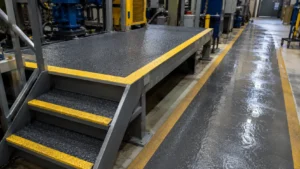
Stainless steel protective coating may also be used for abrasion resistance, cleanability, color identification, safety marking, or appearance control. In some equipment applications, the main reason for coating is not corrosion, but surface durability, cleaning efficiency, or visual management.
For these projects, buyers should define the required function clearly. A coating selected for color and cleanability may not be suitable for chemical exposure or CUI unless the system is designed for those risks.
Stainless Exposure vs Protection Method
The right stainless steel protective coating depends on the exposure trigger, surface condition, inspection requirement, and whether the coating is used for corrosion control, chemical resistance, abrasion resistance, identification, or cleanability.
| Stainless Steel Condition | Main Risk | Coating / Protection Direction | Surface Prep Focus | Buyer Data Needed |
|---|---|---|---|---|
| Marine stainless steel | Chloride pitting, salt deposits | Marine-compatible protective coating or topcoat system | Salt removal, abrasion, adhesion test | Coastal distance, salt exposure, maintenance access |
| Stainless under insulation | CUI, trapped moisture, chlorides | CUI-resistant coating system where required | Cleanliness, profile, dry surface | Temperature, insulation type, wet/dry cycling |
| Chemical plant stainless | Chemical splash, cleaning agents | Chemical-resistant coating or lining review | Degreasing, compatibility test | Chemical type, concentration, temperature |
| Stainless equipment housing | Cleaning, abrasion, appearance | Primer + PU or specialty topcoat if needed | Smooth surface prep, adhesion check | Cleaning method, color/gloss, handling |
| Stainless near dissimilar metals | Galvanic corrosion | Coating, sealing, or isolation approach | Joint cleaning, coating continuity | Fastener material, moisture, joint design |
| Old coated stainless | Peeling, unknown compatibility | Recoatable system only after testing | Sanding, patch test, adhesion | Old coating type, failure condition |
This table is not a fixed specification. It is a selection map that helps buyers identify whether coating is actually needed and which technical risk should be checked first.
Surface Preparation Is the Hard Part When Coating Stainless Steel
Coating stainless steel often fails because the surface is smooth, passive, contaminated, or not prepared enough for mechanical adhesion. Unlike abrasive-blasted carbon steel, stainless steel may not provide enough surface profile for a coating to grip unless the surface is properly prepared.
Smooth Passive Surface and Low Profile
Stainless steel has a passive surface and often a smooth finish. This can make coating adhesion more difficult. If the coating is applied over a polished, brushed, oily, or contaminated stainless surface without proper preparation, peeling or delamination may occur.
A coating system should not be approved only because it is chemically resistant. It must also bond to the stainless substrate.
Oil, Fingerprints, Salts, and Process Contamination
Oil, fingerprints, salts, cleaning chemicals, polishing residues, and process contamination can reduce coating adhesion. Marine stainless steel may also carry chloride salts that must be removed before coating.
Degreasing, washing, drying, and cleanliness checks are important before applying primer or coating. If contamination remains, the coating may blister, peel, or fail at the interface.
Abrasion, Sweep Blasting, or Mechanical Roughening
Stainless steel surface preparation may require controlled abrasion, sweep blasting, or mechanical roughening to improve adhesion. The method should be selected carefully to avoid damaging the surface, embedding contaminants, or creating corrosion risks.
The preparation method depends on stainless grade, surface finish, service environment, and coating system. The TDS should be checked before application.
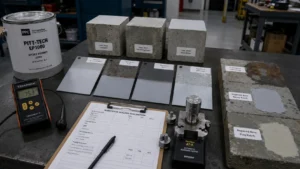
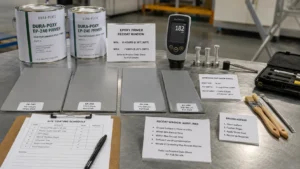
Adhesion Testing Before Full Application
Adhesion testing is strongly recommended when coating stainless steel in high-risk projects. This is especially important for polished stainless, old coated stainless, marine exposure, chemical splash areas, or equipment that must be cleaned frequently.
A small test area can reveal adhesion problems before the full project is coated. If the coating fails during testing, the surface preparation or primer selection should be adjusted before production.
Choose the Coating System by Function, Not by Stainless Steel Name
Stainless steel coating systems should be selected by function: chloride resistance, chemical resistance, CUI protection, abrasion resistance, appearance, cleanability, or insulation from galvanic contact. The correct system depends on the risk trigger, not only the stainless grade.
Epoxy Primer or Epoxy Barrier Layer
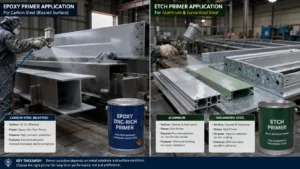
Epoxy primer or epoxy barrier coating may be used when the system needs adhesion, chemical resistance, or barrier protection. On stainless steel, primer selection must focus on bonding to the smooth passive surface.
For chemical splash, industrial equipment, or CUI-related environments, epoxy systems may be considered as part of a broader protective coating strategy. Buyers can review the epoxy anti-corrosion coating series when epoxy barrier performance is required, but the final choice should be verified against stainless surface preparation and exposure conditions.
Polyurethane Topcoat for Weathering and Appearance
Polyurethane topcoat may be used when stainless steel needs weathering resistance, UV stability, color retention, gloss retention, or cleanable appearance. This is more relevant for outdoor equipment, marine above-water components, visible machinery, or identification systems.
The topcoat cannot solve poor primer adhesion. The stainless surface and primer layer must be compatible before applying the final topcoat.
Specialty Coatings for Chemical, CUI, or Abrasion Conditions
Specialty coatings may be required when stainless steel faces chemical splash, repeated cleaning, abrasion, CUI, high humidity, or mixed exposure conditions. In these cases, a standard coating system may not provide enough chemical or mechanical resistance.
For chemical, abrasion, or special service conditions, specialty industrial coatings may be reviewed as a product direction. The exact system should still be selected by exposure, temperature, surface preparation, and inspection requirements.
When Coating May Not Be Needed
Coating may not be needed when stainless steel is used in a clean, dry, non-aggressive indoor environment with no chlorides, no chemical splash, no abrasion, no galvanic contact, and no special appearance requirement.
This matters because over-coating stainless steel can add cost and create future maintenance issues if the coating is not needed. The best answer is not always “apply coating.” The best answer is to confirm whether the service condition creates a real risk.
Common Stainless Steel Coating Mistakes
Most stainless steel coating mistakes come from assuming stainless steel cannot corrode, applying coating without adhesion preparation, or using a system designed for carbon steel without review.
Treating Stainless Steel Like Carbon Steel
Stainless steel and carbon steel have different corrosion behavior and different surface preparation requirements. Carbon steel often needs rust prevention and blast profile control. Stainless steel often needs adhesion control, salt removal, contamination removal, and protection against localized corrosion triggers.
Using the same primer strategy without review can cause adhesion problems or poor long-term performance.
Ignoring Chlorides or CUI
Chlorides and CUI are two major reasons stainless steel may need coating. If a buyer ignores salt exposure, insulation condition, operating temperature, or wet-dry cycling, the coating recommendation may be incomplete.
For marine, coastal, or offshore assets, buyers should consider marine and offshore coating applications as part of the exposure review.
Applying Coating Over Smooth or Contaminated Surface
Applying coating over smooth or contaminated stainless steel can lead to peeling, blistering, or weak adhesion. The surface may look clean but still contain oils, salts, fingerprints, or polishing residues.
Surface preparation should be written into the coating procedure, not left as an informal field decision.
Selecting Coating Only for Appearance
Selecting coating only for appearance can be risky if the environment also includes chemicals, chlorides, abrasion, or CUI. A decorative topcoat may not have enough chemical resistance or adhesion performance for industrial service.
Buyers should define the real function: corrosion control, chemical resistance, abrasion resistance, color identification, cleanability, or weathering.
Prepare RFQ Data for Stainless Steel Protective Coating
A useful RFQ for stainless steel protective coating should include stainless grade, exposure condition, surface state, chemical or chloride risk, temperature, coating function, and adhesion test requirement. Without these details, suppliers can only recommend a generic system.
Before requesting TDS or price, prepare:
- Stainless steel grade, if known
- Asset type: pipe, vessel, equipment housing, panel, platform, frame, tank, or machinery part
- Indoor, outdoor, marine, coastal, chemical, CUI, or abrasion exposure
- Chloride exposure or salt contamination risk
- Chemical type, concentration, exposure time, and temperature if applicable
- Insulation condition, operating temperature, and wet/dry cycling if CUI is a concern
- Dissimilar metal contact, fasteners, or joint details
- Surface condition: polished, brushed, blasted, old coated, oily, contaminated, or salt-exposed
- Surface preparation method
- Adhesion test requirement
- Target DFT and total system DFT
- Topcoat, color, gloss, or cleanability requirement
- Application method: spray, brush, roller, shop coating, or field coating
- Required documents: TDS, SDS, system proposal, COA, or inspection guidance
For stainless steel equipment and machinery, buyers can also review machinery and equipment coatings when coating requirements include cleaning, handling, abrasion, appearance, or equipment protection.
FAQ About Stainless Steel Protective Coating
Does stainless steel need protective coating?
Stainless steel does not always need protective coating. Coating should be considered when stainless steel faces chlorides, marine atmosphere, CUI, chemical splash, galvanic corrosion, abrasion, cleanability requirements, or color identification needs.
Why does stainless steel corrode in marine environments?
Stainless steel can corrode in marine environments because chloride salts can attack the passive layer and cause localized pitting or crevice corrosion. Salt deposits, humidity, stagnant moisture, and difficult cleaning areas increase the risk.
Can protective coating be applied to stainless steel?
Protective coating can be applied to stainless steel, but surface preparation is critical. The surface may need degreasing, salt removal, controlled abrasion, adhesion testing, and a compatible primer or coating system.
What coating is used for stainless steel in chemical plants?
The coating used for stainless steel in chemical plants depends on chemical type, concentration, temperature, splash or immersion condition, cleaning method, and surface preparation. Chemical resistant coating for stainless steel should be selected through compatibility review, not by product name alone.
Is CUI a problem for stainless steel?
CUI can be a problem for stainless steel when moisture and chlorides are trapped under insulation. Temperature cycling, wet insulation, damaged jacketing, and limited inspection access can increase the risk of corrosion under insulation.
What should I send before asking for stainless steel coating price?
Before asking for price, send stainless grade, asset type, exposure environment, chloride or chemical risk, CUI condition, surface state, surface preparation method, DFT target, coating function, adhesion test requirement, and required documents.
Request Stainless Steel Protective Coating Review
The safest way to select stainless steel protective coating is to review stainless grade, exposure trigger, surface preparation, adhesion risk, coating function, and inspection requirement together. Stainless steel should not be coated by default, but it should also not be assumed immune in chloride, CUI, chemical, marine, or galvanic conditions.
For stainless steel protective coating TDS, surface preparation review, chemical or marine exposure support, CUI coating discussion, or RFQ guidance, send your stainless steel grade, asset type, exposure environment, surface condition, chemical/chloride/CUI risk, DFT target, coating function, and required documents through the stainless steel protective coating project inquiry form. HUILI can help review whether your project needs epoxy barrier coating, polyurethane topcoat, specialty industrial coating, or a stainless steel coating system designed for your service condition.