Industrial metal coatings should be selected by product family, application area, and service condition before buyers compare price. For EPC contractors, procurement managers, distributors, machinery manufacturers, and maintenance teams, the key question is not “Which metal coating is cheapest?” but “Which coating system fits the asset, exposure, DFT target, and documentation requirements?”
This guide helps buyers compare primer systems, epoxy coatings, polyurethane topcoats, tank linings, marine coatings, machinery coatings, water-based systems, and high-temperature coatings before requesting TDS or RFQ support.
Start with the Coating Product Family, Not Only the Metal Surface
Industrial metal coatings should be selected by product family and application demand, not only by the metal substrate. The same steel asset may need a primer, an epoxy intermediate coat, a polyurethane topcoat, a tank lining, or a specialty coating depending on exposure.
A steel bridge, a storage tank, a pipeline, a machine frame, and a marine structure are all metal assets, but they do not need the same industrial coating products. The right choice depends on whether the coating layer must provide adhesion, corrosion resistance, chemical resistance, UV resistance, immersion protection, heat resistance, or finish appearance.
Why Industrial Buyers Need a Product Matrix
Industrial buyers need a product matrix because metal coatings are purchased as systems, not isolated names. A complete industrial coating system may include a primer, an intermediate coat, a topcoat, a lining, or a specialty functional layer.
For example, a steel structure may need zinc-rich primer, epoxy intermediate coat, and polyurethane topcoat. A tank interior may need lining-grade epoxy instead of a normal primer. A high-temperature stack may need a silicone or aluminum-silicone coating instead of a standard epoxy system.
Why Price per Kg Is Not Enough for Coating Selection
Price per kg is not enough for coating selection because applied cost depends on solids content, theoretical coverage, DFT, number of coats, loss factor, surface preparation, and service life. A lower unit price can become more expensive if it requires more coats, longer curing, higher maintenance, or early repair.
For RFQ comparison, buyers should ask for the coating system role, recommended DFT, theoretical spreading rate, compatible layers, surface preparation requirement, TDS, SDS, and packaging information. This makes the comparison more useful than a simple product price list.
Industrial Metal Coatings Product Matrix
The fastest way to compare industrial metal coatings is to map each product family to its application, system role, and buyer data requirement. This product matrix helps buyers decide which product series should be reviewed first.
| Product Family | System Role | Typical Metal Application | Main Selection Factor | Buyer Data Needed |
|---|---|---|---|---|
| Anti-rust primers | First layer, adhesion, corrosion base | Steel structures, machinery, pipelines | Surface prep, rust condition, compatibility | Substrate, prep grade, DFT target |
| Epoxy anti-corrosion coatings | Barrier, intermediate coat, selected lining | Steel, tanks, pipelines, equipment | Chemical resistance, immersion, DFT | Medium, temperature, exposure |
| Polyurethane coatings | Topcoat, weathering layer | Outdoor steel, equipment, infrastructure | UV resistance, gloss and color retention | Outdoor exposure, color, durability |
| Water-based coatings | Low-VOC anti-corrosion system | Indoor steel, regulated facilities | VOC limits, drying condition | Site rules, humidity, application method |
| Tank coatings and linings | Internal or external tank protection | Storage tanks, fuel tanks, chemical tanks | Immersion and chemical compatibility | Stored medium, temperature, cleaning method |
| Marine coatings | Salt-resistant protective system | Ships, ports, offshore structures | C5-M/CX, salt spray, splash zone | Marine zone, salt exposure, DFT target |
| High-temperature coatings | Heat-resistant protection | Boilers, stacks, pipelines, power plants | Service temperature, thermal cycling | Operating temperature, surface prep |
| Machinery coatings | Primer-to-topcoat finish system | Mining, construction, industrial equipment | Appearance, impact, corrosion resistance | Equipment type, handling, finish requirement |
| Specialty industrial coatings | Special function layer | Anti-static tanks, glass flake, fluorocarbon, polyurea | Functional performance requirement | Function, standard, exposure |
For buyers who need a broad product overview, the industrial coatings product catalog can be used as the starting point before narrowing the system by application and environment.
Route the Project by Application Area
Application area decides which industrial coating product family should be reviewed first. A good coating supplier should ask where the coating will be used before recommending a product.
Steel Structures and Infrastructure
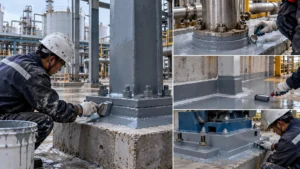
Steel structures and infrastructure usually require primer-based anti-corrosion systems with defined surface preparation, DFT, and weathering protection. Common systems include zinc-rich primer or epoxy primer, epoxy intermediate coat, and polyurethane topcoat for outdoor steel.
For new steel, the starting point is usually surface preparation and primer selection. For maintenance steel, rust condition, old coating compatibility, and spot repair method become more important.
Storage Tanks and Pipelines
Storage tanks and pipelines require different coating systems for external atmospheric exposure, internal immersion, chemical service, buried sections, and insulated pipelines. A normal steel coating system should not be used as a tank lining unless the product is designed for immersion.
For these assets, buyers should review storage tank and pipeline coating systems before asking for product price. The RFQ should include stored medium, service temperature, cleaning method, DFT requirement, and whether holiday detection is needed.
Machinery and Equipment
Machinery and equipment coatings must balance corrosion resistance, appearance, abrasion, impact, oil exposure, cleaning chemicals, and handling during transport. Many systems use epoxy primer with polyurethane or acrylic polyurethane topcoat to combine adhesion and finish durability.
For equipment manufacturers, coating selection should also consider production speed, curing time, packaging, touch-up repair, and export shipping conditions. A coating that performs well in the workshop may still fail during transport if cure and film hardness are not ready.
Marine and Offshore Metal Assets
Marine and offshore metal assets require coatings that can resist salt, humidity, splash zone exposure, UV, abrasion, and maintenance access limitations. Marine coating selection should consider whether the asset is above water, in splash zone, submerged, on deck, or inside a vessel.
Marine coatings should not be selected only from generic metal coatings. The system may need zinc-rich primer, epoxy barrier coat, glass flake epoxy, polyurethane topcoat, or other specialized marine protective coatings depending on zone and durability target.
Compare Industrial Coating Systems Before Asking for Price
Industrial coating systems should be compared by applied cost, DFT, service life, surface preparation, and compatible layers instead of price per kg only. This is especially important when comparing industrial coatings from different suppliers.
Primer + Intermediate + Topcoat Cost
Primer, intermediate coat, and topcoat cost should be compared as a full system because each layer has a different function. The primer supports adhesion and corrosion resistance, the intermediate layer adds barrier thickness, and the topcoat provides UV resistance, color retention, or chemical resistance.
If buyers compare only one coating layer, the quote may look cheaper but fail to include the actual system needed for the project. This can lead to missing DFT, wrong topcoat, poor recoat compatibility, or reduced service life.
DFT and Theoretical Coverage
DFT and theoretical coverage directly affect applied cost and coating performance. A coating with higher solids content may cover more area at the same DFT, while a low-solids product may need more coats or higher consumption.
Typical primer DFT may be around 40–80 μm, high-build epoxy intermediate coats may be around 100–200+ μm per coat, and lining systems may require several hundred microns depending on service. Final values must follow the product TDS and project specification.
Service Life and Maintenance Cycle
Service life and maintenance cycle should be part of coating comparison because low initial cost may create higher long-term repair cost. A short-term maintenance coating may be acceptable for temporary repair, but infrastructure, tanks, marine assets, and power plant steel usually need more durable systems.
For long service life, buyers should check environment, surface preparation, DFT, curing conditions, inspection method, and compatible coating layers together.
Check Supplier Documents Before Purchase
An industrial coating supplier should provide technical documents that prove product compatibility, application limits, and system suitability. For B2B industrial projects, documentation quality often matters as much as product price.
TDS and SDS
TDS and SDS are the basic documents buyers should request before purchasing industrial metal coatings. The TDS should show mixing ratio, DFT, drying time, pot life where applicable, recoat interval, surface preparation, theoretical coverage, and compatible layers.
The SDS supports safe handling, storage, transport, and application. For export projects, buyers may also need packaging information, shelf life, batch number, and compliance documents depending on destination market.
Coating System Proposal
A coating system proposal should show which primer, intermediate coat, topcoat, or lining is recommended for the application. This is more useful than receiving a single product name without system context.
For example, a steel structure system may include primer + epoxy intermediate + polyurethane topcoat, while a tank interior may require a lining system. A good industrial coating supplier should explain why the system fits the asset and exposure.
DFT, Surface Preparation, and Recoat Guidance
DFT, surface preparation, and recoat guidance should be confirmed before purchase because they affect both performance and jobsite schedule. If the surface preparation level is unrealistic for the project, the coating system may not perform as expected.
Buyers should ask whether abrasive blasting, power tool cleaning, degreasing, salt removal, or surface profile measurement is required. Recoat interval is also important when steel is primed in a workshop but topcoated later on site.
Packaging, Lead Time, and Export Support
Packaging, lead time, and export support matter for projects in the Middle East, Southeast Asia, Central Asia, and other overseas markets. Industrial coatings may need suitable packaging, clear labels, batch traceability, TDS/SDS documents, and stable delivery planning.
For distributors, this is especially important because the same product may be supplied to different projects with different documentation and packaging needs.
Prepare RFQ Data for Industrial Metal Coatings
A useful RFQ for industrial metal coatings should include asset type, service environment, surface preparation, target DFT, quantity, drawings, and required documents. The more specific the RFQ, the more useful the coating recommendation and quotation will be.
Before sending an RFQ, prepare:
- Asset type: steel structure, storage tank, pipeline, equipment, marine asset, or machinery
- Metal substrate: carbon steel, galvanized steel, aluminum, stainless steel, or mixed metal
- Application area: indoor, outdoor, marine, chemical, immersion, high-temperature, or buried service
- New build, maintenance, or repair project
- Surface preparation method available on site
- Target DFT or existing specification
- Coating area or drawings
- Required product family, if already known
- Required documents: TDS, SDS, COA, coating system proposal, or inspection guidance
- Packaging requirement and order quantity
- Destination market and delivery schedule
- Required topcoat color or finish appearance
If the project is still at selection stage, buyers can start from the anti-rust and primer coating series and epoxy anti-corrosion coating series before finalizing the complete industrial coating systems.
FAQ About Industrial Metal Coatings
What industrial metal coatings are used for steel structures?
Industrial metal coatings for steel structures usually include anti-rust primer, epoxy intermediate coat, and polyurethane topcoat. For C3–C5 exposure, the system should be selected by surface preparation grade, DFT, corrosivity environment, and expected service life.
Which industrial metal coating is used for tanks?
Tanks may use external protective coating systems or internal lining systems depending on exposure. Tank exteriors may use epoxy and polyurethane systems, while tank interiors often need lining-grade epoxy or chemical-resistant lining based on stored medium, temperature, and immersion conditions.
How do I compare industrial coating products before RFQ?
Industrial coating products should be compared by product family, system role, DFT, theoretical coverage, surface preparation, compatible layers, and TDS data. Comparing only price per kg can be misleading because applied cost depends on consumption, number of coats, loss factor, and maintenance cycle.
What documents should an industrial coating supplier provide?
An industrial coating supplier should provide TDS, SDS, recommended coating system, surface preparation guidance, DFT range, recoat interval, packaging information, and COA if required by the project. For export projects, buyers may also need batch traceability and destination-specific documentation.
Are water-based industrial metal coatings suitable for heavy-duty use?
Water-based industrial metal coatings can be suitable for some anti-corrosion applications, especially where VOC limits, indoor application, or regulated facility requirements matter. However, heavy-duty exposure still requires checking DFT, drying conditions, corrosion category, and compatibility with the full coating system.
What information should I send to get coating price?
To get coating price, send the asset type, metal substrate, exposure environment, surface preparation method, coating area, DFT target, quantity, destination, and required documents. This helps the supplier quote a usable coating system instead of a generic product.
Request Industrial Metal Coatings TDS and RFQ Support
The fastest way to choose industrial metal coatings is to send the project asset, exposure environment, product family, DFT target, and document requirements for review. A proper recommendation should match primer, intermediate coat, topcoat, lining, or specialty coating to the real project condition.
For TDS, RFQ, or product matrix support, send your asset type, substrate, service environment, surface preparation method, DFT target, coating area, quantity, destination, drawings, and documentation requirements through the industrial metal coatings RFQ support form. HUILI can help review the suitable product family and coating system before quotation.