Protective metal coating should be selected by metal substrate first, then by exposure environment, surface preparation, primer compatibility, and required service life. For EPC contractors, procurement managers, corrosion engineers, equipment manufacturers, and industrial coating distributors, the main mistake is treating “metal” as one surface.
Carbon steel, aluminum, stainless steel, and galvanized steel fail in different ways. This guide helps buyers compare protective coating for metal substrates, check adhesion risks, and prepare better RFQ data before asking for TDS or system advice.
Start with the Metal, Not the Coating Type
A protective metal coating should be selected first by metal substrate because carbon steel, aluminum, stainless steel, and galvanized steel fail in different ways. The coating system that works well on abrasive-blasted carbon steel may not bond correctly to smooth aluminum, passive stainless steel, or newly galvanized steel.
In real industrial projects, coating failure often starts from the wrong substrate assumption. The product may be suitable for steel, but the surface may be aluminum oxide, zinc passivation, stainless passive film, mill scale, or old coating. Each condition changes the primer selection, surface preparation, and inspection method.
Why Carbon Steel, Aluminum, Stainless Steel, and Galvanized Steel Need Different Systems
Different metals need different systems because each substrate has a different corrosion mechanism and adhesion risk. Carbon steel rusts quickly when water, oxygen, and salts reach the surface, so steel coating for corrosion resistance often needs strong surface preparation, primer adhesion, and sufficient dry film thickness.
Aluminum forms an aluminum oxide layer that can reduce coating adhesion if the surface is not cleaned and abraded correctly. Stainless steel has a passive film, but it can still suffer chloride pitting, chemical attack, or corrosion under insulation. Galvanized steel has a zinc layer that can protect the steel, but coating adhesion depends heavily on zinc surface condition, white rust, and passivation.
Why the Same Primer May Not Work on Every Metal
The same primer may not work on every metal because primer compatibility depends on surface energy, profile, oxide layer, cleanliness, and chemical bonding. A primer designed for blast-cleaned carbon steel may not be the best choice for aluminum panels, stainless pipes, or galvanized frames.
This is why industrial metal coating selection should start with substrate identification. Before comparing coating price, buyers should confirm the metal type, surface condition, previous coating, exposure environment, and required service life.
Map the Metal Substrate Before Selecting the System
A metal substrate map helps buyers choose the right protective metal coatings by linking each metal to its main risk, preparation focus, and likely system direction. This is the most practical starting point for mixed-metal projects.
| Metal Substrate | Main Risk | Surface Preparation Focus | Typical Coating System Direction | Buyer Check |
|---|---|---|---|---|
| Carbon steel | Rust, underfilm corrosion | Abrasive blasting, surface profile, salt control | Zinc-rich primer or epoxy primer + epoxy intermediate + PU topcoat | Environment class, DFT, design life |
| Aluminum | Oxide layer, adhesion failure | Degreasing, abrasion, suitable primer | Epoxy or specialty primer + PU/acrylic topcoat | Adhesion test, marine or chemical exposure |
| Stainless steel | Chloride pitting, CUI, chemical attack | Cleaning, abrasion, profile control | Specialty primer + chemical/heat-resistant system | Chloride, temperature, CUI risk |
| Galvanized steel | Poor adhesion, white rust, zinc corrosion | Remove passivation, clean zinc salts, light abrasion | Duplex coating system or compatible primer + topcoat | Galvanizing age, surface condition |
| Mixed metal assembly | Galvanic corrosion | Isolate dissimilar metals, seal joints | Compatible primer/topcoat system | Contact points, fasteners, drainage |
This table should not replace the product TDS or project specification. It is a selection map that helps procurement and engineering teams ask the right questions before choosing a coating for metal assets.
Select Protective Metal Coating for Carbon Steel
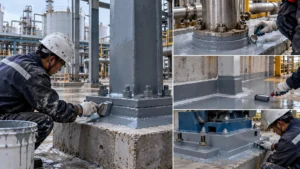
Carbon steel usually needs the strongest anti-corrosion coating system because it rusts quickly when water, oxygen, and salts reach the substrate. In many industrial projects, carbon steel requires abrasive blasting, a corrosion-resistant primer, and a coating system matched to the service environment.
New Steel Structures
New steel structures usually need a coating system designed around surface preparation, primer type, DFT, and corrosivity category. For C3–C5 environments, many projects use zinc-rich primer or epoxy primer, epoxy intermediate coat, and polyurethane topcoat.
ISO 12944 is commonly used as a framework for protective coating systems on steel structures in atmospheric environments. For bridges, workshops, pipe racks, platforms, and power plant steel, buyers should connect coating selection with real steel structure coating systems instead of buying a single product by name.
Storage Tanks and Pipelines
Storage tanks and pipelines need different protective metal coating decisions for external atmospheric exposure and internal immersion service. A tank exterior may use epoxy primer, epoxy intermediate, and PU topcoat, while a tank interior may need lining-grade epoxy or chemical-resistant lining.
For pipelines, the coating requirement changes between above-ground, buried, insulated, and internal exposure. Buyers should review storage tank and pipeline coating systems when the asset involves immersion, soil exposure, chemical media, or corrosion under insulation risk.
Machinery and Equipment
Machinery and equipment coatings must balance corrosion resistance, appearance, impact resistance, and cleaning chemical exposure. Carbon steel equipment may use epoxy primer with polyurethane or acrylic polyurethane topcoat when both durability and finish appearance matter.
For equipment manufacturers, the coating system should also match production speed, handling time, packaging, and transport conditions. A protective coating for metal equipment can fail during shipping or installation if curing, recoat interval, or DFT is not controlled.
Select Protective Coating for Aluminum Without Losing Adhesion
Protective coating for aluminum must control the oxide layer and surface cleanliness because adhesion failure is often the main risk. Aluminum does not rust like carbon steel, but it can corrode, pit, or lose coating adhesion in marine, industrial, or chemical environments.
Why Aluminum Is Different from Carbon Steel
Aluminum is different from carbon steel because it forms a thin aluminum oxide layer that changes how primers bond to the surface. This oxide layer can protect aluminum in some environments, but it can also reduce coating adhesion if oil, oxidation, or smooth surface conditions remain before priming.
For coatings for steel and aluminum, the same topcoat may sometimes be used, but the primer and surface preparation are often different. Buyers should not assume that a steel primer automatically works on aluminum without adhesion testing or manufacturer confirmation.
Surface Preparation for Aluminum
Surface preparation for aluminum usually focuses on degreasing, light abrasion, oxide control, and a suitable primer. Heavy abrasive blasting used for steel may be too aggressive for thin aluminum parts, so preparation must match component thickness and surface condition.
A good aluminum coating specification should include cleaning method, abrasion method, primer type, and adhesion test requirement. If the aluminum part is exposed to seawater, chlorides, or chemicals, the system should be reviewed more carefully before large-scale application.
Where Aluminum Coating Is Common
Aluminum coating is common on marine components, lightweight equipment housings, machinery covers, offshore accessories, rail components, and selected industrial panels. The coating system may need to resist salt spray, UV exposure, abrasion, or cleaning chemicals.
For procurement teams, the key is to describe the aluminum grade, surface finish, exposure condition, and whether the part is cast, extruded, sheet, or fabricated. These details affect primer compatibility and coating adhesion.
Decide When Stainless Steel Still Needs Protective Coating
Stainless steel still needs protective coating in chloride, chemical, high-temperature, or CUI conditions where the passive film may break down. The word “stainless” does not mean corrosion-proof in every industrial environment.
Chloride Pitting and Chemical Exposure
Chloride pitting can occur when stainless steel is exposed to seawater, desalination environments, chemical plants, or chloride-containing process fluids. In these environments, a protective metal coating may be used to reduce exposure to chlorides and aggressive chemicals.
The coating decision should consider stainless grade, chloride concentration, service temperature, cleaning method, and whether the exposure is continuous or intermittent. A generic coating for metal may not be enough if the environment includes acids, alkalis, solvents, or high chloride deposits.
Corrosion Under Insulation
Corrosion under insulation can affect stainless steel pipes, vessels, and equipment when moisture is trapped beneath insulation. This risk is especially important where temperature cycling causes condensation, hidden water retention, or chemical contamination under insulation.
For CUI risk, coating selection should consider operating temperature range, insulation type, inspection access, and whether the system can tolerate wet-dry cycling. Stainless steel may still need a specialty protective system if the asset is difficult to inspect after insulation is installed.
Adhesion Risk on Smooth Stainless Steel
Smooth stainless steel can create adhesion risk because the surface may have low profile, contamination, or a passive film that reduces primer bonding. Cleaning and controlled abrasion are often needed before applying a protective coating.
For stainless steel, adhesion testing is often more important than relying on coating chemistry alone. ASTM D4541 is widely used for pull-off strength testing of coatings and can help verify whether the coating system bonds adequately to the substrate.
Coat Galvanized Steel Only After Checking the Zinc Surface
Galvanized steel can be coated, but the zinc surface condition controls adhesion and duplex system performance. A galvanized surface may be newly passivated, weathered, contaminated, or covered with white rust, and each condition needs different preparation.
New Galvanized Steel vs Weathered Galvanized Steel
New galvanized steel may have passivation residues or a smooth zinc surface that makes coating adhesion difficult. Weathered galvanized steel may be easier to coat after proper cleaning, but it can also contain zinc salts, dirt, or white rust.
Before applying a protective metal coating, the zinc surface should be inspected for age, contamination, white rust, oil, and passivation. The wrong primer over galvanized steel can cause peeling, blistering, or poor intercoat adhesion.
Duplex Coating System for Galvanized Steel
A duplex coating system combines galvanizing with an organic coating system to improve durability and appearance. The zinc layer provides sacrificial protection, while the coating layer helps reduce zinc consumption, weathering, and environmental exposure.
Duplex systems are common for outdoor steel structures, handrails, platforms, transmission structures, and industrial frames. The key is choosing a primer that is compatible with the zinc surface and applying the coating after correct cleaning and surface preparation.
Why Coatings Peel from Galvanized Steel
Coatings peel from galvanized steel when the zinc surface is contaminated, too smooth, passivated, covered with white rust, or primed with an incompatible coating. Adhesion failure is often visible at edges, scratches, bolt holes, or areas exposed to moisture.
For galvanized steel, buyer data should include galvanizing age, whether the surface is newly galvanized or weathered, and whether white rust is present. This helps the coating manufacturer recommend the correct cleaning and primer system.
Match the Service Environment Before Finalizing the Coating System
The service environment decides whether the protective metal coating needs corrosion resistance, chemical resistance, UV resistance, abrasion resistance, or immersion resistance. Substrate type is the first decision, but exposure defines the final system.
| Service Environment | Main Coating Requirement | Typical System Direction |
|---|---|---|
| Outdoor C3–C5 steel | Corrosion + UV resistance | Epoxy primer/intermediate + PU topcoat |
| Marine or coastal metal | Salt resistance + adhesion | Zinc-rich/epoxy + PU or marine system |
| Chemical plant | Chemical resistance | Epoxy, glass flake, or specialty system |
| Tank interior | Immersion resistance | Lining-grade epoxy or chemical lining |
| Equipment and machinery | Impact + appearance | Epoxy primer + PU/acrylic topcoat |
| High-temperature metal | Heat resistance | Silicone or aluminum-silicone system |
| Insulated metal | CUI resistance | Temperature-rated coating system |
A protective coating for metal should be selected as a system, not a single layer. Primer, intermediate coat, topcoat, DFT, curing, surface preparation, and inspection method must work together.
Prepare RFQ Data for Mixed-Metal Projects
A useful RFQ for protective metal coating should identify every metal substrate, exposure condition, surface preparation method, and required coating performance. Mixed-metal projects need more detail because one coating system may not be suitable for every part.
Before requesting advice, prepare:
- Metal substrate list: carbon steel, aluminum, stainless steel, galvanized steel, or mixed metals
- Asset type: steel structure, tank, pipeline, equipment, machinery, frame, or component
- New fabrication or maintenance repair
- Existing coating or galvanizing condition
- Exposure: indoor, outdoor, coastal, chemical, immersion, CUI, high temperature, or abrasion
- Surface preparation allowed: blasting, abrasion, degreasing, power tool cleaning, or washing
- Target durability or maintenance cycle
- Required DFT or owner specification
- Required topcoat color, gloss, UV resistance, or chemical resistance
- Drawings, photos, dimensions, and estimated coating area
- Application method: shop coating, field coating, brush, roller, airless spray, or manual repair
For primer selection, buyers can compare anti-corrosion primers for metal substrates before finalizing the full coating system. The correct primer often determines whether the protective coating bonds successfully to the substrate.
FAQ About Protective Metal Coating
What is the best protective metal coating for carbon steel?
The best protective metal coating for carbon steel usually starts with strong surface preparation and an anti-corrosion primer system. For C3–C5 environments, many steel projects use zinc-rich primer or epoxy primer, epoxy intermediate coat, and polyurethane topcoat, with DFT and durability confirmed by specification.
Can the same coating be used on steel and aluminum?
The same coating cannot always be used on steel and aluminum because the substrates have different surface chemistry and adhesion requirements. Carbon steel often needs rust-control and profile-based adhesion, while aluminum needs oxide control, degreasing, abrasion, and primer compatibility review.
Does stainless steel need protective coating?
Stainless steel needs protective coating when chloride pitting, chemical exposure, high temperature, or corrosion under insulation may damage the passive film. Marine, desalination, chemical, and insulated piping environments are common cases where stainless steel still needs coating review.
Can galvanized steel be coated?
Galvanized steel can be coated when the zinc surface is properly cleaned, free of harmful passivation or white rust, and matched with a compatible primer. A duplex coating system can improve durability, but poor preparation can cause peeling or blistering.
What causes protective coating failure on metal?
Protective coating failure on metal is often caused by poor surface preparation, salt contamination, wrong primer, low DFT, intercoat adhesion failure, or a coating system that does not match the service environment. Aluminum oxide, stainless passive film, and galvanized zinc condition can also create adhesion failure if ignored.
What details should I send before asking for coating advice?
Before asking for protective metal coating advice, send the metal substrate, service environment, surface preparation method, current surface condition, DFT target, temperature, chemical exposure, drawings, and photos. These details help the technical team recommend a coating system rather than a generic product.
Request a Protective Metal Coating System Review
The safest way to choose a protective metal coating is to review substrate type, exposure environment, surface preparation, coating compatibility, and service-life target together. This is especially important for projects with carbon steel, aluminum, stainless steel, galvanized steel, or mixed-metal assemblies.
For technical support, send your substrate list, project photos, drawings, exposure environment, surface preparation limits, DFT requirements, and target service life through the protective metal coating project inquiry form. HUILI can help review whether your project needs epoxy coating, anti-corrosion primer, polyurethane topcoat, tank lining, duplex coating, or a more specialized industrial coating system.