Industrial steel structures sit in harsh, changing environments where moisture, salts, and pollutants are always trying to attack bare metal.
A well-designed protective coating for steel is often the most cost-effective way to control corrosion, extend service life, and avoid unplanned shutdowns over a 10–25+ year horizon.
Quick Guide
- Define the environment first using ISO 12944 corrosion classes (C2–C5/CX) and targeted durability years.
- Build a coating system with primer, intermediate, and topcoat layers that match the environment and design life.
- Use zinc-rich or high-build epoxy where corrosion risk is high, and polyurethane or fluorocarbon where UV and aesthetics matter.
- Treat surface preparation (for example to Sa 2.5) as non‑negotiable if long life is required.
- For complex projects, request system design and TDS based on ISO 12944, steel detail, and expected maintenance strategy.
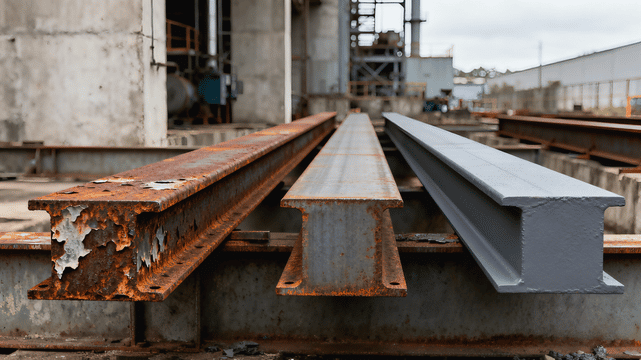
Why Steel Corrosion Is a Critical Challenge in Industrial Projects
Global studies consistently show that corrosion costs run into significant percentages of national GDP when you include maintenance, replacement, and lost productivity.
In industrial plants, bridges, and steel infrastructure, this translates into early coating failures, frequent repairs, and downtime that directly impacts output and safety.
For owners and EPC teams, the real cost is rarely just the paint.
Repeated access, scaffolding, surface preparation, and shutdown planning mean that every extra repaint cycle multiplies lifecycle cost.
The Role of Protective Coating for Steel
Protective coatings act as engineered barriers that separate steel from oxygen, moisture, and aggressive chemicals.
Compared with switching to more exotic alloys or fully redesigning structures, a correctly chosen coating system is usually the most economical way to extend service life.
Coating systems also support modular maintenance: you can spot-repair damaged areas or overcoat aging systems instead of replacing whole assets.
That flexibility is one reason coating-based steel protection dominates industrial and infrastructure projects worldwide.
What This Guide Covers
This guide focuses on three areas that matter most for engineering and procurement teams.
First, it explains the main types of protective coating for steel and where each fits.
Second, it walks through coating materials, layer roles, and thickness logic tied to performance.
Third, it shows how ISO 12944 environment classes connect to coating system design so you can move from concept to RFQ with clear technical logic.
Definition of Steel Protection Coating
A steel protection coating is more than a single paint for color; it is part of a surface-engineering system designed to control corrosion and weathering around the steel.
In industrial projects, that system usually includes surface preparation, one or more coating layers, and inspection steps to confirm quality.
Core Protection Mechanisms
- Barrier protection: Coating layers block oxygen, water, and ions from reaching the steel surface.
- Cathodic protection: Zinc-rich primers provide sacrificial protection at defects by corroding preferentially to the steel.
- Inhibition: Certain pigments and binders help slow corrosion reactions at the steel interface.
Protective coating for steel is a system designed to prevent corrosion by isolating the steel surface and/or providing electrochemical protection.
Economic Impact of Corrosion
Uncontrolled corrosion increases maintenance frequency, shortens repaint intervals, and forces early replacement of steel components.
When you add access equipment, labor, and downtime, the lifecycle cost can easily exceed the original project savings from using lighter or less expensive steel.
By aligning coating system selection with ISO 12944 durability categories, owners can design for service-life ranges such as roughly 5–7 years, 7–15 years, or 15–25+ years between major maintenance.
That linkage between environment, coating system, and durability is the foundation of modern corrosion management.
Structural and Safety Risks
As steel sections lose cross‑section through corrosion, their load-carrying capacity declines and fatigue performance deteriorates.
In bridges, platforms, and industrial structures, this can eventually translate into restricted use, emergency strengthening, or in extreme cases structural failure.
Poorly protected details such as connections, stiffeners, and splash zones are often the first locations to suffer serious corrosion.
A robust coating system, combined with good detailing and inspection, reduces both technical risk and regulatory exposure for asset owners.
Service Life Extension Through Coating Systems
Moving from a basic coating to a well‑designed multi‑layer system can extend expected service life from a low range up toward 15–25+ years, depending on exposure class and maintenance.
ISO 12944 uses durability categories linked to corrosion classes to express those expectations clearly for designers and specifiers.
For example, in a high‑corrosivity C5 or CX marine environment, a zinc-rich primer plus high‑build epoxy intermediate and durable topcoat can support very high durability when applied and inspected correctly.
This longer life often offsets higher upfront coating cost through fewer major overhauls.
Main Types of Steel Protection Coatings
Protective coating for steel normally combines different resin technologies to balance barrier performance, mechanical strength, UV resistance, and appearance.
Understanding the strengths of each category makes it easier to build the right system for each zone of your project.
Epoxy Coating
Epoxy coatings offer strong adhesion to blast‑cleaned steel and very good barrier protection against water and many chemicals.
They are widely used as primers and intermediate coats in industrial systems, especially where corrosion resistance and mechanical toughness are critical.
Polyurethane Coating
Polyurethane coatings provide excellent UV resistance, color and gloss retention, and good overall durability in outdoor exposure.
They are typically used as topcoats over epoxy or zinc/epoxy systems on exposed steel such as bridges, structures, and tanks.
Zinc-Rich Coating
Zinc-rich primers, whether inorganic or epoxy-based, provide cathodic protection to steel at defects and cut edges.
They are the backbone of many heavy‑duty systems in C4, C5, and marine environments where long life and cut-edge protection are essential.
Acrylic and Alkyd Coatings
Acrylic and alkyd coatings are often used for light‑duty or cost‑sensitive applications where intense chemical or marine exposure is not expected.
They may serve as primers or single‑coat finishes on secondary structures, handrails, or indoor steel where faster drying and lower cost are priorities.
Fluorocarbon Coating
Fluorocarbon finishes are high-end topcoats used where color and gloss retention over long periods are critical, such as landmark architecture or offshore structures.
When combined with robust primers and intermediates, they support very high durability expectations in aggressive environments.
Role of Each Layer in a Coating System
A coating system is most effective when each layer has a clear job.
Thinking in terms of primer, intermediate, and topcoat makes system design and troubleshooting much easier.
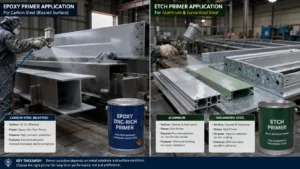
Primer (Zinc / Epoxy)
The primer bonds to the prepared steel and provides the first line of corrosion defense, especially at edges and defects.
Zinc-rich primers offer cathodic protection, while epoxy primers emphasize barrier protection and adhesion.
Intermediate Coating (Epoxy)
Epoxy intermediates build total dry film thickness (DFT) and strengthen barrier performance, particularly in splash and condensation zones.
They also help smooth surface profile from abrasive blasting, improving topcoat appearance and coverage.
Topcoat (PU / Fluorocarbon)
The topcoat faces the environment and protects underlying layers from UV, weather, and mechanical wear.
Polyurethane and fluorocarbon topcoats maintain appearance and protect the system in outdoor or aggressive industrial atmospheres.
Coating Thickness and Performance (DFT)
Dry film thickness is one of the most important parameters linking paint consumption to expected durability.
For harsher environments or higher durability classes, total system DFT typically increases within defined ranges to offer more barrier and, where relevant, zinc content.
Practical implications:
- Thinner total DFT ranges are used in mild indoor or rural environments.
- Medium DFT ranges suit typical urban or light industrial exposure.
- Higher DFT ranges are used in heavy industrial, C5, and marine environments where salt and humidity are severe.
Coating System Design Based on ISO 12944
ISO 12944 connects corrosion environment, coating system, and expected durability in a way that is understood by owners, designers, and inspectors globally.
Using it as a framework helps projects standardize specifications and compare systems in a consistent way.
Environmental Classification (ISO 12944)
Common atmospheric corrosion classes include:
- C2: Low – dry indoor or low-pollution rural environments.
- C3: Medium – urban and light industrial atmospheres.
- C4: High – industrial areas and coastal zones with moderate salinity.
- C5 / CX: Very high to extreme – heavy industrial or marine/offshore conditions.
Recommended Coating Systems by Environment
Typical engineering practice uses different system types and durability expectations for each class.
- C2–C3 Environment: Epoxy primer plus polyurethane topcoat for around a low-to-medium durability range.
- C4 Environment: Zinc-rich primer plus epoxy intermediate plus polyurethane topcoat for a medium-to-high durability range.
- C5 / Offshore: Zinc-rich primer plus high-build epoxy plus fluorocarbon or advanced topcoat for high-to-very-high durability ranges.
Environment | Coating System | Typical Durability Range
—|—|—
C2 | Epoxy primer + PU topcoat | Low to medium durability range
C3 | Epoxy multi‑coat system | Medium range around 7–15 years before major maintenance
C4 | Zinc-rich + Epoxy + PU | Medium to high range around 15–25 years
C5 | Zinc-rich + Epoxy + Fluorocarbon | High to very high range tending toward 25+ years
For deeper background on category definitions and durability concepts, see ISO 12944 corrosion protection guidance.
Where Protective Coatings Are Used
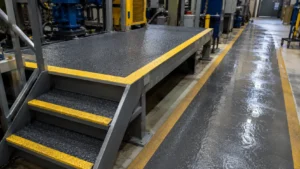
Protective coating for steel is applied wherever corrosion could threaten performance, appearance, or safety.
Structural Steel
Buildings, industrial frames, and bridges rely on coating systems to protect beams, columns, bracing, and connections.
Different zones—indoors, splash zones, external frames—may need different systems even within one structure.
Oil & Gas / Offshore
Offshore platforms, jetties, and coastal process plants face constant salt, humidity, and mechanical damage.
Here, zinc-rich plus epoxy plus high-performance topcoats are common, often backed by stringent inspection regimes.
Tanks and Pipelines
Storage tanks and pipelines often require separate internal linings and external protective systems.
External shells, roofs, and pipe racks frequently use zinc/epoxy/PU combinations tailored to local ISO 12944 class.
Industrial Equipment
Chemical equipment, machinery frames, and plant utilities use coatings to manage corrosion and cleaning requirements.
Water-based anti-corrosion coatings can be attractive in some applications where volatile organic compound limits are strict.
For a practical view of how these systems are applied across projects, see the steel structure coating solutions page.
Why Coating Systems Are Preferred
Modern coating systems give engineers freedom to tune performance by adjusting primer type, DFT, and topcoat technology.
They are maintainable, which means you can plan partial repairs and overcoats instead of full replacement.
Over a full life cycle, this flexibility often reduces total cost compared with alternatives that are difficult to repair or modify.
Coatings also integrate well with other protection strategies such as design detailing and drainage control.
Coating vs Galvanizing
Both coating systems and galvanizing are established methods for steel protection, and in some cases they are used together.
Choosing between them depends on design flexibility, application constraints, and long‑term maintenance strategy.
Parameter | Coating System | Galvanizing
—|—|—
Flexibility | Very flexible across shapes, repairs, and colors. | Less flexible; part size and bath access limit options.
Repair | Local repair and overcoating are straightforward with correct surface prep. | Repair is possible but more specialized and often less convenient on site.
Application | Can be applied in shop or on site, including field repairs. | Normally applied in a factory bath before erection.
Lifecycle Cost | Optimizable via ISO-based design life and planned maintenance. | Higher upfront cost; long life but less adaptable if design changes.
When to Choose Coating Systems
Coating systems are often preferred when you need design flexibility, complex connections, on‑site welding, or a specific color and gloss level.
They are also a strong choice when staged construction and future modifications are expected.
When Galvanizing Is Suitable
Galvanizing works well for prefabricated members that fit into the bath and will operate in environments where zinc’s performance is well understood.
In many projects, galvanized steel is then over‑coated to combine sacrificial protection with decorative or added barrier performance.
Key Selection Factors
A good specification turns environment and project constraints into a clear coating system requirement.
Key factors include:
- Environment class by ISO 12944 (C2 to CX, plus immersion categories where relevant).
- Project budget and whether you prioritize lower initial cost or extended maintenance intervals.
- Target design life before first major maintenance, aligned with ISO durability ranges.
- Maintenance strategy: ease of access, shutdown tolerance, and inspection capability.
- Application conditions: shop vs site, climate during application, and achievable surface preparation level.
Quick Decision Framework
- If the structure is offshore or in severe marine exposure, a zinc-rich primer plus high-build epoxy plus durable topcoat is usually the primary direction to consider.
- If the structure is indoors in a mild environment, an epoxy system may be sufficient when matched to the correct ISO class and durability target.
For more detailed system design thinking across different environments and assets, you can reference the industrial coating system design guide.
Critical Errors to Avoid
Common mistakes in protective coating for steel include:
- Ignoring the true environment class and simply choosing a generic “industrial paint.”
- Selecting purely on initial price rather than total cost over the planned service life.
- Treating coating as a single product instead of a system with defined layers and thickness.
- Reducing surface preparation quality so that Sa 2.5 or agreed cleanliness is not achieved, leading to premature failure.
Many premature failures can be traced back to a weak specification, poor surface preparation, or uncontrolled DFT rather than to the coating technology itself.
Final Recommendations
Protective coating for steel should always be treated as a system linked to environment class, expected durability, and maintenance strategy.
When the system is designed and applied correctly, you gain longer service life, lower lifecycle cost, and more predictable maintenance windows.
For industrial and infrastructure projects, aligning with ISO 12944 and using proven zinc/epoxy/PU or advanced systems is a practical way to connect technical design with commercial decisions.
The most robust specifications come from cooperation between owners, engineers, coating manufacturers, and applicators early in the project.
Frequently Asked Questions
What is the best protective coating for steel?
There is no single best coating for every project; the right system depends on environment class, durability target, and application conditions.
In many outdoor and marine projects, zinc-rich plus epoxy plus polyurethane or fluorocarbon is a strong starting point.
How long does steel coating last?
Service life ranges depend on environment and system, but ISO 12944 uses durability categories that roughly span low, medium, high, and very high ranges up to and beyond around 25 years.
Correct surface preparation, film thickness, and maintenance planning are essential to reach the upper end of these ranges.
What is the difference between epoxy and polyurethane coating?
Epoxy is usually chosen for adhesion and barrier protection, making it ideal for primers and intermediates.
Polyurethane is typically selected as a topcoat where UV resistance, color retention, and long-term appearance matter.
Is zinc coating necessary for steel protection?
Zinc-rich primers are highly recommended in high and very high corrosivity environments because they add sacrificial protection at defects.
In milder environments, epoxy-based systems without zinc may still provide adequate protection when correctly designed and maintained.
Can protective coatings be applied on-site?
Yes, many systems are designed for both shop and site application, including repair and overcoating.
Site work requires tighter control of weather, access, and surface preparation, so planning and QC are critical.
What coating is best for offshore steel structures?
Offshore structures often use zinc-rich primer, high-build epoxy intermediate, and a high-performance topcoat such as polyurethane or fluorocarbon, designed for very high durability in C5/CX environments.
System selection should always reference the specific ISO class, wave and splash zones, and inspection requirements.
Technical Note
Coating system recommendations for steel structures depend on environment classification, detailing, expected durability, surface preparation quality, and project-specific standards.
Always confirm final system selection, DFT ranges, and inspection requirements against the latest TDS, ISO 12944 guidance, and project specification before procurement or application.
Get the Right Coating System for Your Project
To receive a tailored protective coating system for steel, send your environment (ISO class if known), asset type, expected service life range, surface preparation condition, and preferred maintenance strategy.
Our team can then recommend a primer–intermediate–topcoat system, share TDS for suitable anti-corrosion primers, and support you in preparing a clear RFQ package for steel structures.